JERRY Firewood Processor vs Chainsaw and Splitter: Cost per Cord Math
JERRY Firewood Processor vs Chainsaw and Splitter: Cost per Cord Math
Short answer: the difference between a firewood processor and a chainsaw plus splitter is not saw speed, it is operator-hours per cord. A three-station routine moves every round twice and usually needs two people; a processor saws, splits and conveys at one station with one operator. Put your own stopwatch numbers into the formula below and the cost per cord decides the purchase, not the brochure.
The two setups, on one page
Chainsaw plus splitter is a three-station routine: cut at the log pile, carry the round to the splitter, split, then lift the split pieces to the stack. Every piece is handled at least twice, and the splitter waits while the saw runs.
A firewood processor is one station: the log is rolled onto a lift or table, clamped, cut to a set length by the saw unit, pushed through a wedge, and carried out by a conveyor. The operator stands at the controls; the wood moves, not the person.
That is the whole difference. Everything below is the arithmetic of what it is worth at your volume.
The formula, before any numbers
Work in four lines. Nothing here is specific to our machines, which is the point:
Pieces per cord = how many finished split pieces make one cord at your length, diameter and stacking method.
Seconds per piece = elapsed station time per finished piece, timed with a stopwatch, including loading and clearing.
Elapsed hours per cord = (pieces per cord x seconds per piece) / 3600 / duty factor. Use a duty factor of about 0.75 for planning: fuel, sharpening, repositioning logs and moving the pile take the rest.
Cost per cord = elapsed hours x operators x your loaded labour rate + consumables.
Operator-hours, not elapsed hours, is the line that separates the two methods. A two-person chainsaw and splitter routine can look acceptable per hour of wall-clock time and still be twice the labour of a one-person station.
A worked example you can overwrite
The numbers below are assumptions for illustration, not a measured throughput claim for any machine. Replace each one with your own timing before you use the result: 600 finished pieces per cord, a duty factor of 0.75, and a loaded labour rate of USD 20 per hour.
| Method | Operators | Seconds per piece | Elapsed hours per cord | Operator-hours per cord | Labour cost per cord |
|---|---|---|---|---|---|
| Chainsaw + 15T splitter, three stations | 2 | 55 | 12.2 | 24.4 | USD 488 |
| Chainsaw + 28T splitter with hydraulic log lift | 1.5 | 42 | 9.3 | 14.0 | USD 280 |
| Processor + JR200 gravity log table | 1 | 30 | 6.7 | 6.7 | USD 133 |
| Processor + JR300 powered live deck | 1 | 22 | 4.9 | 4.9 | USD 98 |
Read the table as a method, not a promise. The spread between the first row and the last is about USD 390 of labour per cord, and that gap is what has to repay the capital difference between a saw and splitter and a processor at your volume. The payback line is simply:
Cords to repay = capital difference / labour saving per cord.
If you cut 200 cords a year, a saving of a few hundred dollars per cord is measured in tens of thousands per year; at 20 cords a year the same machine may never repay itself on labour alone, and the case has to rest on something else, such as selling uniform lengths or replacing a hired hand.
Where the seconds actually go
Per finished piece, the clock is spent roughly like this. Only the third item is machine speed; the rest is layout:
Lifting and presenting the log. A hydraulic log lifter on a splitter, or a lift arm and table on a processor, replaces a manual lift of every round.
Clamping and positioning. A galvanised hydraulic clamp on a processor holds the log square to the saw, so the operator does not chase a rolling round.
Sawing to length. Seconds per cut. A log length stopper removes the measure-and-mark step; the length is set once and repeated.
Splitting. One wedge stroke, with 4-way or 6-way wedges multiplying the number of pieces per stroke at the cost of more hydraulic demand.
Clearing. A conveyor takes the piece away instead of the operator bending to pick it off the ground. This is the item most often left out of a comparison and the one that adds up most quickly over a season.
The configuration choices that move the number
On a JERRY firewood processor, these are the items that change operator-hours per cord rather than the headline specification:
Infeed. JR100 is a roller rack that keeps rounds at working height; JR200 is a sloped gravity table that feeds by weight; JR300 is a powered live deck with a hydraulic chain stepping system that indexes logs one at a time, which turns batch deliveries into a queue instead of a task.
Wedge. 4-way for smaller finished sizes and softer wood; 6-way for volume where the hydraulic system can carry the extra load through knots. Hydraulic wedge height adjustment keeps the split size consistent as log diameter changes.
Log length stopper. A mechanical stop at a fixed finished length is what makes resale loads uniform. Uniformity is checked by buyers first, so it is a revenue item as much as a time item.
Outfeed conveyor. Independent switch, galvanised rollers, winch-adjusted angle and left or right swing: the difference between filling a trailer directly and building a pile that has to be moved again.
Saw unit. A standard Stihl bar and chain from the German production line, with an automatic chain oil tank, sight glass and flow adjustment, keeps consumables available locally instead of locking you to a proprietary cutter.
Hydraulic cooling. A stainless auxiliary oil tank raises oil volume and radiating area, which is what keeps cycle times stable through a long shift rather than degrading as the oil heats.
Proportional saw feed. The manual saw push rod carries an emergency stop and a one-touch start, with a proportional valve so the operator can slow the feed in hardwood and speed it up in softwood.
Where the splitter still earns its place
A processor is not a replacement for every splitter in the yard. Two cases keep a standalone machine useful:
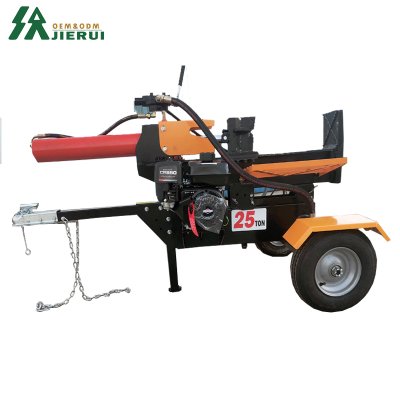
Oversize rounds that exceed the processor's log capacity or the wedge's appetite. A 25T or 50T splitter handles them without stopping the processing line.
Re-splitting and kindling. Pieces that leave the wedge too large for the market, and kindling production, are quicker on a dedicated splitter with a two-hand safety control.
For a one-person firewood business that already owns a saw and a splitter, the honest answer is sometimes to add a log lift and a conveyor to the splitter rather than to buy a processing station. The formula above tells you which side of that line you are on.
The costs that are not labour
Labour is the largest line, but three others belong in the same comparison before you sign:
Saw consumables. Bars and chains are a running cost per cord. A standard Stihl bar and chain is available from local dealers, so the cost is a purchase price rather than a proprietary part.
Hydraulic oil and filters. A processor holds more oil than a splitter and runs it hotter for longer, which is why oil volume, cooling area and a serviceable filter matter more than the litre count on the spec sheet. Budget oil and filter changes per season, not per year, on volume work.
Fuel and downtime. Petrol and diesel units with EPA and EU Stage V certification burn what the engine is rated for; the variable is idle time. A station that keeps the operator loading instead of walking keeps the engine working, which is a fuel item as well as a time item.
Add those three lines to the labour cost per cord and compare the totals. In most yards the ranking does not change, but the size of the gap does.
Safety and compliance, stated plainly
Machines for the EU market are supplied with CE marking; petrol and diesel engines are available with EPA and EU Stage V emissions certification; the factory is audited by TÜV Rheinland and holds Verified Custom Manufacturer status. Log splitters for European buyers are available with two-hand safety control, so the ram only advances while both hands are on the controls, and with a mesh guard where the market requires it. Ask for the certificate documents for the exact model and engine you order, since the applicable directive depends on the drive type.
Questions buyers ask
How many cords per hour does a firewood processor produce?
There is no single honest figure. It depends on finished length, average diameter, wedge configuration and how the logs are presented. Time ten pieces at your own site and use the formula above; any number quoted without those inputs is marketing.
Can one person run a processor?
Yes, with an infeed that presents the log at working height: a lift arm plus JR200 gravity table, or a JR300 live deck for batch logs. Without an infeed system, a second person loading usually sets the pace.
Is a processor worth it below 50 cords a year?
Run the payback line. Below that volume the labour saving often does not repay the capital difference, and the justification has to come from uniform length, reduced handling injuries or replacing paid labour.
Do I still need a chainsaw?
For trees that are too large for the processor, for limbing, and for site work away from the machine, yes. The processor replaces the cross-cutting routine, not every saw in the business.
Petrol, diesel or electric?
Petrol and diesel units suit sites without reliable power and are available with EPA and EU Stage V certification; electric drive suits a fixed yard with a stable supply. Confirm the voltage and phase available before ordering.
Key facts
Product line: firewood processors with a Stihl bar and chain, hydraulic log lifter, galvanised hydraulic clamp, mechanical log length stopper, 4-way or 6-way wedge, and an outfeed conveyor with independent control.
Infeed options: JR100 roller rack, JR200 gravity log table, JR300 powered live deck.
Splitter line for oversize rounds and kindling: 8T to 50T, including 15T horizontal/vertical with a 520 mm stroke and 15 s cycle, 25T horizontal/vertical, 28T with hydraulic log lifter, and 50T dual-way wedge.
Patented pre-cut debarker available on JERRY sawmill units.
Certification: CE; petrol and diesel engines available with EPA and EU Stage V emissions certification. Factory audited by TÜV Rheinland. Verified Custom Manufacturer.
Trade terms: MOQ 1 set, FOB / CFR / CIF / EXW, shipped from Qingdao, China. Factory in Zibo, Shandong.
Related reading on this site
Firewood Processor vs Chainsaw and Splitter: The Throughput Math
Stihl Bar and Chain on a Firewood Processor: Maintenance Schedule
Sizing a Log Splitter: 8T to 50T by Wood Diameter and Species
Send us your finished length, your average round diameter, your weekly volume in cords and the labour rate you actually pay, and we will run the same arithmetic with you and quote the configuration that fits the work. jerry@jerry-sawmill.com | forest-machinery.com/firewood-processor