JERRY 15T Vertical/Horizontal Log Splitter vs 20T+ Commercial Splitters
Short answer
A 15-tonne horizontal/vertical splitter that weighs 125 kg covers most firewood work for a one- or two-person operation. Moving to the 20-30 tonne class adds splitting force, a wider or stepped wedge and, on some models, a hydraulic log lift - and it adds 88 kg to 329 kg of machine weight. The table below compares the JERRY 15T with a 20-tonne and a 30-tonne machine, using only the specifications each manufacturer publishes.
The three machines, by published specification
| Parameter | JERRY 15T horizontal/vertical | Wallenstein WX540 | Timberwolf TW-2 |
|---|---|---|---|
| Rated splitting force | 15 ton | 20 ton | 30.375 ton |
| Working positions | Horizontal and vertical, 90-degree position change | Horizontal / vertical | Horizontal splitting chamber; no vertical position listed |
| Engine | Runtong 180 cc air-cooled four-stroke petrol, OHV, cast-iron cylinder sleeve | Vanguard 6.5 hp (203 cc) | Honda GX270, 8.5 hp |
| Starting | Electric start and manual recoil | Not published on the model page | Electric start listed as an upgrade option |
| Cylinder bore | 70 mm | 4 in (10 cm) | 4 in |
| Published cycle time | 15 s | 6.62 s average, 13.24 s full cycle | 9 s |
| Splitting stroke | 520 mm, customization available | Not published; split opening 24 in (61 cm) | 26 in |
| Wedge | 2-way or 4-way | Wide wedge, 9 in (23 cm) high; 4-way wedge optional | Step wedge 12 in tall, 1 in thick; slide-on 4-way standard |
| Log lift | Not part of the standard 15T configuration | Not listed on the model page | Hydraulic, rated to 250 lb |
| Hydraulic system | CBT1/4.2 pump, 40 L three-position valve, 16-22 MPa, 5-6.5 L of No. 46 oil | Two-stage pump, 3.5 US gal (13 l) reservoir | 16 GPM pump |
| Weight | 125 kg net, 145 kg gross | 470 lb (213 kg) | 1,000 lb (454 kg) |
| Dimensions | 1,430 x 520 x 1,160 mm | 80 x 48 x 40 in (203 x 122 x 102 cm) | Not published as figures on the specification table |
| Tyres and hitch | 4.1-3.5-4 tyres, transport handle | 4.80 x 8 tyres, 2 in ball hitch | Not published on the specification table |
| Published output | Not published as cords per hour | Not published on the model page | Average output about 1 cord per hour |
| List price | Quoted per configuration, FOB Qingdao | Not published on the model page (dealer network) | USD 6,999.50 list price |
Sources: JERRY 15T specification as published on forest-machinery.com, November 2026. Wallenstein WX540 specification as published by the Wallenstein official site, November 2026. Timberwolf TW-2 specification as published by the Timberwolf official site, November 2026. Prices are list prices as published by the manufacturer and are subject to change; they are quoted in different markets and on different trade terms, so they are not a like-for-like comparison.
What the extra tonnage actually changes
Splitting force is hydraulic pressure multiplied by the area of the cylinder piston. That has two consequences a specification table does not spell out.
First, bore size and pressure move together. The WX540 and the TW-2 both list a 4-inch cylinder, yet one is rated at 20 ton and the other at 30.375 ton, because the pressure the relief valve is set to differs between the two machines. A tonnage figure on its own therefore tells you what the maker has rated the frame and cylinder to, not how the machine will behave on a particular round.
Second, the wedge does work that tonnage cannot. Wallenstein describes its wide wedge as the reason a block "pops" early in the split, and Timberwolf describes its step wedge, 12 in tall and 1 in thick, as a way to start a crack with a concentrated pressure point before the full wedge enters the round. Both manufacturers present wedge geometry, not tonnage alone, as the mechanism that reduces the resistance the cylinder has to overcome. On the JERRY 15T the wedge is offered as a 2-way or 4-way on a 70 mm cylinder running at 16-22 MPa. The practical reading: a 15-tonne machine with a well-formed wedge splits rounds that a badly shaped 20-tonne wedge will stall on, and the reverse is also true.
Cycle time: check the definition before the number
The three published figures are not measured the same way, and that changes the conclusion.
Wallenstein WX540 publishes both an average splitter cycle time of 6.62 s and a full cycle of 13.24 s. The average is the figure a buyer notices; the full cycle is the out-and-back travel.
Timberwolf TW-2 publishes a single cycle time of 9 s against a 26 in stroke and a 16 GPM pump.
JERRY 15T publishes 15 s against a 520 mm stroke, a CBT1/4.2 pump and a 40 L three-position valve.
Read on the like-for-like basis, the WX540 full cycle of 13.24 s and the JERRY 15 s figure are close. The TW-2's 9 s is achieved with a larger engine, a higher-flow pump and a shorter stroke on a heavier machine. None of that makes one machine faster than another in a woodlot, because throughput also depends on how the round is presented to the wedge and how quickly the operator can clear the split pieces. Timberwolf is the only one of the three that publishes an output figure, about 1 cord per hour under ideal conditions; the other two publish no cords-per-hour number, so no throughput comparison is made here.
Weight and transport: 125 kg, 213 kg, 454 kg
This is where the classes separate most sharply, and it decides where the machine can work rather than how fast it splits.
125 kg net. The JERRY 15T sits on 4.1-3.5-4 tyres with a transport handle. At this weight one or two people move it by hand, and it loads into a pickup bed or a small trailer without a ramp.
213 kg. The WX540 is a towable unit on 4.80 x 8 tyres with a 2 in ball hitch, 203 cm long and 122 cm wide, with 32 lb of tongue weight. It follows a vehicle; it does not go in the back of one.
454 kg. The TW-2 weighs 1,000 lb and carries a hydraulic log lift and table grate. Moving it between sites is a trailer job, and the towing vehicle has to match the weight.
For a contractor who splits at the customer's yard, or for a farm that splits in three or four locations, that 329 kg between the lightest and heaviest machine is the number that matters. For a fixed yard where the splitter never moves, it is close to irrelevant.
Working position and log handling
Both the JERRY 15T and the WX540 rotate through 90 degrees, so a round too heavy to lift can stay on the ground and be split in the vertical position. The geometry is the same idea on both machines: the log stays at ground level, the wedge comes to it, and the operator never lifts the round onto a beam.
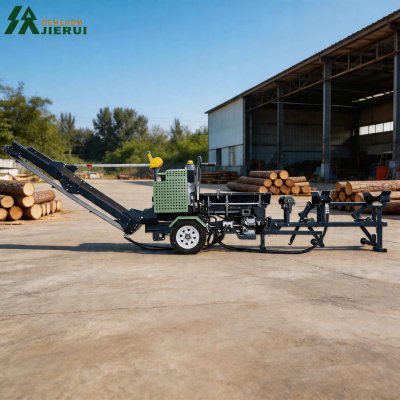
The TW-2 takes a different route. Its specification lists a horizontal splitting chamber with a hydraulic log lift rated to 250 lb, plus a self-centring chamber and a table grate that separates bark and chips from the split pieces. The round is lifted mechanically rather than split in place. That suits a fixed site with a steady supply of heavy rounds; the 90-degree machines suit work that moves.
Where a firewood processor enters the comparison
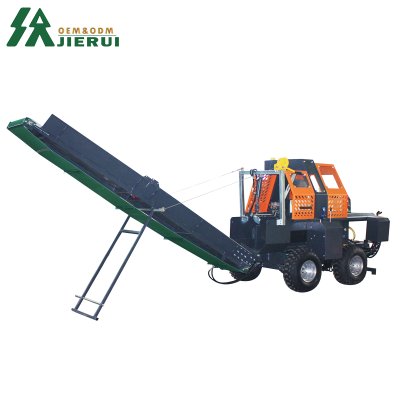
A splitter still needs the rounds cut to length first. Timberwolf itself describes the TW-2 as its entry-level firewood processor, at about 1 cord per hour, and the feature list explains why: log lift, splitting chamber, 4-way wedge and table grate in one machine. A processor goes one step further and integrates the cross-cut as well - log lifter, automatic chain cut to a set length, hydraulic splitting with a 4-way or 6-way wedge, and a conveyor that carries the finished firewood out.
JERRY builds processors on the same principle, with imported German Stihl bars and chains, a dedicated chain-oil tank with a sight glass and oil-flow control. If cutting is the bottleneck in your operation, the honest comparison is not 15 tonne against 30 tonne - it is splitter against processor, because the second machine removes a labour step the first one cannot.
What is not published, and therefore not compared
Emissions and CE status of the two competitors. Neither model page read for this article states a CE, EPA or Stage V position, so no compliance comparison is made.
Maximum log diameter for the JERRY 15T. The published specification gives a 520 mm splitting stroke and a 70 mm cylinder bore, not a rated maximum round diameter. No diameter figure is claimed here.
WX540 stroke length and price. Neither appears on the model page; both are marked as not published rather than estimated.
TW-2 dimensions and tyre size. The page links dimension drawings but publishes no figures, so the table leaves them blank.
Throughput of the JERRY 15T and the WX540. Only Timberwolf publishes a cords-per-hour figure, so output is not ranked.
Price. Only the TW-2 has a public list price. The JERRY 15T is quoted per configuration on FOB Qingdao terms, and the WX540 price is handled through Wallenstein's dealer network. Comparing a US dealer list price with an FOB China quotation would be misleading, so the two are not set against each other.
Which machine fits which operation
| Operation | Machine that fits the description | Reason from the published specification |
|---|---|---|
| One or two people splitting bought-in cut rounds, several sites, transport in a pickup | JERRY 15T | 125 kg, transport handle, 520 mm stroke, 90-degree vertical position, 2-way or 4-way wedge |
| Trailer-based firewood work, one tow vehicle, want a 20-tonne machine with ground-level splitting | Wallenstein WX540 | 20 ton, horizontal/vertical, 2 in ball hitch, hands-free return, 213 kg |
| Fixed yard, heavy rounds, one operator, want the machine to lift and to screen debris | Timberwolf TW-2 | 30.375 ton, hydraulic log lift to 250 lb, table grate, about 1 cord per hour published output |
| Cutting to length is the bottleneck, not splitting | A firewood processor | Integrates lifting, cross-cutting, splitting and conveying in one pass |
Certification, documentation and shipping terms
JERRY log splitters carry CE marking. Petrol engines in the range are certified to EPA for North America and to Stage V (EU) for Europe; diesel models are Stage V only, so petrol or electric is the compliant choice for a North American buyer. Shandong Jierui Machinery is a Verified Custom Manufacturer with a TUV Rheinland factory audit, and the factory is in Zibo, Shandong.
Commercial terms: MOQ 1 set, shipped from Qingdao, quoted FOB, CFR, CIF or EXW. OEM and ODM work covers logo, engine choice, colour, splitting stroke and project-specific configuration, which is why the 15T is quoted per configuration rather than from a fixed price list.
Frequently asked questions
Is 15 tonnes enough for hardwood?
For ordinary firewood - rounds that two people can handle - a 15-tonne machine with a 70 mm bore at 16-22 MPa and a 4-way wedge is within its working range. Knotty crotch wood, frozen hardwood and rounds above the comfortable handling limit are where the 20-30 tonne class and a log lift earn their place. Diameter and grain matter more than species names alone.
Why does a 20-tonne machine list 6.62 s when the 15-tonne figure is 15 s?
Because the numbers are not the same measurement. Wallenstein publishes 6.62 s as an average cycle and 13.24 s as the full cycle; the JERRY figure is a single published cycle time. On a full-cycle basis the two are close (13.24 s against 15 s). Pump flow, stroke length and engine size all move the number, which is why the full cycle is the figure to compare.
Can the 15T be towed on the road?
No. It is a 125 kg machine on 4.1-3.5-4 tyres with a transport handle, intended for short-distance repositioning and for loading into a vehicle or trailer. The WX540, by contrast, is a road-towable unit with a 2 in ball hitch. Check your local rules for either machine before towing.
What documents come with the machine for import?
CE marking applies across the range, and the petrol engine carries EPA and Stage V certification. Ask us for the certificate set that matches your destination market and your customs broker's requirement, and we will send the documents that apply to the model and engine you order.
What is the minimum order and where does it ship from?
MOQ is 1 set, shipped from Qingdao on FOB, CFR, CIF or EXW terms.
Key facts
JERRY 15T: 15 ton, horizontal and vertical with 90-degree change, 520 mm stroke, 15 s cycle, 70 mm bore, 16-22 MPa, 2-way or 4-way wedge, 125 kg net
Wallenstein WX540: 20 ton, horizontal/vertical, 24 in split opening, 6.62 s average and 13.24 s full cycle, 4 in bore, 213 kg
Timberwolf TW-2: 30.375 ton, 8.5 hp Honda GX270, 9 s cycle, 26 in stroke, step wedge, hydraulic log lift to 250 lb, 454 kg, about 1 cord per hour
JERRY compliance: CE; petrol engines EPA and Stage V; TUV Rheinland factory audit; Verified Custom Manufacturer
Trade terms: MOQ 1 set, Qingdao, FOB / CFR / CIF / EXW; factory in Zibo, Shandong
Related reading
Vertical vs Horizontal Log Splitter: When the 90-Degree Rotate Design Pays Off
Sizing a Log Splitter: 8T to 50T by Wood Diameter and Species
JERRY 15T Horizontal Vertical Hydraulic Log Splitter - full specification
Wallenstein, Vanguard, Timberwolf and Honda are trademarks of their respective owners. Competitor specifications quoted above are as published on the manufacturers' official sites in November 2026 and may change without notice.
Next step
Tell us the round diameter you handle most often, the species, whether the rounds are knotty, and whether the splitter has to travel between sites. We will confirm whether the 15T covers the work or whether your volume points to a 25T, a 28T with log lifter, or a processor, and quote it on FOB, CFR or CIF terms. Email jerry@jerry-sawmill.com or visit forest-machinery.com.