JERRY JR1000 vs Wood-Mizer LT40: Manual vs Hydraulic in Daily Output
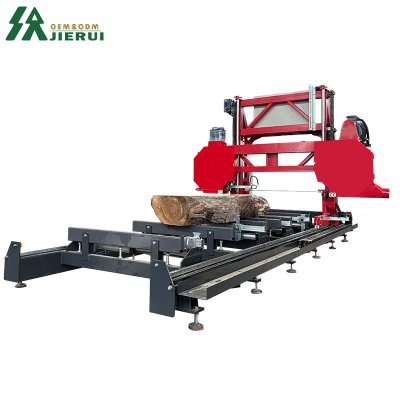
On a JERRY JR1000 the head lifts, the head travels and the log is positioned by hand; on a Wood-Mizer LT40WIDE the head, clamp, turner, side supports and loading arms are hydraulic and Wood-Mizer publishes a production rate of up to 550 board feet per hour. Both mills list the same 41 in (105 cm) maximum log diameter. What separates them in a working day is handling time per cut, not blade speed.
That single sentence explains most of the price difference between the two machines, and it is also the reason a comparison built only on horsepower or blade length is useless. A manual mill and a hydraulic mill can run the same blade at the same feed rate and still finish the week with different stacks of lumber, because one operator spends part of every cut moving steel by hand.
This article puts the published figures from Wood-Mizer's own product page beside our published JR1000 specification, states plainly which numbers neither side publishes, and gives the arithmetic a buyer can run with their own logs and their own labour cost. Every competitor figure below was read from woodmizer.com in November 2026.
The two mills side by side
Nothing in this table has been estimated or carried over from memory. Where a manufacturer does not publish a value, the cell says so.
| Item | JERRY JR1000 | Wood-Mizer LT40WIDE |
|---|---|---|
| Maximum log diameter | 105 cm (41 in) | 41 in (1.05 m) |
| Maximum width of cut | Not published | 34 1/2 in (0.88 m) |
| Maximum cant width | Not published | 26 1/2 in (0.67 m) |
| Maximum log length | 3.5 m (11 ft 6 in), the published cutting length on a 4 m track | 21 ft (6.4 m); 45 ft (13.7 m) with bed extensions |
| Bed or track | 4 m track, double-layered, with rail anti-lift blocks | 26 ft 2 in (8 m) overall; monorail bed, cantilever frame; 6 ft, 12 ft or 24 ft extensions |
| Power options | 11 kW (27 HP) motor on 380 V, or petrol, or diesel | 26.5 HP (19.7 kW) Kohler petrol; 35 HP (26 kW) Yanmar diesel; 38 HP (28.3 kW) Kohler petrol |
| Blade wheel diameter | 500 mm | 19 in (483 mm), belt-driven |
| Blade size | 4200 × 35 × 0.9 mm | 171 in (4,343 mm) long, 1 1/4 in (32 mm) wide, .045 in (1.14 mm) or .055 in (1.4 mm) thick |
| Blade tension | Manual, through a T-handle tensioner | Hydraulic tension system |
| Blade lubrication | Water spray cooling on the blade during the cut | 5 gal (18 L) tank with automatic flow; LubeMizer system optional |
| Head lift | Manual, through a reducer with a locking system on a linear guide rail with double sliding blocks | Electric up and down |
| Head travel | Manual | Power feed |
| Thickness setting | Manual handwheel and stainless steel scale | SimpleSet setworks standard; Accuset 2 optional |
| Log loading | Manual, with a ramp and winch available on the trailer version | Hydraulic loading arms with self-levelling cylinders |
| Log turning | Manual | Hydraulic claw turner |
| Log clamping | Adjustable horizontal log supports | 1 hydraulic bi-directional log clamp |
| Side supports | Adjustable log supports on the bed | 2 hydraulic and 2 manual side supports |
| Log levelling | Adjustable support legs along the track | Hydraulic roller toeboards |
| Pre-cut debarker | Not fitted to the JR series; available on our commercial line as a patented pre-cut debarker | Optional, $2,495.00 as listed |
| Published production rate | Not published as board feet per hour; published safe cutting speed 4 m/min | Up to 550 bd ft/hr (1.3 m³/hr) |
| Machine weight | 770 kg | 3,900 lb (1,769 kg) with the heaviest power option |
| Trailer | Trailer version with leaf-spring suspension and towing device | Standard trailer package, 2 in (50 mm) hitch |
| Warranty stated | 1 year | 2-year sawmill warranty; 5-year chassis warranty |
| Published price | $3,000.00 (JR1000) | From $43,695.00 with 26.5 HP petrol and walk-along controls |
Wood-Mizer specification as published by the Wood-Mizer official site, November 2026 (LT40WIDE product page and its published option list). Prices are list prices in USD, subject to change. JERRY figures are from our own published JR-series specification and are confirmed again on the quotation.
What "manual" actually means on a JR1000
The word manual covers five separate motions on our mill, and it is worth naming them because they are where the operator's day goes:
Head lift. A handwheel drives a reducer with a locking system on a linear guide rail with double sliding blocks. The lock lets the head be parked at any height, so the board thickness is set and held by the operator.
Head travel. The saw head is pushed and pulled along the track by hand for every cut and every return.
Log positioning. The log sits on adjustable horizontal supports. Turning it to the next face, and re-dogging a cant, are done with a cant hook by the operator.
Blade tension. A T-handle tensioner is set by hand when a blade is changed.
Blade guide. The guide is set to the cut width by hand.
Read that list again and the machine's place in the market becomes obvious: the JR1000 is a 770 kg mill with a 105 cm log capacity, a 4 m track and a published safe cutting speed of 4 m/min, configured to run on 380 V three-phase, petrol or diesel. It is built to be bought once, towed to the log, and operated by one person who is willing to handle the log. On a farm, a homestead or a small yard where the timber arrives a few logs at a time, that trade is rational — the capital stays in the land instead of the mill.
The JR series does not publish a board-feet-per-hour figure, and we are not going to derive one here and present it as a test result. Throughput on a manual mill depends on the operator's condition at four in the afternoon as much as on the blade.
What the LT40WIDE's hydraulics replace
The LT40WIDE moves six of those motions to the hydraulic circuit and the control panel. Loading arms lift the log onto the bed. A bi-directional clamp holds it. A claw turner rotates it. Two hydraulic and two manual side supports steady it, and hydraulic roller toeboards level the heartwood. The head itself is powered in both directions, lifts electrically, and indexes to preset thicknesses through SimpleSet. Even blade tension is hydraulic.
The operator is left walking alongside the mill with a control console, which is why Wood-Mizer can publish a production rate: the handling is inside the machine rather than inside the operator's arms. The same page lists 550 board feet per hour as the model's production rate, and the base configuration is quoted with walk-along controls, with Command Control and Accuset 2 setworks as a priced option.
None of that makes the manual mill a worse machine. It makes it a different purchase: $3,000.00 of mill plus the operator's labour, against $43,695.00 of mill that has already absorbed part of that labour into hydraulic cylinders, a pump, a control valve stack and the engineering to make them reliable for years.
Where an eight-hour day actually goes
Daily output is set by one ratio: saw time divided by total cycle time. Take a 4 m log at 60 cm small-end diameter, cutting 25 mm boards, which gives about 23 cuts to break the log down. At the JR1000's published safe cutting speed of 4 m/min, each 4 m pass takes 60 seconds of saw time whatever mill is carrying the blade.
Everything else in the cycle is handling. The table below is arithmetic, not a measurement of either machine: it shows what happens to output as the handling allowance per cut changes.
| Handling allowance per cut (planning assumption) | Cycle time per cut | Handling share of the cycle | Saw-time fraction (relative output) | Cuts in an 8 h shift at 80% uptime |
|---|---|---|---|---|
| 20 s — powered return, setworks, hydraulic clamp and turner | 80 s | 25% | 0.75 | 288 |
| 45 s — hand return, handwheel thickness, manual re-dog | 105 s | 43% | 0.57 | 219 |
| 60 s — as above, plus a stubborn cant or a blade change | 120 s | 50% | 0.50 | 192 |
| 90 s — heavy logs, one operator loading and sawing | 150 s | 60% | 0.40 | 154 |
Assumptions: 4 m log, 60 cm small-end diameter, 25 mm finished thickness with a 1 mm kerf, 23 cuts per log, 4 m/min feed applied equally to both mills, 8-hour shift at 80% uptime (384 minutes). Change any of them and the table changes; the 384 minutes is the only fixed input.
Two conclusions follow, and both matter more than any single output number. First, handling is not a detail: going from 20 to 45 seconds per cut removes a quarter of the day. Second, the leverage is entirely in the handling allowance, which is why the honest way to compare a manual and a hydraulic mill is to price the operator's hour, not to compare horsepower.
The formula to run with your own numbers is:
Cuts per shift = (shift minutes × uptime) ÷ (saw time per cut + handling time per cut)
Then multiply by the board feet your log yields per cut. If you do not know your handling time, measure it: ten cuts, stopwatch, one operator. That measurement is worth more than any published rate, because it is the only input in the formula that differs between the two mills when both are driven at the same feed rate.
Log size and length: where the two mills part company
The headline capacity is a tie. Wood-Mizer publishes 41 in (1.05 m) maximum log diameter for the LT40WIDE; our JR1000 is published at 105 cm (41 in). On diameter alone, neither mill opens a door the other closes.
Length is where they separate. The LT40WIDE takes a 21 ft (6.4 m) log as standard and up to 45 ft (13.7 m) with bed extensions, on an 8 m overall bed. The JR1000 publishes a 3.5 m cutting length on its 4 m track. If your timber is 12 ft sawlogs, that difference decides the purchase before any other specification is discussed.
Width of cut is the second gap, and here the honest answer is that we do not publish a figure for the JR1000, while Wood-Mizer publishes 34 1/2 in (0.88 m) of cut width and 26 1/2 in (0.67 m) of cant width. A buyer who needs wide slabs should treat our silence as a question to ask us in writing, not as a number to assume.
Weight and blade size tell the same story from another angle. The JR1000 is a 770 kg mill with a 500 mm blade wheel and a 4200 × 35 × 0.9 mm blade; the LT40WIDE is listed at 3,900 lb (1,769 kg) with the heaviest power option, 19 in (483 mm) wheels and a 171 in (4,343 mm) blade. The Wood-Mizer blade is wider and thicker, and it is held by a hydraulic tensioner on a machine that weighs more than twice as much — which is what a heavier, wider cut is built on.
Blades, consumables and the pre-cut question
Both mills cool the blade with water: ours sprays water on the blade during the cut, Wood-Mizer uses a 5 gal (18 L) tank with automatic flow and offers the LubeMizer system as an option. Both list a pre-cut debarker, and the difference is where it sits in the range. On the LT40WIDE the debarker is a $2,495.00 option. On our side the patented pre-cut debarker is fitted to the commercial line, not to the portable JR series — a JR1000 buyer who saws dirty, sandy bark regularly should be told that plainly and quoted the commercial configuration instead.
Blade cost per cut is the consumable that decides the running cost of either machine, and it is driven by three things a buyer can control: how clean the bark is when it reaches the blade, whether the guide rollers are set correctly, and whether the blade is tensioned to the manufacturer's figure. Two of those are free.
Which machine fits which job
A farm or homestead sawing its own building timber, a few logs at a time. The JR1000's 105 cm capacity covers most butt logs, the 3.5 m cutting length covers standard sawlogs, and the trailer version tows to the log. One operator handles the log; the day is paced by him. This is the configuration the machine was designed for.
A small commercial yard where the operator's hour has a price. Here the arithmetic in the section above stops being academic. If handling costs 25 seconds more per cut and a shift is 219 cuts, the hydraulic mill is buying back roughly an hour and a half of handling every shift. Whether that hour and a half is worth the difference in capital is a question about your order book, not about the machines.
Long logs, wide slabs, or dirty bark. A 6.4 m log needs the LT40WIDE's bed or our commercial line, not the JR1000. Wide slab work needs a published width of cut. Dirty bark rewards a debarker, which on our side means the commercial configuration. In each of those three cases the specification decides before price is discussed.
What we could not verify
On the Wood-Mizer side, the page reviewed publishes the production rate, the capacities, the blade specification, the hydraulic functions, the warranty, the base price and the option prices, and all of those are used above. It does not publish a cutting tolerance figure, so no tolerance comparison appears in this article.
On our side, the JR1000 page does not publish a width of cut, a cant width, a cutting tolerance for the portable range, or a board-feet-per-hour figure. None of those has been estimated here, and none has been inferred from the machine's weight or from another model in the range. Buyers who need them for a tender should ask for them in writing with the quotation.
No claim is made in this article about either manufacturer's reliability, service network or resale value. There is no public source that would let us make one honestly.
Questions buyers ask when comparing these two mills
Is the hydraulic mill faster because of the blade? No. At the same feed rate the blade takes the same time to travel the same 4 m. The difference is what happens between cuts: the return, the thickness setting, the clamp and the turn. That is why the two manufacturers publish different things — a feed rate for a manual mill, a board-feet-per-hour rate for a hydraulic one.
Can a JR1000 be upgraded to hydraulic log handling? Our hydraulic log handling is specified on the commercial sawmill line and on the hydraulic trailer version, not as a field kit for a manual JR1000. If hydraulic loading, turning and clamping are what you need, the correct starting point is a quotation on the hydraulic configuration rather than an upgrade path.
What log length can each mill actually saw? The JR1000 publishes a 3.5 m cutting length on a 4 m track. The LT40WIDE publishes 21 ft (6.4 m) as standard and 45 ft (13.7 m) with extensions. Measure your longest recurring log, not your longest ever log.
Does the 41 in capacity mean both mills handle the same log? On diameter, yes — 41 in and 105 cm are the same figure. On weight and length, no: a 41 in hardwood butt log that is 5 m long exceeds the JR1000's published cutting length before it tests its diameter capacity.
What does MOQ 1 set mean? One machine, configured to your order, shipped from Qingdao under FOB, CFR, CIF or EXW terms. There is no container minimum to reach before an order can be placed, and the price is confirmed on the quotation with the configuration and the freight option you choose.
Key facts
Wood-Mizer LT40WIDE, published November 2026: 41 in (1.05 m) maximum log diameter, 34 1/2 in (0.88 m) width of cut, 26 1/2 in (0.67 m) cant width, 21 ft (6.4 m) log as standard and 45 ft (13.7 m) with extensions, up to 550 bd ft/hr (1.3 m³/hr), 26.5 to 38 HP, 19 in blade wheels, 171 in blade, hydraulic tension, hydraulic loading, clamping and turning, SimpleSet setworks, 2-year sawmill and 5-year chassis warranty, from $43,695.00.
JERRY JR1000, published: 105 cm (41 in) maximum log diameter, 3.5 m cutting length on a 4 m track, 11 kW (27 HP) motor on 380 V or petrol or diesel, 500 mm blade wheels, 4200 × 35 × 0.9 mm blade, manual lift and travel, published safe cutting speed 4 m/min, 770 kg, 1-year warranty, $3,000.00.
Daily output arithmetic: cuts per shift = (shift minutes × uptime) ÷ (saw time + handling time). At 60 s of saw time, a 20 s handling allowance gives 288 cuts in 384 available minutes and a 45 s allowance gives 219.
What is not published: JR1000 width of cut, cant width, board-feet-per-hour rate and portable-range cutting tolerance; LT40WIDE cutting tolerance. None of these has been estimated in this article.
Our certifications: CE certification, EPA and EU Stage V engine options, TÜV Rheinland factory audit, Verified Custom Manufacturer. The patented pre-cut debarker is fitted to the commercial line, not to the portable JR series.
Trade terms: MOQ 1 set, shipment from Qingdao, FOB / CFR / CIF / EXW, factory in Zibo, Shandong.
Next step
Send us four numbers and we will quote one configuration instead of a catalogue: the largest log diameter you expect, the longest log you need to saw in one pass, how many hours a day the mill will run, and whether it will run on 380 V, petrol or diesel. If hydraulic log handling is part of the requirement, say so and the quotation will start from the hydraulic configuration rather than the JR series. The diameter-versus-output decision between portable and commercial mills is set out in Portable vs Commercial Sawmill: Choosing by Log Diameter and Output, and the track hardness and tolerance figures behind our commercial line are in What 58–63 HRC Track Hardness Means for Board Tolerance. The JR1000 specification sits on our portable sawmill range page.
Wood-Mizer and LT40 are trademarks of their respective owner. Model names and published figures are used here for identification and comparison only, and were taken from the manufacturer's own product page in November 2026. Prices are list prices, subject to change.
Contact: jerry@jerry-sawmill.com | forest-machinery.com