Choosing a CNC Sawmill: JERRY vs Baker and Cook's Saw
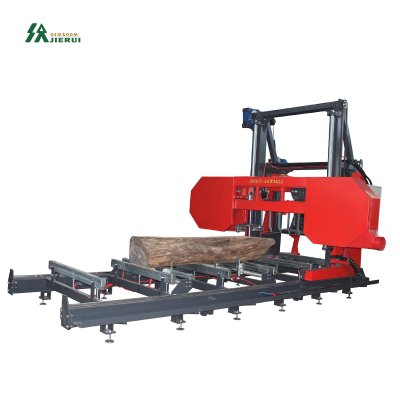
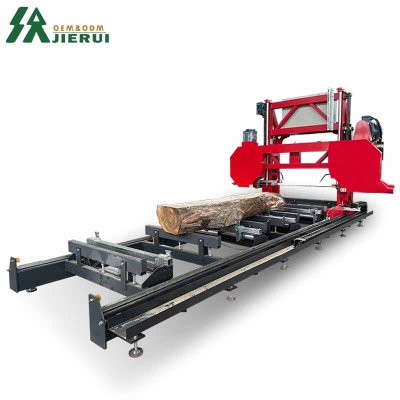
JERRY's JR1000D publishes a 100 cm (39 in) maximum log diameter, 4.5 m of cut on a 6 m track, and a PLC with touchscreen that drives head lift and travel automatically. Baker's Blue Streak 3638G and Cook's AC-36 publish 36 in maximum log diameter, about 21 ft of cut, hydraulic log handling, and computer setworks as an option. Capacity above 36 in and how thickness is programmed are the published differences.
"CNC sawmill" is used loosely in this trade. On a band sawmill it can mean a mill with a programmable setworks, a mill with a PLC that also drives the carriage, or simply a mill whose head is moved by hydraulics instead of a hand crank. This article separates those three things, puts the published figures from Baker's and Cook's own product pages beside our published JR1000D specification, and marks every cell that none of the three manufacturers publishes.
Every Baker figure below was read from baker-online.com in November 2026. Every Cook's figure was read from cookssaw.com in November 2026. Every JERRY figure was read from our own commercial CNC sawmill specification page in the same month. Nothing has been estimated, converted from memory, or taken from a photograph.
What "CNC" means on a band sawmill: three control levels
Almost every disagreement about CNC sawmills comes from comparing machines at different control levels. It helps to name them.
Level 1, manual. The head is pushed by hand and its height is set with a crank against a mechanical scale. Baker's 18HD and Cook's MP-32 sit here. These mills are inexpensive to own and easy to repair, and the operator is the control system.
Level 2, hydraulic. The head travels and lifts on hydraulics at the touch of a lever, and blade height is read from an indicator or a scale. Baker's Blue Streak 3638G is published at this level: fully hydraulic loader, turner, clamp, fence arms and head lift, hydraulic carriage speed control, and a vertical blade-height indicator. The operator still judges each thickness.
Level 3, programmable. The target thickness is entered once and repeated. Cook's publishes its AccuSet computer setworks with nine presets, standard on the AC3667T and optional on the other AC-36 models. Baker lists computer setworks as an option on its Stationary Blue Streak page. JERRY's JR1000D uses a PLC with a multi-language touchscreen, and head lift and head travel are automatic rather than lever-driven.
A mill at Level 2 marketed as "CNC" and a mill at Level 3 both cut boards. They differ in how many times a day the operator measures, and that is the number worth asking about.
The three mills side by side
Where a manufacturer does not publish a value, the cell says "Not published". A blank would imply a measurement we do not have. The Baker and Cook's columns quote the hydraulic portable model closest to the JR1000D in role.
| Item | JERRY JR1000D | Baker Blue Streak 3638G | Cook's AC-36 (AC3640G) |
|---|---|---|---|
| Machine class as described by the manufacturer | Automatic CNC heavy-duty sawmill | Hydraulic portable sawmill | Fully hydraulic portable sawmill |
| Maximum log diameter | 100 cm (39 in) | 36 in | 36 in |
| Maximum cutting length, one pass | 4.5 m (14 ft 9 in) | 20 ft 6 in | 21 ft standard; 28 ft on portable with bed extension; unlimited stationary |
| Track or bed | 6 m track | Machine length 30 ft (9.14 m) | 6x3 heavy-wall twin beam bed |
| Thickness control as published | PLC with multi-language touchscreen; thickness switched on screen | Vertical blade-height indicator; computer setworks not listed on the 3638G page | Computer setworks optional; AccuSet with nine presets standard on AC3667T |
| Head lift | Automatic | Hydraulic | Hydraulic, two-speed fast and slow |
| Head travel | Automatic | Hydraulic carriage speed control | Hydraulic forward and reverse |
| Control position | Oversized joystick and touchscreen | Operator station on the mill | Remote station on a 15 ft lead with swing arm |
| Blade, as published | 85 mm wide | 17 ft 4 in x 1-1/4 in or 1-1/2 in x 0.042 in hardback | 16 ft 10 in x 1-1/2 in |
| Band wheel diameter | 770 mm | 28 in | 26 in |
| Standard engine | 22 HP petrol or diesel, electric start | 38 HP Kohler petrol, electric start | 38 HP EFI Kohler petrol; 30 or 40 HP electric and 49 or 67 HP diesel also offered |
| Log handling, published items | Automatic lift and travel on the track | Hydraulic loader, turner, clamp, fence arms | Hydraulic 8,500 lb log lift, two hydraulic clamps, bi-directional chain turner, two squaring arms, log taper |
| Board return | Not published | Board drag-back system | Board drag-back system |
| Debarker | Patented pre-cut debarker on the commercial line | In-line debarker listed as an option | Hydraulic debarker standard on AC3667T, optional on other AC-36 models |
| Weight | 3,000 kg (6,614 lb) | 7,400 lb (3,357 kg) | 7,200 to 7,500 lb depending on options |
| Transport as published | Packing size 3.5 x 2.2 x 2 m | Tandem-axle trailer with lights and brakes | Dual axles with electric brakes on both axles |
| Published list price | USD 20,000, FOB Qingdao | From USD 60,215 | MSRP USD 58,425 for AC3640G |
JERRY JR1000D specification as published on forest-machinery.com, November 2026. Baker Blue Streak 3638G specification as published by the Baker official site, November 2026. Cook's AC-36 specification as published by the Cook's Saw official site, November 2026. All three prices are list prices published by each manufacturer on its own website, quoted on different Incoterms, in different currencies of account and for different configurations, and subject to change. They are not a like-for-like quotation for the same scope of supply.
Log capacity: 39 in versus 36 in, and what sits above both
Baker and Cook's publish the same ceiling on their hydraulic portables: 36 in maximum log diameter. JERRY publishes 100 cm (39 in) on the JR1000D, and the same platform continues upward through the JR1300D at 130 cm (51 in), the JR1600D at 160 cm (63 in) and the JR2000D at 200 cm (79 in).
Three inches of diameter sounds small until it is converted into what a buyer actually does with a log. A 36 in ceiling means a butt log of 95 cm has to be slabbed down or refused. A 100 cm ceiling takes it in one set-up. That difference is about the timber in front of the mill, not about the mill's quality, and it is the single row in the table above where the published numbers separate the three machines.
The rest of the capacity story is arithmetic rather than opinion. A log of 5 m falls outside JERRY's published 4.5 m cut length and inside Cook's 21 ft and Baker's 20 ft 6 in, so on the JR1000D it is cut in more than one pass or cut to length first. A log of 4 m falls inside all three.
Setworks and PLC: where the programs sit
All three factories automate the repeated cut, and each documents it at a different point in the chain.
Cook's AccuSet. Cook's publishes a computer setworks with a clear display and nine presets, fully programmable, standard on the AC3667T and optional on the AC3630E, AC3640E, AC3640G and AC3649D. The AC-36 also publishes a two-speed head lift, fast for travel and slow for positioning, and a remote operating station on a 15 ft lead with a swing arm so the operator can stand where the board comes off.
Baker. On the Blue Streak 3638G the published control package is hydraulic: loader, turner, clamp, fence arms and head lift from the operator station, with a vertical blade-height indicator for thickness. Computer setworks appears in the options list of the Stationary Blue Streak page, not on the portable 3638G page read in November 2026. A buyer who wants programmable thickness on a Baker portable should ask the factory to confirm whether that option extends to the portable model being quoted.
JERRY. The JR1000D publishes a PLC that sequences the sawing cycle, with thickness entered on a multi-language touchscreen, and head lift and travel automatic. The same control package includes automatic blade guidance that follows log diameter using wear-resistant ceramic guides, automatic blade tensioning with break detection and a forced emergency stop, and the patented pre-cut debarker, which follows the contour of the log ahead of the blade.
Accuracy is where the comparison has to stop being symmetrical. Neither the Baker 3638G page nor the Cook's AC-36 page publishes a cutting tolerance for the model, so there is no competitor figure to place beside ours. Our commercial line documentation states a finished-board thickness tolerance of 0.3 to 0.5 mm, which is a factory specification rather than a third-party measured result, and it is not repeated here as a head-to-head claim. A buyer who needs a tolerance in writing should ask all three factories for it against their own timber, on their own site, and treat an unmeasured figure from any of them as a starting point rather than a result.
Blade, band wheel and what the numbers imply
Blade width and band wheel diameter decide how much the blade can be pushed before it wanders, and they are the two rows buyers skim past.
JERRY publishes an 85 mm blade on 770 mm wheels for the JR1000D, rising to a 110 mm blade on 1,100 mm wheels on the JR2000D. Baker publishes 1-1/4 in or 1-1/2 in blade stock on 28 in wheels for the 3638G. Cook's publishes 1-1/2 in or 2 in blade stock on 26 in all-metal wheels for the AC-36, with the wider blade offered on the 40 HP electric and 67 HP diesel variants.
Read together, the three factories have made different trade-offs between blade mass, wheel size and horsepower. A wider blade and a larger wheel take more power to drive, which is why the 38 HP Baker and the 38 HP Cook's sit at 36 in of log and the 22 HP JERRY sits at 39 in with a narrower blade. Neither arrangement is a defect; they are answers to different questions about log size and engine budget.
Debarkers: pre-cut, in-line and hydraulic
Dirt, grit and frozen bark are the main reasons a band blade loses its edge early, and all three factories offer a device to deal with it.
JERRY's is a patented pre-cut debarker mounted ahead of the main blade on the commercial line: it cuts a cleared path through the bark layer before the teeth arrive, and it follows the shape of the log. Baker lists an in-line debarker as an option for the 3638G. Cook's publishes a hydraulic debarker that cuts a groove ahead of the blade, standard on the AC3667T and optional on the other AC-36 models.
The three approaches are packaged differently. On the Cook's range the debarker and the computer setworks arrive together as standard only on the top model, and both are options below it. On the JR1000D the pre-cut debarker belongs to the commercial line specification. Baker sells its debarker as a separate option on the portable. Buyers comparing quotations should check whether the debarker is in the price or in the options column, because it changes the comparison materially and it is easy to miss.
Price context, with the caveats that belong with it
The published list prices, read in November 2026, are USD 20,000 for the JERRY JR1000D, from USD 60,215 for the Baker Blue Streak 3638G, and an MSRP of USD 58,425 for the Cook's AC3640G. Cook's also displays a sale price on its own page for that model; we do not restate it here as a comparison basis, because a promotional price on one site is not a market price.
Those three numbers are not the same kind of number. The JERRY figure is FOB Qingdao and excludes freight, insurance and destination charges. The Baker figure is a starting price for the base machine before options. The Cook's figure is an MSRP for one model in the range, before options and before delivery. A buyer building a budget should put freight, duty, the debarker, the setworks and the spare blade set into all three columns before comparing totals.
What the published pages do not state
Stating the gaps is part of the comparison, not a footnote to it.
Cutting tolerance in millimetres: not published by Baker or by Cook's for the models compared. Our own commercial line documentation states 0.3 to 0.5 mm on finished boards, but no third-party measurement of either competitor is available to compare it with.
Safe cutting speed: JERRY publishes 6 m/min for the JR1000D and JR1300D and 4 m/min for the JR1600D and JR2000D; Baker and Cook's do not publish a safe cutting speed for the models compared.
Band wheel diameter: published by all three, but JERRY gives it in millimetres and the other two in inches, so the figures above have not been converted into a common unit beyond the table.
Maximum width of cut and clearance above the blade for the JR1000D: not published in our own specification table.
Machine dimensions and transport weight for the JR1000D beyond packing size: not published.
Any statement about reliability, resale value or after-sales response for any of the three brands: no public source was used, so nothing is claimed.
Which mill fits which yard
This is application fit, not a ranking. Each of the three is a complete mill sold with a warranty by a factory that has been building them for years.
Logs above 36 in, or a mix that reaches 200 cm. A yard that regularly takes butt logs over 95 cm has no published option among the Baker and Cook's hydraulic portables compared here; the JR1300D, JR1600D and JR2000D extend the same platform to 130, 160 and 200 cm. If those logs are rare and can be slabbed down, the 36 in machines stay in play.
Programmable thickness with a remote operator position. A one or two man operation cutting repetitive dimensions, where the operator wants to stand at the board end rather than walk the head, is the case the Cook's AC-36 is built around: remote station on a 15 ft lead, two-speed head lift, computer setworks with nine presets on the top model.
Hydraulic handling with a US parts and service base. A yard that wants a dealer and a parts counter in the United States, and whose logs stay under 36 in, is the case the Baker Blue Streak is built around: hydraulic loader, turner, clamp and fence arms, tandem-axle trailer with brakes, and in-line debarker as an option.
Container shipping and export documentation. The JR1000D packs to 3.5 x 2.2 x 2 m and ships FOB Qingdao, with CFR, CIF or EXW available on request. A buyer in Africa, South America or Central Asia who is pricing a first mill against a container budget is the case that format was designed for.
Certification and factory facts, stated precisely
Machines from our factory carry CE marking, and EPA and EU Stage V engine options are available for the markets that require them. Our factory in Zibo, Shandong has been audited by TÜV Rheinland, and we hold Verified Custom Manufacturer status on Alibaba.com. Minimum order quantity is 1 set, which means a single machine can be ordered for a trial rather than a container load. We ship from Qingdao under FOB, CFR, CIF or EXW.
We can only speak to our own documentation. The Baker and Cook's pages read for this article do not publish CE marking or EU Stage V engine options, which is consistent with mills built mainly for the North American market. A buyer in the EU should ask either supplier directly for CE documentation rather than assume an answer in either direction, and should ask which engine variant the certificate covers.
Questions buyers ask before choosing
Is a hydraulic sawmill the same as a CNC sawmill?
No. Hydraulics replace the operator's arms; CNC replaces the operator's judgement about thickness. Baker's 3638G is published with fully hydraulic handling and a blade-height indicator, and its computer setworks is listed as an option on the stationary model. Cook's publishes computer setworks as an option on the AC-36 below the AC3667T. JERRY's JR1000D publishes a PLC with a touchscreen where thickness is entered and head lift and travel run automatically.
Can the JR1000D cut a 21 ft log in one pass?
No. The published maximum cutting length is 4.5 m on a 6 m track, which is about 14 ft 9 in. Cook's publishes 21 ft standard on the AC-36, extendable to 28 ft on the portable with a bed extension and unlimited on the stationary version. Baker publishes 20 ft 6 in for the Blue Streak. If 6 m logs are the normal input, that row decides more than any other.
Which of the three has the lowest published price?
The JR1000D at USD 20,000 against a starting price of USD 60,215 for the Baker 3638G and an MSRP of USD 58,425 for the Cook's AC3640G, all read from the manufacturers' own pages in November 2026. The figures cover different configurations, different Incoterms and different continents of dispatch, so they are not a like-for-like quotation. Price the freight, the duty and the options actually needed before using any of them in a budget.
What does the pre-cut debarker do, and is it on every model?
It runs ahead of the saw blade and clears the bark layer so the teeth do not cut through dirt and grit, following the shape of the log as it goes. The design is patented on our commercial line. It is specified on the JR1000D and is not fitted to every model in the range, so confirm it against the model being quoted.
Can JERRY supply a machine with CE, EPA or Stage V paperwork?
Yes. CE marking applies to our machines, and EPA and EU Stage V engine options are available. MOQ is 1 set, so a single unit can be ordered with the documentation for its destination market, and the quotation will name the engine variant the certificate covers.
Key facts
| Models compared | JERRY JR1000D (also JR1300D, JR1600D, JR2000D), Baker Blue Streak 3638G, Cook's AC-36 |
| Published maximum log diameter | JERRY 100 cm (39 in); Baker 36 in; Cook's 36 in |
| Published cut length, one pass | JERRY 4.5 m on a 6 m track; Baker 20 ft 6 in; Cook's 21 ft, 28 ft with bed extension |
| Published thickness control | JERRY PLC with touchscreen and automatic lift and travel; Baker hydraulic with blade-height indicator, computer setworks listed on the stationary model; Cook's AccuSet computer setworks optional, standard on AC3667T |
| Published blade and band wheels | JERRY 85 mm on 770 mm; Baker 1-1/4 in or 1-1/2 in on 28 in; Cook's 1-1/2 in or 2 in on 26 in |
| Published weight | JERRY 3,000 kg; Baker 7,400 lb; Cook's 7,200 to 7,500 lb |
| Published list price | JERRY USD 20,000 FOB Qingdao; Baker from USD 60,215; Cook's MSRP USD 58,425 for AC3640G |
| Cutting tolerance | Not published by Baker or Cook's for the models compared; our commercial line documentation states 0.3 to 0.5 mm on finished boards as a factory figure |
| Certification (JERRY) | CE; EPA and EU Stage V engine options; TÜV Rheinland audited factory; Verified Custom Manufacturer |
| Trade terms (JERRY) | MOQ 1 set; FOB, CFR, CIF or EXW from Qingdao; factory in Zibo, Shandong, China |
Baker, Blue Streak and Baker Blue Streak are trademarks of their respective owner, and Cook's, Cook's Saw and AccuSet are trademarks of their respective owner. They are used here only to identify the machines being compared. JERRY, JR1000D, JR1300D, JR1600D and JR2000D are our own model designations.
Choosing between them
Send the log diameter range, the typical log length, the target board thickness, the timber species and the destination port, and we will quote the JR1000D or the next model up against those numbers rather than against a brochure. If the requirement includes CE or Stage V documentation, say so in the first message and the quotation will list the certificate and the engine variant that apply.
Two earlier comparisons on this site carry the same method further: JERRY JR1000D vs TimberKing 1620TW: Bed Length, Setworks and Operator Fatigue looks at the hydraulic class from the operator's side, and JERRY JR1000 vs Wood-Mizer LT40: Manual vs Hydraulic in Daily Output sets out the handling-time arithmetic that separates a manual mill from a hydraulic one. The rail hardness and tolerance figures behind our commercial line are explained in What 58-63 HRC Track Hardness Means for Board Tolerance, and the full JR-series specification sits on our automatic CNC heavy-duty sawmill page.
Email: jerry@jerry-sawmill.com
Website: forest-machinery.com