JERRY JR1000D vs TimberKing 1620TW: Bed Length, Setworks and Operator Fatigue
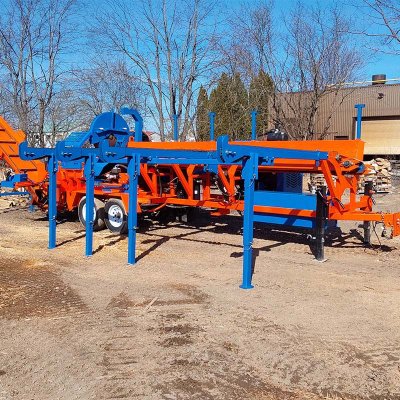
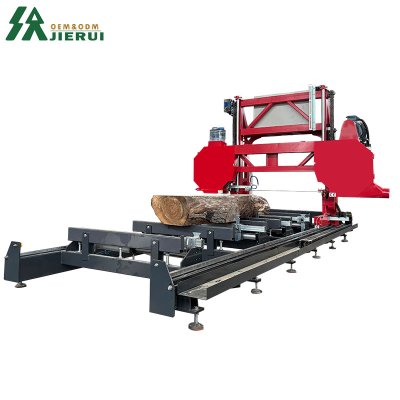
The JERRY JR1000D publishes a 6 m track with a 4.5 m maximum cutting length, automatic head lift and travel driven by a PLC with a touchscreen, and a 22 HP engine. The TimberKing 1620TW publishes a 21 ft (6.4 m) maximum cut length on a 31 ft machine, SetworksPlus computer setworks, and hydraulic controls at 41 in (104 cm) above ground on a stationary command post. The published numbers differ on exactly three points: how long a log can be cut in one pass, how target thickness is set, and where the operator stands.
Those three points decide most of the daily experience of running a sawmill, and they are also the three points a specification sheet usually hides behind adjectives. This article puts the published figures from TimberKing's own product pages beside our published JR1000D specification, marks every cell that neither manufacturer publishes, and leaves the judgement about which machine suits a given yard to the buyer.
Every TimberKing figure below was read from timberking.com in November 2026. Every JERRY figure was read from our own commercial sawmill specification page in November 2026. Nothing has been estimated, converted from memory, or inferred from a photograph.
The two mills side by side
Where a manufacturer does not publish a value, the cell says "Not published". A blank would imply a measurement we do not have.
| Item | JERRY JR1000D | TimberKing 1620TW |
|---|---|---|
| Machine class as described by the manufacturer | Automatic CNC heavy-duty sawmill | Full-size portable sawmill with essential hydraulics |
| Maximum log diameter | 100 cm (39 in) | 39 in (99 cm) |
| Maximum cutting length, one pass | 4.5 m (14 ft 9 in) | 21 ft (6.4 m); 20 ft with the optional diesel engine |
| Track or bed length | 6 m (19 ft 8 in) track | Machine length 31 ft (9.45 m); bed extensions not listed for the 1620TW |
| Maximum width of cut | Not published | 35 in (89 cm) |
| Clearance above blade | Not published | 16 in (41 cm) |
| Machine width | Not published | 7 ft 11 in (2.41 m) |
| Engine, standard | 22 HP petrol or diesel, electric start | 33 HP V-twin petrol, electric start; 25 HP Kubota diesel optional; 37 HP EFI upgrade optional |
| Head lift | Automatic | Direct-action hydraulic |
| Head travel / feed | Automatic | Direct-action hydraulic |
| Target thickness control | PLC with multi-language touchscreen; thickness switched on screen | SetworksPlus computer setworks; thickness selected with a switch |
| Setworks enclosure rating | Not published | Setworks box and encoder IP67; encoder also IP69 |
| Blade guidance | Automatic adjustment to log diameter, wear-resistant ceramic guide sheets | Greaseable guide rollers; automatic guide adjustment on the 2020TW, manual on the 1620TW |
| Blade tension | Automatic tensioning with break detection and forced emergency stop | Not published |
| Saw wheel diameter | 770 mm | Not published |
| Blade width | 85 mm | Not published |
| Safe cutting speed, as published | 6 m/min | Not published |
| Log handling, published items | Automatic lift and travel on the track | Hydraulic log loader, hydraulic bi-directional chain log turner, hydraulic log clamp, manual mechanical log stops |
| Control position | Oversized joystick and touchscreen; mounting height Not published | Operator-height command post, controls 41 in (104 cm) above ground, stationary post |
| Outriggers | Not published | 6 outriggers, 5,000 lb (2,268 kg) capacity each |
| Weight | 3,000 kg (6,614 lb) | 4,140 lb (1,878 kg) |
| Highway transport package | Not published | Standard: 6,000 lb axle, 15 in tyres, electric brakes, break-away harness, lights |
| Warranty, as published | 1 year | 3-year limited mechanical; 5-year limited cutting deck; 30-day money-back |
| List price, as published | USD 20,000, JR1000D, FOB Qingdao | USD 38,745, 1620TW, FOB Kansas City, MO |
JERRY JR1000D specification as published on forest-machinery.com, November 2026. TimberKing 1620TW specification as published by the TimberKing official site, November 2026. Both figures are list prices published by each manufacturer on its own website, quoted on different Incoterms and for different configurations, and subject to change; they are not a like-for-like quotation for the same scope of supply.
Bed length: what the two numbers actually measure
A sawmill advertisement can quote three different lengths, and they are not interchangeable: the length of the track or bed, the length of log the head can pass in one run, and the overall length of the machine on the ground. Confusing them is the most common reason a buyer is surprised on delivery.
JERRY publishes a 6 m track and a 4.5 m maximum cutting length for the JR1000D. The gap between the two is the space the head and the clamping hardware occupy at each end of the track.
TimberKing publishes a 21 ft (6.4 m) maximum cut length for the 1620TW, reduced to 20 ft with the optional Kubota diesel, and a 31 ft (9.45 m) machine length. TimberKing also publishes 21 ft "extendable" for the 2020TW without stating an extension length on that page, so no extended figure is quoted here.
The practical consequence is arithmetic, not opinion. A log of 5.5 m falls inside the TimberKing published cut length and outside the JERRY published cut length, so on the JR1000D it would be cut in more than one pass. A log of 4 m falls inside both. If the yard routinely handles 5 m plus hardwood, that difference matters more than horsepower; if logs are cut to 3 m or 4 m before they reach the mill, it does not.
Background reading on the same product line: Portable vs Commercial Sawmill: Choosing by Log Diameter and Output, What 58-63 HRC Track Hardness Means for Board Tolerance, and JERRY JR1000 vs Wood-Mizer LT40: Manual vs Hydraulic in Daily Output. The JR1000D specification table quoted in this article is published on our commercial CNC sawmill page.
Setworks: PLC with a touchscreen versus SetworksPlus
Both machines automate the repeat cut. They automate it at different points in the control chain, and each manufacturer documents its own approach.
JERRY JR1000D. A PLC runs the sawing cycle, and the operator sets target thickness on a multi-language touchscreen. Head lift and head travel are automatic rather than hand-cranked, and the same control package includes automatic blade guidance that follows log diameter, automatic blade tensioning, and a forced emergency stop if the blade breaks. Our patented pre-cut debarker is part of the commercial line specification: it follows the shape of the log ahead of the blade to keep the cut path clear.
TimberKing 1620TW. SetworksPlus is a computer setworks that moves the head to the thickness selected on a switch, cut after cut. TimberKing publishes the environmental ratings of the setworks hardware: the setworks box and encoder meet IP67, and the encoder also meets IP69 for jet-sprayed water. The 2020TW uses SuperSetworks, described by TimberKing as the same setworks used on its 2500 mills.
What neither page publishes is a repeatability figure in millimetres. TimberKing does not publish a cutting tolerance for the 1620TW, and JERRY does not publish a cutting tolerance for the JR1000D. Any comparison of accuracy at this level would be invented, so this article makes none. A buyer who needs a tolerance figure in writing should ask both factories for it against their own timber.
Operator fatigue: what each manufacturer publishes about the operator's position
Fatigue in sawmilling is mostly a geometry problem. Every metre the operator walks, and every bend to reach a control, is repeated a few hundred times a day.
TimberKing publishes a specific number: controls 41 in (104 cm) above ground, described as elbow height, on a stationary command post for the 1620TW and a swing command post for the 2020TW. TimberKing also states that its hydraulic log handling tools work full time, rather than stopping when the head leaves the back of the mill.
JERRY publishes the control hardware rather than a height: an oversized joystick and a touchscreen, with head lift and travel automatic so that the operator is not cranking a winch between cuts. JERRY does not publish a control mounting height for the JR1000D, so no figure is claimed here.
On a stationary command post the operator stays in one place and the head comes to them, which suits a mill where the log is loaded once and cut through. On a walk-along layout the operator moves with the head, which suits low-volume or oversize work where the operator wants to watch the cut. Neither layout removes fatigue; they move it to a different part of the body, and the right answer depends on how many hours a day the machine runs and how many people share it.
Where the two machines sit in a yard
This is application fit, not a ranking. Both are published as complete mills with a warranty, and both factories sell into markets where the other is rare.
Long logs, one-pass throughput, US dealer support. A yard that buys 6 m logs and wants a single pass, plus a dealer network inside the United States, is the case the TimberKing 1620TW is built around: 21 ft cut length, hydraulic log handling, highway transport package standard, 3-year mechanical warranty.
Mixed log diameters with automated settings, shipped from China. A yard that switches between 40 cm and 100 cm logs several times a day and wants thickness changed on a screen rather than by feel is the case the JR1000D is built around: 100 cm maximum log diameter, PLC cycle, automatic lift and travel, and the same 100 cm capacity in a machine weighing 3,000 kg.
Container shipping and export documentation. The JR1000D packs to 3.5 x 2.2 x 2 m, and we ship FOB Qingdao with CFR, CIF or EXW available on request; TimberKing quotes FOB Kansas City. The Incoterm and the port belong in the comparison before the price does.
Very large logs. The JR1600D and JR2000D extend the same platform to 160 cm and 200 cm maximum log diameter with 900 mm and 1,100 mm saw wheels. TimberKing's 6000TW is published at 60 in (152 cm) maximum log diameter.
Certification and factory facts, stated precisely
Machines from our factory carry CE marking, and EPA and EU Stage V engine options are available for the markets that require them. Our factory in Zibo, Shandong has been audited by TÜV Rheinland, and we hold Verified Custom Manufacturer status on Alibaba.com. Minimum order quantity is 1 set, which means a single machine can be ordered for a trial rather than a container load. We ship from Qingdao under FOB, CFR, CIF or EXW.
TimberKing publishes that its mills are built in Kansas City, Missouri, and that its prices are FOB Kansas City. Its product pages do not publish CE marking, which is consistent with a mill built for the North American market. A buyer in the EU should ask any North American supplier directly about CE documentation rather than assume either answer.
What we could not verify
TimberKing 1620TW cutting tolerance: not published on the product page read in November 2026.
TimberKing 1620TW saw wheel diameter and blade dimensions: not published on that page.
TimberKing 1620TW safe cutting speed: not published.
JERRY JR1000D maximum width of cut, clearance above blade and control height: not published in our own specification table.
JERRY JR1000D cutting tolerance: not published; we do not quote one without a measurement against the buyer's timber.
Any statement about either manufacturer's reliability, resale value or after-sales response: no public source was used, so nothing is claimed.
Questions buyers ask before choosing
Can the JR1000D cut a 6 m log in one pass?
No. The published maximum cutting length is 4.5 m on a 6 m track. A 6 m log is cut in more than one pass, or cut to length first. The TimberKing 1620TW publishes 21 ft (6.4 m) of cut length, which covers a 6 m log in one pass.
Is a PLC the same thing as computer setworks?
No. A PLC sequences the machine cycle; computer setworks positions the head for a target thickness. The JR1000D uses a PLC with a touchscreen for thickness and cycle control. TimberKing's SetworksPlus positions the head for the selected thickness and publishes IP67/IP69 ratings for its setworks hardware. Both automate repeat cuts; neither manufacturer publishes a repeatability figure in millimetres.
Which machine has the lower published list price?
The JR1000D at USD 20,000 against USD 38,745 for the 1620TW, both read from the manufacturers' own pages in November 2026. The two figures cover different configurations, different Incoterms and different ports, so they are not a like-for-like quotation. Freight, duty and the options actually needed should be priced before either number is used in a budget.
Can JERRY supply a machine with CE, EPA or Stage V paperwork?
Yes. CE marking applies to our machines, and EPA and EU Stage V engine options are available. MOQ is 1 set, so a single unit can be ordered with the documentation for the destination market.
What does the pre-cut debarker do?
It follows the contour of the log ahead of the saw blade so the blade runs in a cleared path instead of cutting through bark and dirt. The design is patented on our commercial line. It is specified on the JR1000D; it is not fitted to every model in the range, so confirm it against the model being quoted.
Key facts
| Models compared | JERRY JR1000D (also JR1300D, JR1600D, JR2000D) versus TimberKing 1620TW |
| Published cut length | JERRY 4.5 m on a 6 m track; TimberKing 21 ft (6.4 m), 20 ft with diesel |
| Published maximum log diameter | JERRY 100 cm (39 in); TimberKing 39 in (99 cm) |
| Published thickness control | JERRY PLC plus multi-language touchscreen; TimberKing SetworksPlus, IP67 box and encoder |
| Published control height | JERRY not published; TimberKing 41 in (104 cm), stationary command post |
| Published weight | JERRY 3,000 kg; TimberKing 4,140 lb (1,878 kg) |
| Published list price | JERRY USD 20,000 FOB Qingdao; TimberKing USD 38,745 FOB Kansas City, MO |
| Certification | CE; EPA and EU Stage V engine options; TÜV Rheinland audited factory; Verified Custom Manufacturer |
| Trade terms | MOQ 1 set; FOB, CFR, CIF or EXW from Qingdao; factory in Zibo, Shandong, China |
TimberKing and TimberKing 1620TW, SetworksPlus and SuperSetworks are trademarks of their respective owner and are used here only to identify the machine being compared. JERRY, JR1000D, JR1300D, JR1600D and JR2000D are our own model designations.
Choosing between them
Send the log diameter range, the typical log length, the target board thickness and the destination port, and we will quote the JR1000D or the next model up against those numbers rather than against a brochure. If the requirement includes CE or Stage V documentation, say so in the first message and the quotation will list the certificate and engine variant that apply.
Email: jerry@jerry-sawmill.com
Website: forest-machinery.com