JERRY Portable Sawmill vs Hud-Son Hunter/Sawyer: Entry-Level Sawmill Cost per Board
Cost per board foot is machine price divided by the board feet the mill produces before it is paid off — not the sticker price alone. Hud-Son publishes its Freedom-line Sawyer and Hunter at $3,395.00 with a 21 in log capacity, a 12 ft track and a 9 ft maximum log length; a JERRY JR59 is published at $2,285.00 with a 24 in (60 cm) log capacity, a 4 m track and a 3.5 m maximum log length. Divide either price by the same savings-per-board-foot figure and the break-even volume appears.
That is the whole method, and it is the reason two mills with different sticker prices can land in the same place for one buyer and in very different places for another. The variables are the price, the board feet the machine can physically produce, and what a board foot is worth to you. Only the first is printed on a product page. This article puts the published numbers from Hud-Son's own site beside our JR-series figures, shows the arithmetic, and leaves the choice to the buyer.
How to calculate cost per board foot
Use one formula and keep the units consistent:
Cost per board foot = (machine price + consumables over the period) ÷ board feet produced over the period
A board foot is 144 cubic inches of finished lumber — 1 in thick, 12 in wide, 12 in long. Two mills sawing the same species at similar feed rates will produce board feet at a rate set mainly by log diameter, log length and how often the operator stops to turn the log. That is why the honest way to compare two entry-level mills is not "which one has the lower sticker price" but "how many board feet does each price need to justify itself".
Take a mill at $3,395 and a mill at $2,285. If milling your own timber saves you $0.60 per board foot compared with buying the same board, the first mill needs 5,659 board feet to break even and the second needs 3,809. Neither number is a claim about quality. They are division.
The two entry-level mills side by side
Every Hud-Son figure below is taken from Hud-Son's own product pages in November 2026. Where Hud-Son does not publish a value, the cell says so; nothing has been estimated or carried over from memory.
| Item | JERRY JR59 / JR69 | Hud-Son Sawyer / Hunter | Hud-Son HFE-28 |
|---|---|---|---|
| Maximum log diameter | 24 in (60 cm) / 28 in (70 cm) | 21 in | 28 in |
| Distance between blade guides | Not published as a single figure; set by the roller guide on the head | 19 in | 24 in |
| Maximum thickness of cut | Not published on the current portable specification sheet | 9 in | 9 in |
| Track as supplied | 4 m (13 ft 1 in) | 12 ft, in two 6 ft welded steel sections | 12 ft, in two 6 ft sections |
| Maximum log length on standard track | 3.5 m (11 ft 6 in), the published cutting length | 9 ft | 9 ft |
| Track extension | Quoted per order with the mill | 6 ft section, $500.00 each | 6 ft steel section with dog, $550.00 |
| Blade | 3300 × 35 × 0.9 mm (JR59/JR69); 4200 × 35 × 0.9 mm (JR80/JR1000) | 132 × 1.25 × .035 in (3,353 × 31.75 × 0.89 mm) | 132 × 1.25 × .035 in |
| Blade lubrication | Water sprayed on the blade during the cut, with a tank on the frame | 5 gallon blade lubrication tank | 5 gallon blade lubrication tank |
| Saw wheel diameter | 400 mm (JR59/JR69); 500 mm (JR80/JR1000) | 16 in bandwheels | 16 in bandwheels |
| Power | 5.5 kW electric motor (JR59/JR69), 7.5 kW (JR80), 11 kW (JR1000); 220 V or 380 V; petrol or diesel engine also offered | 6.5 hp petrol, manual start, centrifugal clutch | 14 hp petrol, manual start |
| Head lift | Manual lift through a reducer with a locking system; linear guide rail with double sliding blocks | Manual cable lift | Manual cable lift |
| Log holding | Adjustable horizontal log supports on the trailer bed | 2 cam-style log dogs on square posts | 2 cam-style log dogs on square posts |
| Published cutting speed | 6 m/min (JR59/JR69), 4 m/min (JR80/JR1000), stated safe cutting speed | Not published | Not published |
| Mobility | Trailer version with leaf-spring suspension and a towing device | Stationary frame; buyers build or add their own trailer | Stationary frame, 3 ft × 7 ft storage footprint |
| Machine weight | 500 kg (JR59/JR69), 650 kg (JR80), 770 kg (JR1000) | Not published on the product page reviewed | Not published on the product page reviewed |
| Warranty stated | 1 year | 3-year limited, residential use; 6 years on main shafts and bearings | 3-year limited, residential use; 6 years on main shafts and bearings |
| Published price | $2,285.00 (JR59), $2,667.00 (JR69), $2,835.00 (JR80), $3,000.00 (JR1000) | $3,395.00 assembled (Sawyer), $3,395.00 unassembled (Hunter); marked down from $3,995.00 | $5,495.00 |
Specification as published by Hud-Son official site, November 2026 (Sawyer product page, Hunter product page, HFE-28 product page, Freedom Line and Homesteader landing pages). Prices are list prices in USD, subject to change, and are quoted here only as published. JERRY figures are from our own published JR-series specification and are confirmed again on the quotation.
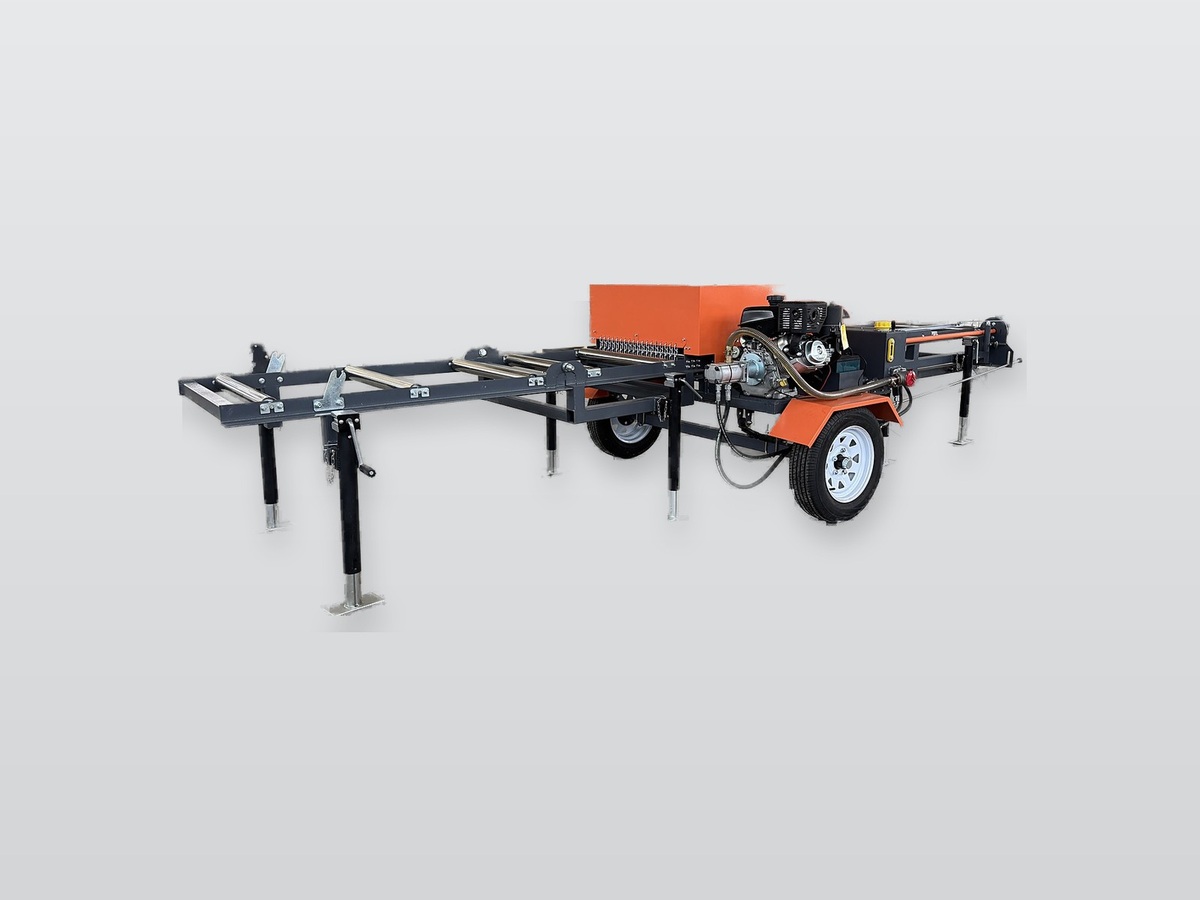
What the Hud-Son Freedom price includes
The Freedom line is the simplest place in Hud-Son's range to start, and the published detail is unusually complete for an entry mill. The $3,395.00 price buys a 21 in log capacity, 19 in between the guides, 9 in of cut thickness, a 12 ft track made of two 6 ft welded steel sections, and a 9 ft maximum log length on that track. The Sawyer ships assembled; the Hunter ships unassembled with assembly available, at the same published price.
The accessories are priced individually, which makes the real entry cost easy to calculate: a 6 ft track section is $500.00, a log dog assembly $195.00, and blades run $25.00 each, $115.00 for five or $335.00 for a case of fifteen. Add one track section and one spare dog and the delivered configuration is $4,090.00 before freight. That is not a criticism — it is a transparent way to price a mill, and it lets a buyer start small and grow the bed later.
Two published details matter more than the price for many buyers. The first is the 9 ft maximum log on the standard 12 ft track: a 10 ft trunk needs an extension before it can be sawed in one pass. The second is the 21 in log capacity, which covers most farm and homestead timber but stops short of the butt logs that come out of mature hardwood stands.
What the JERRY JR series includes
Our JR series is published as four models on one page, from the JR59 at $2,285.00 to the JR1000 at $3,000.00, and the differences between them are capacity and power rather than accessories. The JR59 and JR69 take 60 cm and 70 cm logs (24 in and 28 in); the JR80 and JR1000 take 92 cm and 105 cm (36 in and 41 in). All four use a 4 m track with a 3.5 m published cutting length, so log length is the same across the range and log diameter is what changes.
Three specification choices separate the JR line from a bare-frame entry mill. The head lifts on a linear guide rail with double sliding blocks and a reducer with a locking system, rather than a cable. The trailer version carries leaf-spring suspension and a towing device, so the mill can be towed to the log instead of the log being hauled to the mill. And the same frame can be ordered with a 220 V or 380 V electric motor, a petrol engine or a diesel engine, with EPA and EU Stage V engines available — which decides whether the mill runs on a farm supply, a generator or a fuel can.
What the JR line does not publish is a cutting tolerance figure for the portable range, and we are not going to invent one here. Cutting accuracy on a bandsaw mill depends on track levelling, blade tension, guide condition and how the log is held, and a single number quoted outside those conditions would mislead more than it informs.
Break-even: the board feet before the machine pays for itself
The table below divides published machine prices by three different savings-per-board-foot figures. Change the middle column to your own local price difference between bought lumber and milling your own; the arithmetic holds.
| Mill (published price) | Break-even at $0.40 saved per bd ft | At $0.60 | At $0.80 |
|---|---|---|---|
| JERRY JR59 — $2,285.00 | 5,713 bd ft | 3,809 bd ft | 2,857 bd ft |
| JERRY JR69 — $2,667.00 | 6,668 bd ft | 4,445 bd ft | 3,334 bd ft |
| JERRY JR80 — $2,835.00 | 7,088 bd ft | 4,725 bd ft | 3,544 bd ft |
| JERRY JR1000 — $3,000.00 | 7,500 bd ft | 5,000 bd ft | 3,750 bd ft |
| Hud-Son Sawyer — $3,395.00 | 8,488 bd ft | 5,659 bd ft | 4,244 bd ft |
| Hud-Son Sawyer + one 6 ft track section — $3,895.00 | 9,738 bd ft | 6,492 bd ft | 4,869 bd ft |
| Hud-Son HFE-28 — $5,495.00 | 13,738 bd ft | 9,159 bd ft | 6,869 bd ft |
Read the rows against a realistic annual volume rather than against each other. A homestead cutting its own firewood and fence boards may saw 1,000 to 2,000 board feet a year, which puts the JR59 break-even at roughly two to four seasons at $0.60 saved per board foot. A small custom-milling business running 8,000 board feet a year clears the JR59 line inside the first season and the HFE-28 line within two. The mill that breaks even fastest for you is a function of your volume, not of the price column.
Two costs sit outside this table and should be added before you compare quotes: freight to your yard, and the blade and maintenance budget. Freight from Qingdao differs by destination port, container loading and whether the mill ships with a trailer, so it has to be quoted per order rather than estimated here.
Blades, kerf and consumables per board foot
Both mills run a narrow band blade of almost identical section: Hud-Son publishes 132 × 1.25 × .035 in, which converts to 3,353 × 31.75 × 0.89 mm; the JR59 and JR69 use 3300 × 35 × 0.9 mm. A 0.89 mm kerf and a 0.9 mm kerf remove the same 0.9 mm of timber per cut, so kerf does not separate these two mills on yield.
What does separate them is blade cost and blade length logistics. Hud-Son publishes blade prices directly: $25.00 each, $115.00 for five, $335.00 for fifteen. For a shop sawing 3,000 board feet a year with a blade change every few hundred board feet, that is a consumable line worth putting in the spreadsheet before you choose. Our blades ship with the mill and are quoted per order; ask for a per-blade price and a sharpening plan in the same quotation so the two numbers sit side by side.
Neither mill's specification sheet supports a claim about how many board feet a blade will cut before it needs sharpening. Species, grit in the bark, feed rate and operator technique move that number more than the blade does, and any figure quoted without those conditions is marketing rather than measurement.
Throughput: the number neither specification sheet gives in the same units
Cost per board foot hides a second variable: how long the machine takes to produce the board. Our JR-series page publishes a stated safe cutting speed of 6 m/min for the JR59 and JR69 and 4 m/min for the JR80 and JR1000. Hud-Son publishes log capacity, cut thickness, track and power, but not a feed rate for the Sawyer, Hunter or HFE-28, so no like-for-like throughput comparison can be made from the two product pages.
The practical substitute is to ask each supplier the same three questions: what feed rate do you expect in dry oak at 300 mm diameter, how many board feet per hour does that give with one operator, and what is the cycle time to turn a log and reset the head. Those answers, not the published horsepower, decide how many board feet a season actually produces.
What we could not verify
Consistent with how we write every comparison on this site, here is what the Hud-Son pages reviewed do not state, and what we therefore did not put in the table: feed rate or board-feet-per-hour output, cutting tolerance, machine weight for the Sawyer, Hunter and HFE-28, surface treatment and coating specification, and CE or EU certification status for the models sold outside the United States. We did not infer any of these from photographs, from other models in the range, or from memory.
On our own side, the figures we do not publish are equally marked in the table: distance between guides as a single figure, maximum thickness of cut, and cutting tolerance for the portable range. Buyers who need those numbers for a tender document should ask for them in writing with the quotation.
Questions buyers ask before choosing between these mills
Is a 21 in or a 24 in log capacity the difference that matters? Only if your timber crosses that line. A 20 in oak fits both; a 23 in butt log fits the JR59 and needs a larger Hud-Son model. Measure the largest log you actually expect in the next three years, not the largest you have ever seen.
Why does the Hud-Son 12 ft track only take a 9 ft log? Because the head and the log dogs occupy part of the bed. Hud-Son publishes 12 ft of track and 9 ft of maximum log length on that track, and sells a 6 ft section at $500.00 to extend it. Our 4 m track is published with a 3.5 m cutting length for the same reason.
Which mill suits a farm that saws 1,500 board feet a year? Either, on capacity. The decision moves to handling: if the logs are scattered across the property, a trailer-mounted mill that tows to the log saves more time per season than any difference in the specification table. If the logs arrive at one yard, a stationary frame is the simpler, lower-cost base to build around.
Can the JERRY JR series run on farm electricity? Yes. The JR59, JR69 and JR80 are offered with 220 V or 380 V electric motors, and the JR1000 with 380 V, alongside petrol and diesel engine options. Tell us the supply you have and the mill is configured for it.
What does MOQ 1 set mean in practice? One machine, configured to your order, shipped from Qingdao under FOB, CFR, CIF or EXW terms. There is no container minimum to reach before an order can be placed.
Key facts
Hud-Son Sawyer / Hunter, published November 2026: 21 in log capacity, 19 in between guides, 9 in cut thickness, 12 ft track in two 6 ft sections, 9 ft maximum log length, 6.5 hp petrol manual start, 3-year limited residential warranty, $3,395.00 assembled (Sawyer) or unassembled (Hunter), marked down from $3,995.00.
JERRY JR series, published: JR59 $2,285.00 (60 cm / 24 in logs), JR69 $2,667.00 (70 cm / 28 in), JR80 $2,835.00 (92 cm / 36 in), JR1000 $3,000.00 (105 cm / 41 in); 4 m track, 3.5 m cutting length, electric, petrol or diesel power, trailer version with leaf-spring suspension, 1-year warranty.
Break-even arithmetic: published price ÷ savings per board foot. At $0.60 saved per board foot, $2,285.00 needs 3,809 board feet and $3,395.00 needs 5,659.
Blade section: Hud-Son 132 × 1.25 × .035 in (0.89 mm kerf); JERRY 3300 × 35 × 0.9 mm on JR59/JR69, 4200 × 35 × 0.9 mm on JR80/JR1000.
Our certifications: CE certification, EPA and EU Stage V engine options, TÜV Rheinland factory audit, Verified Custom Manufacturer. Our patented pre-cut debarker is fitted to the commercial line, not to the portable JR series.
Trade terms: MOQ 1 set, shipment from Qingdao, FOB / CFR / CIF / EXW, factory in Zibo, Shandong.
Next step
Send us the largest log diameter you expect, the longest log you need to saw in one pass, your annual board-foot target and whether the mill will run on farm electricity, petrol or diesel. We will reply with one JR configuration, one price and the freight options from Qingdao, so you can put it next to the Hud-Son quote and run the division yourself. The same portable-versus-commercial decision is set out in Portable vs Commercial Sawmill: Choosing by Log Diameter and Output, and the track and option trade-offs against another entry mill are in JERRY Portable Sawmill vs Norwood LumberMan MN27.
Hud-Son, Sawyer, Hunter, Homesteader and Freedom are trademarks of their respective owner. Model names and published figures are used here for identification and comparison only, and were taken from the manufacturer's own product pages in November 2026. Prices are list prices, subject to change.
Contact: jerry@jerry-sawmill.com | forest-machinery.com