Vertical vs Horizontal Log Splitter: When the 90° Rotate Design Pays Off
A log splitter with a 90° rotating beam lets one machine work in two positions: vertical, with the round sitting on the ground so nobody has to lift it, and horizontal, with the log on the beam for a faster, repeatable cycle. Choose vertical for heavy rounds you cannot lift by hand, and horizontal for straight logs you can roll into place.
What each position actually changes
In the vertical position the beam stands upright and the wedge travels down onto a round that stays on the ground. The operator never lifts the round — on hardwood above roughly 40 cm (15.8 in) this is the difference between splitting and giving up. It suits big, knotty, short rounds.
In the horizontal position the round sits on the beam and is driven into a fixed wedge, or the wedge is driven into the round depending on the model. Loading is faster because the log rolls into place at working height, and the operator stands in one spot. It suits straight-grained logs, longer billets and steady production.
A rotating model gives both without buying two machines. The trade-off is mechanical: the beam pivot, the valve and the oil tank all have to work in two orientations, which is why a rotating splitter costs more than a fixed horizontal one of the same tonnage.
What the 90° rotate design adds to the machine
Locking pivot at the beam base. The beam swings up and locks; if the lock is loose the wedge drifts off-centre and the round kicks sideways.
Valve position that stays reachable. On a good design the control handle is usable standing or kneeling, so the operator is not walking around the machine to switch sides.
Oil tank and filter placed for both angles. Tilt the machine 90° and a badly placed pickup can starve the pump.
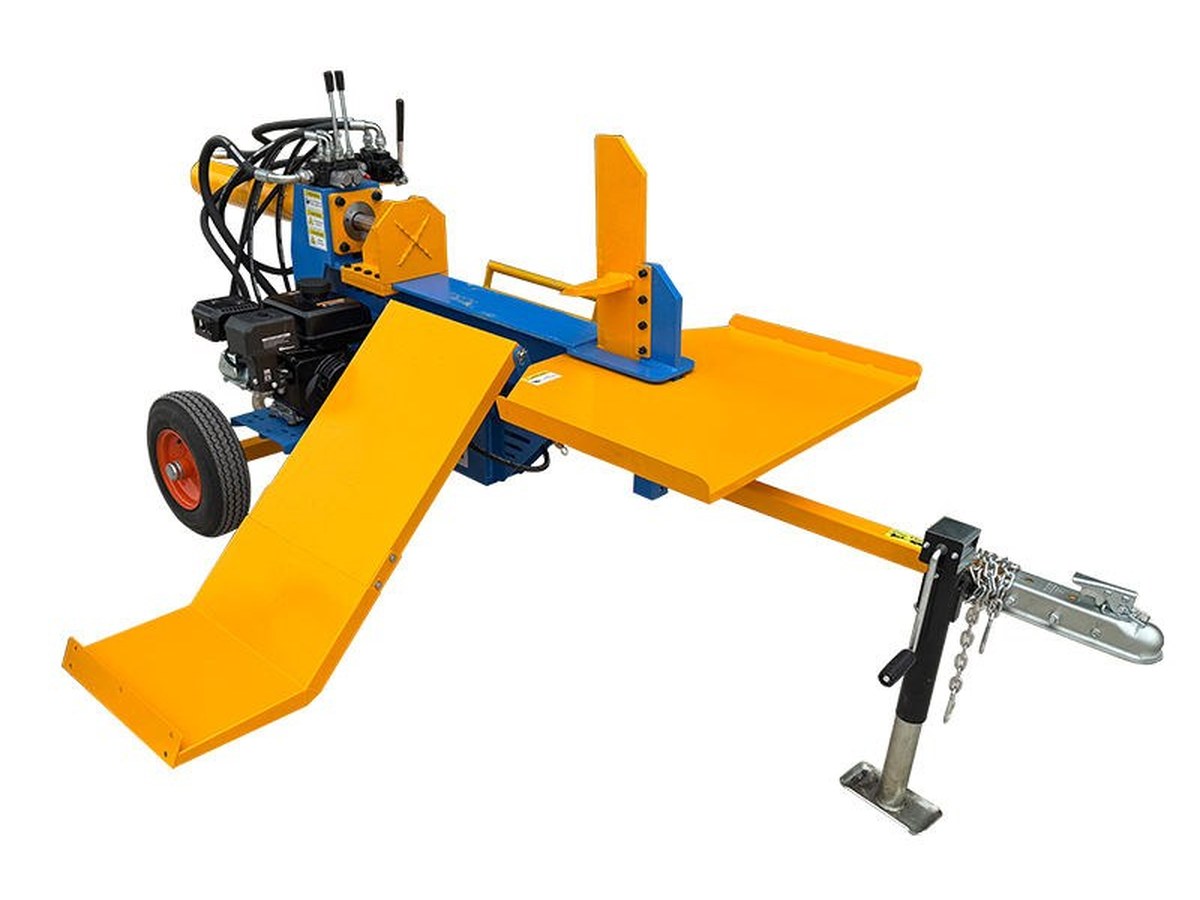
On the JERRY 15-tonne horizontal/vertical splitter the splitting stroke is 520 mm (customisable), the cylinder bore is 70 mm, working pressure is 16–22 MPa and the cycle takes about 15 seconds. It runs a Runtong 180 cc air-cooled four-stroke petrol engine with electric start plus recoil backup, a 3.6 L fuel tank, a CBT1/4.2 pump and a 40 L three-position manual valve on 46# hydraulic oil. Net weight is 125 kg, gross 145 kg, on 4.1-3.5-4 wheels with a transport handle. Wedge choice is 2-way or 4-way — a 4-way wedge quarters the round in one stroke and is the usual pick when firewood is sold by volume.
Matching tonnage to log diameter and species
Tonnage is a starting point, not the whole answer: knotty hardwood in the same diameter can need noticeably more force than clean softwood, and a blunt or narrow wedge multiplies the load.
| Model | Splitting force | Position | Drive | Notes |
|---|---|---|---|---|
| 8T standard / shield | 8 t | Horizontal | Electric, 110/220 V, 3 HP | Splits 0.2–15.8 in; cycle 13 s / 9 s; two-hand safety control; shield version for CE markets |
| 13T flywheel | 13 t | Horizontal | Electric | Inertia flywheel drive, 2–3 s cycle; small to medium clean logs only |
| 15T | 15 t | Horizontal / vertical, 90° rotate | Petrol 180 cc | 520 mm stroke, 70 mm bore, ~15 s cycle, 2-way or 4-way wedge |
| 18T single / dual cylinder | 18 t | Horizontal | Petrol 209 cc, diesel or electric | Dual-cylinder version adjusts wedge height hydraulically instead of by hand |
| 25T | 25 t | Horizontal / vertical, 90° rotate | Petrol, diesel or electric | For large rounds that are unsafe to lift |
| 28T with log lifter | 28 t | Horizontal | Petrol 212 cc, diesel or electric | Integrated hydraulic log lifter; 4.80-8 tyres |
| 50T reciprocating | 50 t | Horizontal | 25 HP diesel or heavy-duty electric | Dual-way wedge splits on the forward and return stroke; hydraulic log lifter |
Where the rotating design pays off — and where it does not
It pays off when the same buyer handles two very different jobs: big yard rounds that must be split where they lie, plus a steady stream of manageable logs. It also pays off for a single operator, because he never has to lift a round he cannot lift safely.
It pays off less when logs are uniformly small and clean: a fixed horizontal machine of the same tonnage is cheaper and has fewer parts to maintain. A flywheel splitter on clean softwood will out-cycle a hydraulic machine several times over in the same hour, but it is not the tool for hardwood or oversized rounds.
Safety points that decide the purchase in Europe
Two-hand control. Both hands must stay on the control for the ram to advance; releasing one hand retracts the ram. This is what CE buyers in Germany and France ask for first.
Shield version. A steel mesh guard around the splitting zone, built for the same CE expectations.
Transport handle and small wheels. A splitter that cannot be moved to the woodpile gets used less.
Questions buyers ask before ordering
Can a vertical splitter be used horizontally as well?
Only if the beam is designed to rotate and lock in both positions. A fixed vertical or fixed horizontal machine cannot be converted in the field.
Is 15 tonnes enough for hardwood?
It handles the rounds most farm and firewood customers bring, and the 4-way wedge speeds up clean timber. If the rounds are consistently large, knotty or oversized, step up to 25 t with the rotating beam rather than pushing a smaller machine.
Why does the cycle time matter more than tonnage?
Firewood output is cycles per hour times wood per cycle. A 15 s cycle with a 4-way wedge can produce more split firewood in an hour than a slower, stronger machine splitting one round at a time.
What power should I choose for Europe or North America?
Petrol engines are supplied with EPA and Stage V (Euro 5) certification; diesel power is Stage V only, with no EPA certification, so petrol or electric is the usual choice for North American buyers.
What hydraulic oil and service parts are needed?
46# hydraulic oil is specified, with a hydraulic filter as the main wearing part; the beam pivot and wedge should be checked for play before each season.
Key facts
Rotating models: 15 t and 25 t, horizontal / vertical with a 90° beam
Fixed horizontal range: 8 t, 13 t (flywheel), 18 t, 28 t with log lifter, 50 t reciprocating dual-way
15 t specification: 520 mm stroke, 70 mm bore, 16–22 MPa, ~15 s cycle, Runtong 180 cc petrol, 125 kg net
Wedge options: 2-way or 4-way
Markets: CE certification, TÜV Rheinland factory audit, Verified Custom Manufacturer
Trade terms: MOQ 1 set, shipped from Qingdao, FOB / CFR / CIF / EXW
Factory: Zibo, Shandong, China
Choosing between the two positions for your logs
Tell us the log diameter, the species and how much firewood you split in a season, and we will point you at the right tonnage and wedge. For a mixed yard where nobody wants to lift big rounds, the 90° rotating 15 t or 25 t is the practical answer; for uniform clean timber, a fixed horizontal machine or a flywheel splitter will do the same work for less money.
Email jerry@jerry-sawmill.com or visit forest-machinery.com.