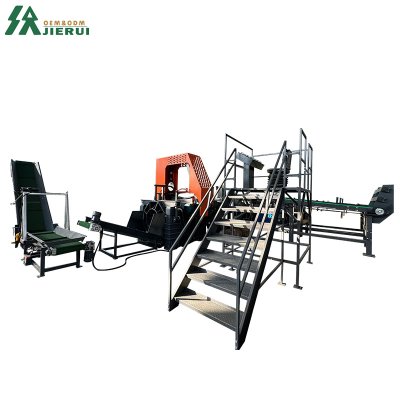
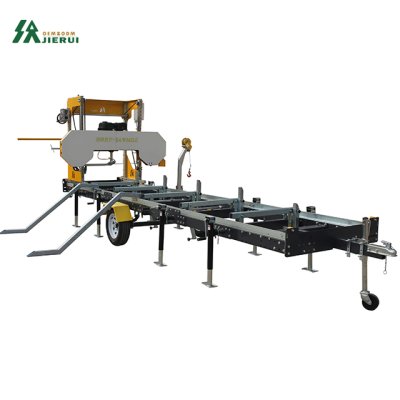
Firewood Processor Safety Zones: Feed Table, Splitter and Discharge
Short answer: a firewood processor is laid out in four working zones - feed table, saw and clamp, splitting wedge, and discharge conveyor - and each zone needs its own keep-out rule. On JERRY processors the saw only engages while the safety handle is held and the guards are in place; if a guard is raised, the hydraulic system stops both the saw and the splitter.
The four zones, and what changes at each one
Most firewood processor accidents are not caused by a lack of power. They happen because an operator steps into a zone that the machine already owns - the travel path of the log, the stroke of the saw bar, the stroke of the ram, or the drop point of the conveyor. Treat the machine as four separate work areas and the layout decisions become straightforward.
| Zone | Where the operator stands | What the machine does there | Published number to plan with |
|---|---|---|---|
| 1. Feed table and infeed conveyor | Beside the log table, clear of the chain track | Chain conveyor carries rounds to the clamp | 610 mm max splitting length, 500 mm max splitting diameter (30T / 45T) |
| 2. Saw capture and hydraulic clamp | At the control side, behind the saw guard | Bar saw cuts the round, clamp holds it | 22 in bar on the 30T, 18 in bar on the 15T manual |
| 3. Splitting wedge and ram | At the lever bank, never beside the wedge | Ram pushes the round through the wedge | 8 s cycle on the 30T, 7 s on the 15T manual |
| 4. Discharge conveyor | Away from the belt end | Cleated belt lifts split wood to the pile | 3.2 m conveyor, 370 mm belt, 420 mm discharge chute |
Zone 1: the feed table sets the reach limit
The feed table is where hands and a moving chain share the same space, so it is the zone where machine geometry matters most. A JERRY processor feeds rounds along a chain conveyor with steel flights; the flights index the log forward to a fixed stop, and the maximum splitting length of 610 mm on the 30T and 45T defines how far that log will travel before the clamp closes.
Two planning rules follow from that number. First, the log table has to be long enough to hold the longest round you intend to process without the butt end hanging off, because a round that overhangs gets pulled sideways as the flights advance. Second, the operator's standing position belongs at the side of the table, not at its end - standing in line with the chain puts the operator in the travel path of every log that slips a flight.
Cutting rounds to length before they reach the table also keeps the zone predictable. A 500 mm green round weighs enough that it will not be steered by hand once the flights engage it.
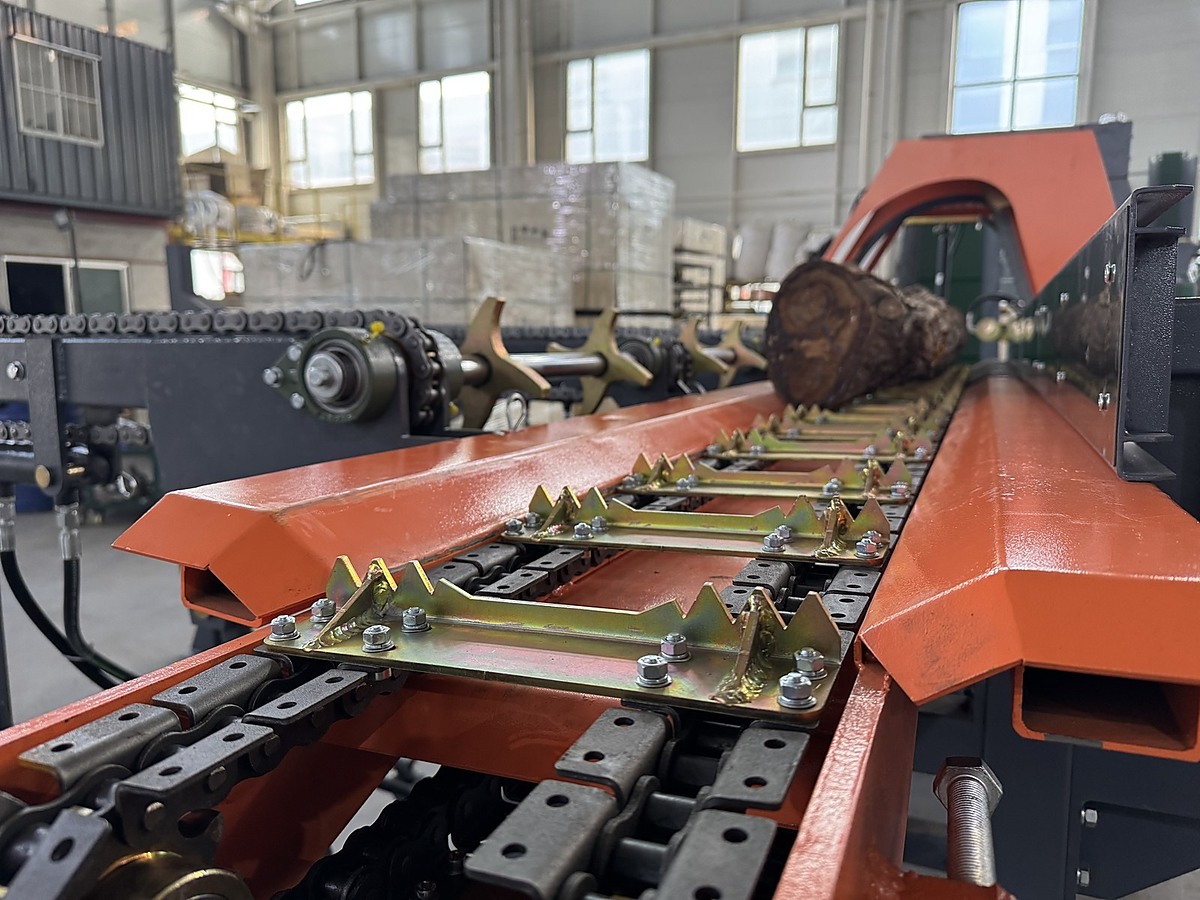
Zone 2: the saw guard is a boundary, not a cover
The saw zone is short - one bar length - but it is the zone with the highest consequence. On the 30T the bar is 22 in, running at 7,000 rpm with a STIHL guide bar and chain; on the 15T manual unit the bar is 18 in. The guard is the boundary between the operator and that bar.
JERRY processors use an interlocked arrangement rather than a fixed cover. The saw only engages when the safety handle is in use and the guards are securely in place, and if the guard is raised the hydraulic system immediately stops both the saw and the splitter. That behaviour is deliberate: it makes the guard the control, so there is no operating state in which the bar runs uncovered.
What to check on any processor, including ours: whether the saw stops when the guard lifts, whether the return spring on the safety handle brings the saw out of cut when released, and whether the clamp holds the round before the bar enters it. A clamp that closes after the cut has started leaves the round free to roll into the bar. Bar and chain condition belongs to the same zone: a slack chain or a worn drive sprocket changes how the bar behaves in the cut, which is why we publish a bar and chain maintenance schedule alongside the machine.
Zone 3: the wedge zone is a stroke, not a point
Buyers often think of the wedge as a single edge, but the hazard is the full ram stroke. On the 30T the stroke is sized by the 610 mm maximum splitting length; a round shorter than that leaves open travel in front of the ram, and that open travel is where hands get caught when someone reaches in to reposition a short piece.
The fix is procedural and physical at the same time. Short rounds should be pushed into position with a stick or a purpose-made pusher, never by hand, and the wedge should be set so the round is supported by the table rather than balanced on the beam. The 4-way wedge is standard on the 30T, with 6-way and 8-way wedges available as options; a 6-way or 8-way wedge increases the number of pieces leaving the wedge at once, so the discharge side has to be clear before the stroke finishes. The trade-off between piece count and handling time is set out in our 4-way vs 6-way wedge comparison.
Cycle time sets the rhythm of this zone: 8 s on the 30T, 8-12 s on the 20T and 45T, 7 s on the 15T manual. An operator who knows the machine can use the return stroke to reposition; an operator who does not will reach in during the stroke. Roof and yard training should be built around that number rather than around an instruction to "be careful".
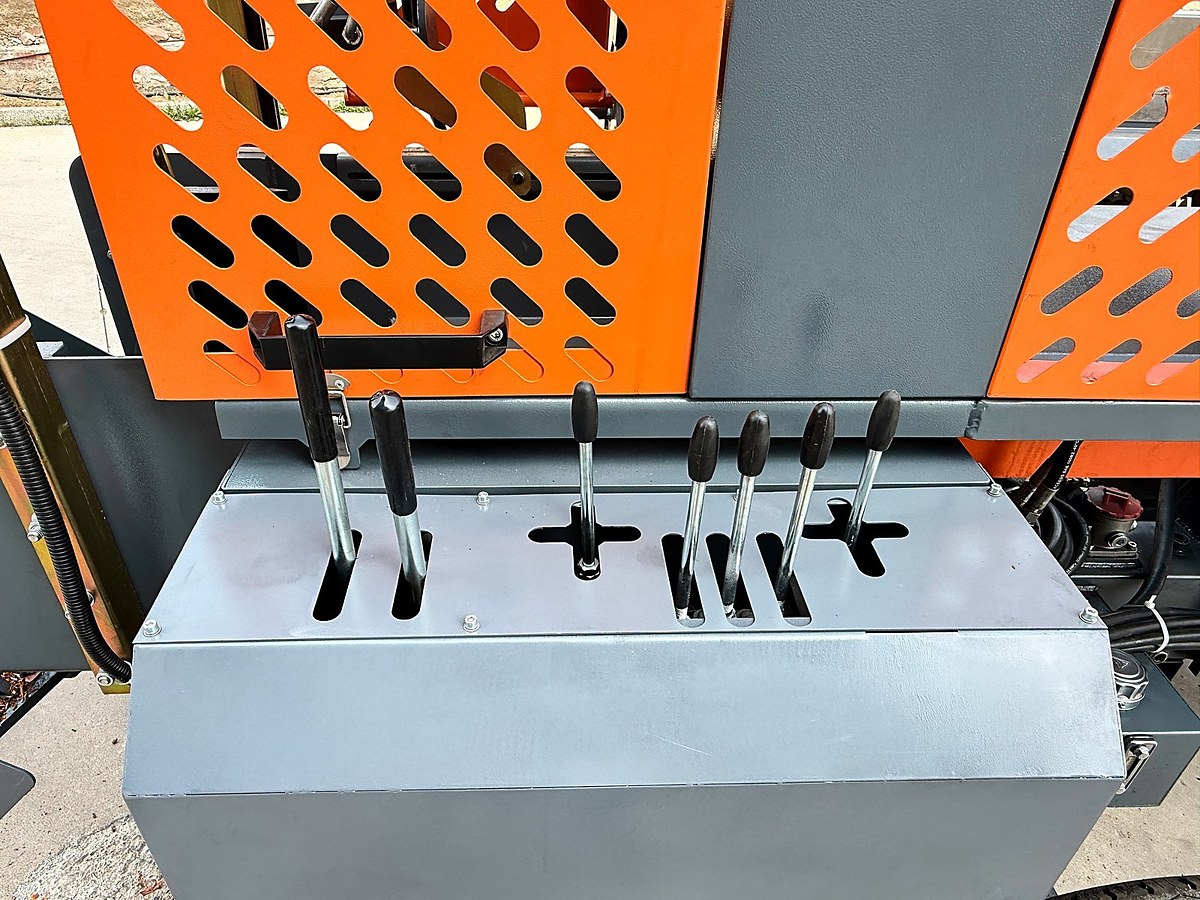
The lever bank in the photo above is the operator's anchor point: from there the saw handle, the clamp, the ram and the conveyor are all reachable without stepping toward the wedge. Machines ordered for a fixed yard benefit from a marked standing position on that side, because the position is what keeps the cycle repeatable.
Zone 4: the discharge conveyor owns the length behind the machine
The discharge conveyor is the zone most often left out of site planning, because it is behind the operator and it looks like a transport device rather than a hazard. On the 30T it is 3.2 m long, with a 370 mm belt and a 420 mm chute, and it lifts split wood to a pile that grows at roughly the height of the conveyor head.
Practically, that means the machine needs a clear strip at least as long as the conveyor behind the splitter, and the strip has to stay clear of stacked wood, pallets and parked vehicles. Split pieces leave the belt with forward momentum; a pile built too close to the head causes pieces to bounce back toward the machine. If the conveyor is raised for transport, the strip shortens but the head is higher, so the drop zone moves rather than disappears.
Zone 5: towing, jack stands and the transport state
A processor is also a trailer. The 30T uses a 50 mm tow hitch and weighs 1,100 kg; the 15T manual unit runs on 12 in high-speed trailer wheels and weighs 500 kg. Before the machine is moved, the conveyor should be lowered into its transport position, the jack stands raised, and the wedge and ram brought back to the start of the stroke. The packed dimensions of the 30T are 2,800 x 1,720 x 1,650 mm, which is the envelope to check against a container door and a yard gate, not the working envelope.
What CE marking asks for at each zone
CE marking under the Machinery Directive 2006/42/EC is built on a risk assessment for the machine as supplied, and for a firewood processor that assessment is organised along exactly these zones. The measures that show up in the assessment are interlocked guards at the saw, a hold-to-run saw control, a clamp that closes before the cut, guarding or distance protection at the wedge, and a discharge arrangement that keeps the operator out of the drop path.
On the JERRY side, the processors carry CE marking, the Zibo factory is audited by TÜV Rheinland, and the company holds Verified Custom Manufacturer status. Gasoline-engined units can be supplied with EPA and EU Stage V compliant engines. The minimum order is 1 set, and machines ship from Qingdao under FOB, CFR, CIF or EXW terms.
Zone numbers by model
| Model | Splitting force | Max splitting diameter | Max splitting length | Cycle time | Bar | Weight |
|---|---|---|---|---|---|---|
| 15T manual | 15 t | 400 mm | 550 mm | 7 s | 18 in STIHL | 500 kg |
| 20T | 20 t | 480 mm | 610 mm | 8-12 s | 22 in STIHL | 980 kg |
| 30T | 30 t | 500 mm | 610 mm | 8 s | 22 in STIHL | 1,100 kg |
| 45T | 45 t | 500 mm | 600 mm | 8-12 s | 22 in STIHL | 1,300 kg |
Three numbers in that table drive the site layout more than the others: the maximum splitting length sets the feed table and the open ram travel, the cycle time sets the operator's working rhythm, and the weight sets what the tow vehicle and the ground have to carry. Splitting force and wedge configuration describe what the machine can break, not how close a person may stand to it.
Planning the working envelope
Draw the machine at its packed size - 2,800 x 1,720 x 1,650 mm for the 30T - then add three rectangles: the log table in front of the feed side, the 3.2 m conveyor behind the discharge side, and a walkway along the control side wide enough for one person to pass without stepping over the tow bar. Position the machine so the control side faces the woodpile you are feeding from and the discharge side faces the pile you are building. If both piles end up on the same side, the operator will cross the discharge path every cycle, and no amount of signage fixes that.
Questions buyers ask before ordering
How much clear space does a firewood processor need?
Plan for the machine footprint plus the conveyor length behind it and the log table in front. For the 30T that is a 2,800 x 1,720 mm machine, a 3.2 m conveyor strip on the discharge side, and a walkway on the control side. The exact figure depends on whether the conveyor is in its working or transport position.
Can the guard interlock be bypassed for a faster cycle?
No. The interlock is the CE measure that keeps the bar covered, and on JERRY processors raising the guard stops both the saw and the splitter. A machine with a bypassed interlock is no longer the machine that was assessed.
Does a firewood processor need two-hand control?
Not in the form used on a standalone log splitter. On this design the saw is controlled by a hold-to-run safety handle and the wedge zone is protected by guard, distance and clamp sequencing. What the risk assessment has to show is that the operator cannot reach the bar or the wedge during a stroke - the mechanism used to achieve that is a design choice.
Where should the operator stand?
At the control bank on the side of the machine, behind the saw guard, with the discharge conveyor on the far side. Standing at the discharge end puts the operator in the drop path; standing in line with the infeed chain puts them in the travel path of the log.
What is the most common layout mistake on a new site?
Building the split-wood pile in front of the conveyor head because it is the shortest carry. The pile then grows back toward the belt, pieces bounce toward the machine, and someone eventually clears the head while the processor is running.
Related reading
Firewood processor vs Wallenstein WP845: log deck and cycle time
STIHL bar and chain on firewood processors: maintenance schedule
Key facts
Models: 15T manual, 20T, 30T, 45T; splitting force 15-45 t
Published capacity: up to 500 mm splitting diameter, 610 mm splitting length, 7-12 s cycle
Saw: 18 in or 22 in STIHL guide bar and chain, 7,000 rpm chain speed on the 30T
Discharge: 3.2 m conveyor, 370 mm belt, 420 mm chute (30T)
Guard logic: saw engages only with the safety handle held and guards in place; raising a guard stops saw and splitter
Compliance: CE marking under 2006/42/EC; TÜV Rheinland factory audit; Verified Custom Manufacturer; EPA and EU Stage V engines available
Trade: MOQ 1 set, Qingdao port, FOB / CFR / CIF / EXW
Factory: Zichuan District, Zibo, Shandong, China
Next step
Send us the log diameter, the round length you sell, and the space you have on the discharge side, and we will confirm which model fits the layout and quote it FOB Qingdao. Write to jerry@jerry-sawmill.com or see the full range at forest-machinery.com.