JERRY Firewood Processor vs Wallenstein WP845: Log Deck and Cycle Time
Short answer: the gap between these two firewood processors is less about splitting force than about how a log reaches the saw. The Wallenstein WP845 drags logs in with a 1,550 lb hydraulic winch and publishes an 8.3 second full-stroke split cycle at 25 ton. JERRY's 20T, 30T and 45T processors publish 8 to 12 second cycles and offer a powered stepping log deck (JR300) for batch feeding.
Two answers to the same bottleneck
Both machines do the same four jobs: take a log, cut it to length, split it, and move the pieces away from the operator. Where they separate is the infeed. The WP845 is built around a hydraulic winch, so one operator straps a log, pulls it to the machine, and the saw plus a 4-way wedge handle the rest, with an auto-cycle valve returning the split ram without a second lever pull.
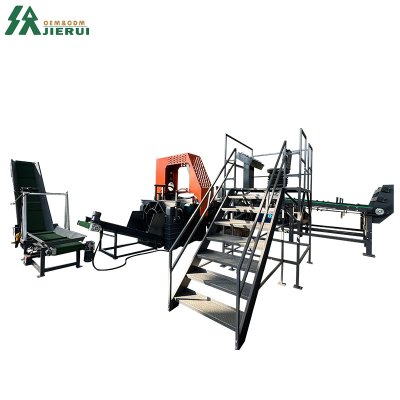
JERRY builds the same core around a different feeding philosophy. Logs can be fed one at a time by hand or with the JR100 lifter or JR200 table, and the JR300 powered log deck adds a hydraulic chain stepping system that queues a batch of logs and indexes them into the machine one by one. On a crew cutting several cords a day, that is the difference between one person bent over a log and one person at the controls.
Every figure below comes from each manufacturer's own published specification. Where a number is not published, the table says so rather than filling the gap with an estimate.
Published specification comparison
| Specification | JERRY 20T / 30T / 45T | Wallenstein WP845 |
|---|---|---|
| Split force | 20 / 30 / 45 ton | 25 ton |
| Max. log diameter (cut and split) | 480 mm (19 in) / 500 mm (19.7 in) / 500 mm (19.8 in) | 22 in (56 cm) |
| Split opening / max. split length | 610 mm (24 in) on 20T and 30T; 600 mm (23.6 in) on 45T | 24 in (61 cm) |
| Published cycle time | 8 s (30T); 8 to 12 s (20T and 45T) | 8.3 s, full stroke |
| Engine | 18 HP LIFAN gasoline, electric start (20T); 27 HP LIFAN 560 cc (30T and 45T) | Vanguard 14 hp (408 cc) |
| Hydraulic pump | 20 / 22 / 24 GPM two-stage | Not published |
| Hydraulic oil capacity | 100 L (20T); 120 L (45T); not published for 30T | 10.6 US gal (40 L) |
| Log infeed | Manual feed, JR100 lifter or JR200 table; JR300 powered stepping log deck optional | Hydraulic winch, 1,550 lb (703 kg) pull, 50 ft (15 m) of 1/4 in rope; pivoting chainsaw holder |
| Splitting wedge | 4-way adjustable standard; 6-way or 8-way optional (45T: 4/6/8-way adjustable) | Adjustable 4-way standard; 6-way listed as an accessory |
| Outfeed | 2.4 m conveyor (200 to 370 mm belt) plus 3.2 m rear loading conveyor | Adjustable offload chute, 54 in (137 cm) discharge height |
| Published throughput | 4 to 7 m³/h (20T and 45T); 4 to 8 m³/h (30T) | Up to 2 cord per hour |
| Weight | 980 kg / 1,100 kg / 1,300 kg | 2,050 lb (930 kg) |
| Transport size | Packing 2,300 × 1,250 × 1,750 mm (20T) | 220 × 69 × 66 in open; 98 × 73 × 79 in folded |
| Tyres and hitch | 22 × 11-10 tyres, 50 mm ball coupler | 5.30 × 12 tyres, 2 in ball, 160 lb (73 kg) tongue weight |
| Recommended guide bar | 22 in STIHL bar and chain, German-made | 22 to 30 in |
| Listed price | US$3,900 / 6,230 / 6,950 as listed on our product pages | Not published on the model page reviewed; dealer quotation |
| Certification stated on the product page | CE; EPA and Stage V engine options; TÜV Rheinland factory audit | Not stated on the model page reviewed |
Wallenstein WP845 specification as published by the Wallenstein official site (United States), November 2026. JERRY figures are as published on our own product pages in November 2026 and are confirmed per order. Prices are list prices and subject to change.
What a "cycle time" actually measures
Cycle time is the most quoted and least comparable number on a firewood processor. Wallenstein publishes 8.3 seconds and names it a full-stroke splitting cycle, which implies ram travel out and back under the auto-cycle valve. JERRY publishes 8 seconds for the 30T and 8 to 12 seconds for the 20T and 45T, and the spread inside our own range already tells you that the figure moves with log diameter, species and wedge configuration.
A split cycle is also only part of the work. The saw cut, the log index, the operator's reach and the conveyor have to happen in the same minute. On a processor fed by hand, the real cycle is set by how fast a log can be presented to the saw, not by how fast the ram moves. That is why the infeed question matters more than a 0.3 second difference between two published figures.
If you are comparing quotations, ask each supplier three things: whether the published cycle includes the return stroke, what log diameter and species the figure was measured on, and what the machine does between splits. Any honest answer will include a range rather than a single number.
Winch, lifter or live deck
The WP845's winch is a genuine one-person solution on a landing. A 1,550 lb pull with 50 feet of rope covers the distance between the machine and a log pile, and the pivoting chainsaw holder and sweep tongue are designed around that single-operator loop. It suits a buyer who works alone, moves between sites, and cuts a few cords at a time.
JERRY's answer to the same problem is modular. The JR100 lifter raises a single log to the infeed, the JR200 table gives a sloped, high-capacity staging surface, and the JR300 is a powered live deck with a hydraulic chain stepping system that separates logs from a batch and indexes them one at a time. The trade-off is footprint and cost: a live deck needs space beside the machine and is priced as an extra, which is why it belongs in the quotation rather than in the base price.
The practical test is how the logs arrive. If they arrive on a forwarder or a trailer and are dumped within rope distance, a winch covers the job. If they arrive as a stack that has to be broken down all day, a stepping deck keeps the saw fed without a second person.
Where the published diameter limits sit
This is the dimension where the two machines are not equal, and it is worth stating plainly: Wallenstein publishes 22 in (56 cm) of maximum log diameter for the WP845, and JERRY publishes 480 to 500 mm (19 to 19.8 in) across the 20T, 30T and 45T. A 22 inch log is 559 mm, so it sits outside our published figure on those three models.
What that means in practice depends on the wood. On a firewood operation running mixed softwood and small hardwood, most stems are under 19 inches and the limit never binds. On a contract where the customer's logs routinely run 20 to 22 inches, the WP845's published figure leaves more margin, and the honest step is to ask us for the largest diameter confirmed in writing for the model you are quoted, or to look at a larger frame.
Split opening is closer: 24 in (61 cm) on the WP845 against 610 mm (24 in) on the 20T and 30T. Split opening and log diameter are different limits, and buyers regularly confuse them. The opening is what the wedge can pass; the diameter is what the machine can accept and hold.
Throughput in cubic metres and in cords
Wallenstein publishes up to 2 cord per hour. At the standard equivalence of 1 cord = 3.62 m³, that is roughly 7.2 m³ per hour. JERRY publishes 4 to 7 m³/h on the 20T and 45T and 4 to 8 m³/h on the 30T.
On paper, the WP845's published ceiling sits above the middle of the JERRY range. That comparison is worth exactly as much as the conditions behind it, which is to say very little on its own: neither manufacturer is quoting your timber, your log lengths, your wedge configuration or your operator. Published throughput is a ceiling figure for clean, straight logs with a sharp chain. Knots, crotch wood, frozen bark and a dull chain move it more than any specification on the page.
What does transfer between machines is the arithmetic of a working day. Count how many logs per hour the infeed can present, multiply by the average piece volume, and compare that to the published ceiling. The smaller of the two numbers is your real output, and it is usually the infeed.
Weight, towing and site access
The WP845 is 2,050 lb (930 kg) with a 160 lb tongue weight, 5.30 × 12 tyres, a 2 inch ball and Torflex suspension, and it folds to 98 × 73 × 79 inches for transport. Those numbers describe a machine a half-ton pickup can move on a proper trailer without a commercial licence in most markets.
JERRY's processors run 980 kg (20T), 1,100 kg (30T) and 1,300 kg (45T) with 22 × 11-10 flotation tyres and a 50 mm ball coupler. The heavier models are still trailer-portable, but at 1.3 tonnes the tow vehicle and the braking question become part of the purchase decision, not an afterthought.
If the machine stays in one yard, weight is a stability advantage. If it moves weekly, folded dimensions and tongue weight decide whether the move is a 20-minute job or a two-person operation.
Documents, certification and delivery terms
JERRY processors are supplied with CE documentation, the factory is audited by TÜV Rheinland and holds Verified Custom Manufacturer status, and gasoline units can be specified with EPA and EU Stage V engines for the destination market. Terms are FOB, CFR, CIF or EXW from Qingdao, with an MOQ of one set, and the factory is in Zibo, Shandong.
Wallenstein's WP845 model page does not state certification, and its route to market is a dealer network, so a European buyer should confirm the conformity documentation for the exact unit rather than assume it. What is published there is the warranty: five years for consumer use, two years for commercial use.
Importing from China moves cost between the machine price and the freight line. The difference between FOB, CFR, CIF and EXW, and which one puts insurance and port charges on which side, is set out in this comparison of Incoterms for forestry machinery.
Wedge configuration decides firewood size, not tonnage
Both machines publish a 4-way wedge as standard and a 6-way as an option, and JERRY's 45T adds an 8-way. The choice is a market decision, not a power decision: a 4-way wedge on 40 cm logs produces pieces a household stove will take, while a 6-way on the same log produces splits that suit a commercial buyer paying by volume. Wedge height adjustment matters just as much, because a wedge set too high on small logs makes slivers and a wedge set too low on large ones stalls the ram.
The relationship between wedge geometry and firewood size is covered in this note on 4-way and 6-way wedges, and the chain and bar maintenance interval that keeps a processor cutting straight is in this maintenance schedule for STIHL bars and chains.
Which buyer fits which machine
A single operator cutting for a few dozen households: the winch-fed WP845 matches that pattern, because one person can winch, cut, split and pile without a second pair of hands, and the dealer network is local in North America.
A yard cutting several cords a day with two or three people: the infeed becomes the constraint, and a JERRY 30T or 45T with the JR300 stepping deck and the 3.2 m rear loading conveyor keeps the saw fed while one operator handles the controls.
A buyer with 20 to 22 inch logs as the normal case: check the diameter limit in writing before comparing anything else. The WP845 publishes 22 in; our 20T to 45T publish 19 to 19.8 in, and a larger model is the correct answer rather than a workaround.
A buyer importing into Africa, Southeast Asia or South America: voltage, documentation, spare-part shipping and the Incoterm matter more than a 2 inch difference in log capacity. Both routes can supply a document pack; compare what is actually in it.
For the wider class comparison, the same product line has been set against Brute Force processors at 20 to 24 inch logs, and the question of whether a processor earns its price against a chainsaw and a splitter is worked through in this cost-per-cord comparison.
Questions buyers ask before choosing
Does the Wallenstein WP845 have a live log deck?
Not as published. The WP845 model page lists a hydraulic winch with 1,550 lb of pull and 50 feet of rope as the infeed method, plus a pivoting chainsaw holder. A 60 inch winching strap is listed as an accessory. A powered stepping deck is a separate category of equipment in the JERRY range (JR300).
Is an 8 s cycle the same as an 8.3 s cycle?
Only if both manufacturers measure the same motion. Wallenstein names its figure a full-stroke splitting cycle; JERRY publishes 8 seconds for the 30T and 8 to 12 seconds for the 20T and 45T. Ask whether the return stroke is inside the number before treating the two as comparable.
Can a JERRY firewood processor take a 22 inch log?
The 20T, 30T and 45T publish 480 to 500 mm (19 to 19.8 in) of maximum cutting and splitting diameter. A 22 inch log is 559 mm, so it is outside those figures. Tell us the largest diameter in your wood and we will confirm the model that covers it in writing.
How much hydraulic oil does each machine hold?
The WP845 publishes 10.6 US gal (40 L). JERRY publishes 100 L on the 20T and 120 L on the 45T; the 30T figure is not published on our product page and should be confirmed in the quotation. Larger reservoirs take longer to reach a working temperature, which matters on a machine running all day.
Which machine tows behind a half-ton pickup?
The WP845 at 2,050 lb (930 kg) with a 160 lb tongue weight is the lighter package on paper. The JERRY 20T is 980 kg, close to the same figure; the 30T and 45T at 1,100 kg and 1,300 kg need the tow vehicle and braking question settled first.
Key facts
Wallenstein WP845: 25 ton, 22 in (56 cm) max log diameter, 24 in (61 cm) split opening, 8.3 s full-stroke cycle, Vanguard 14 hp (408 cc), 2,050 lb (930 kg), up to 2 cord per hour.
WP845 infeed: hydraulic winch, 1,550 lb (703 kg) pull, 50 ft (15 m) of 1/4 in rope; adjustable 4-way wedge standard, 6-way accessory.
JERRY 20T / 30T / 45T: 20 / 30 / 45 ton, 480 to 500 mm (19 to 19.8 in) max diameter, 600 to 610 mm split length, 8 to 12 s cycle, 18 to 27 HP LIFAN gasoline.
JERRY feeding options: JR100 lifter, JR200 table, JR300 powered stepping log deck; 2.4 m outfeed conveyor plus 3.2 m rear loading conveyor.
JERRY commercial terms: CE documentation, EPA and Stage V engine options, TÜV Rheinland factory audit, Verified Custom Manufacturer, MOQ 1 set, FOB / CFR / CIF / EXW from Qingdao, factory in Zibo, Shandong.
Listed prices: JERRY US$3,900 / 6,230 / 6,950 as listed on our product pages; WP845 price not published on the model page reviewed (subject to change).
Next step
Send the largest log diameter in your wood, the finished length you sell, your weekly volume in cords or cubic metres and your destination port. We will confirm the model and the infeed arrangement that covers those numbers, including whether a stepping deck is needed at all.
Email: jerry@jerry-sawmill.com
Site: forest-machinery.com