Log Trailer with Crane: Bunk Width, Axle Rating and Grapple Reach
A JERRY log trailer with crane in this class carries 1,500 kg or 2,000 kg on a 2,120 mm bunk, and lifts 200 kg at a maximum reach of 3.4 m with a 700 mm grapple. Bunk width and axle rating are not on the published sheet. This article shows which number to use instead, and exactly what to ask the factory for.
This is a second pass over log trailer selection. The first article on this site covered what to compare beyond price. This one takes the three dimensions that buyers most often find missing from a specification table, and works through each with the figures JERRY actually publishes for the JRT03, JRT03A and JRT03B, read from the product page in November 2026.
What the published sheet covers, and what it leaves out
The JERRY sheet is unusually complete on crane geometry and trailer envelope. It gives reach, rated lift at that reach, rotation, grapple opening and area, rotator capacity, working pressure, valve count, engine, flow, payload, overall length, overall width, deck length, deck volume, ground clearance, tyre size and container count per model.
It does not give three numbers that a transport or forestry operation usually needs before signing: the clear bunk width between the stakes, the axle beam rating, and the lifting capacity at radii shorter than full reach. None of those is invented here. Where the figure is not published, this article says so and explains what to request in writing.
All three models on one page
| Item | JRT03 | JRT03A | JRT03B |
|---|---|---|---|
| Timber crane | |||
| Max reach | 3.4 m | 3.4 m | 3.4 m |
| Lifting capacity at 3.4 m | 200 kg | 200 kg | 200 kg |
| Crane turning radius | 360° | 360° | 360° |
| Swing cylinders | 2 pcs | 2 pcs | 2 pcs |
| Grapple opening / area | 700 mm / 0.08 m² | 700 mm / 0.08 m² | 700 mm / 0.08 m² |
| Hydraulic rotator | 1 t (10 kN), unlimited rotation | 1 t (10 kN), unlimited rotation | 1 t (10 kN), unlimited rotation |
| Working pressure | 18–22 MPa | 18–22 MPa | 18–22 MPa |
| Control valve | 5/7 sets | 7/9 sets | 5/7 sets and 2/4 sets |
| Power unit | 6.5 HP, 6 L tank | 9 HP, 6 L tank | 9 HP, 6 L tank |
| Hydraulic flow | 7.5 L/min | 14.4 L/min | 14.4 L/min |
| Crane weight | 190 kg | 190 kg | 190 kg |
| Timber trailer | |||
| Max load | 1,500 kg | 2,000 kg | 2,000 kg |
| Total length | 3,230 mm | 3,230 mm | 3,350 mm |
| Width with wheels | 1,440 mm | 1,440 mm | 1,344 mm |
| Height | 1,600 mm | 1,600 mm | 1,600 mm |
| Front plate | 1,100 × 700 mm | 1,100 × 700 mm | 1,100 × 700 mm |
| Stake sets ("S") | 2 sets | 2 sets | 3 sets |
| Loading area length | 2,120 mm (3,520 mm extended) | 2,120 mm (3,520 mm extended) | 2,120 mm |
| Loading area volume | 1.6–3 m³ | 1.6–3 m³ | 1.6–3 m³ |
| Minimum ground clearance | 200 mm | 200 mm | 200 mm |
| Standard wheel | 22 × 11-10 | 22 × 11-10 | 25 × 10-12 |
| Remote 4WD drive | — | Yes | Yes |
| Remote telescopic trailer | — | — | Yes |
| Remote swing angle | — | — | ±45° |
| Trailer weight | 270 kg | 390 kg | 565 kg |
| Units per 40" high cube | 24 | 24 | 15 |
Specifications as published by JERRY on the log trailer with crane product page, November 2026. List prices on the same page are USD 3,300, USD 3,800 and USD 4,700 respectively, subject to change.
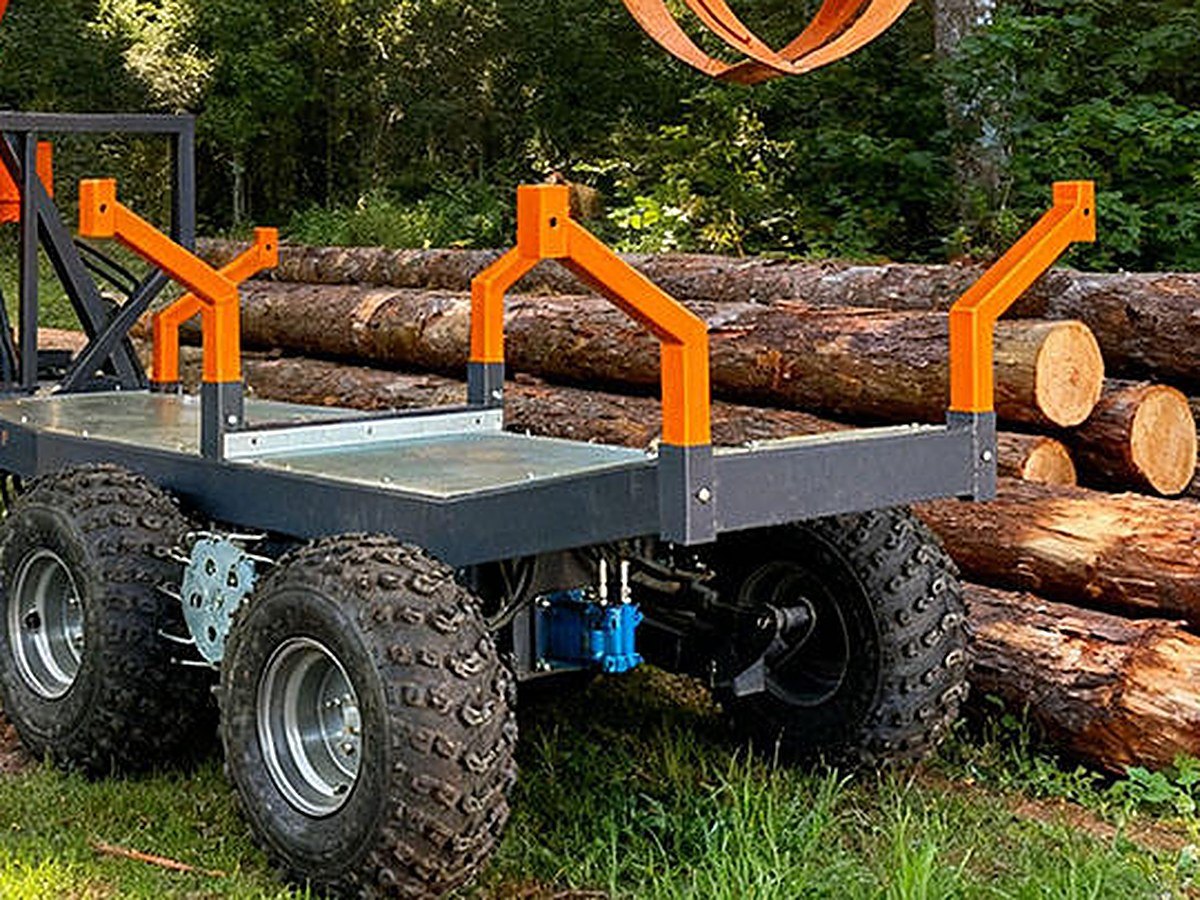
Bunk width: read the overall width, then ask for the drawing
Bunk width is the clear distance between the stake posts, and it decides two things at once: the largest diameter that sits inside the stakes instead of hanging over them, and how much of the trailer's track width is actually load-bearing deck.
The JERRY sheet publishes overall width with wheels — 1,440 mm on the JRT03 and JRT03A, 1,344 mm on the JRT03B — and the loading area length of 2,120 mm, extendable to 3,520 mm on the first two models. It does not publish the clear bunk width. That is deliberate on a machine sold in several configurations: the stake setting is confirmed on the order drawing, because a buyer running 4 m sawlogs and a buyer running 2 m firewood rounds do not need the same deck.
What to do with the numbers that are published: compare overall width with the track you have to drive. At 1,344 mm to 1,440 mm the trailer clears a standard 1.5 m forest track gate with little margin, so measure the narrowest point on your route before choosing. Then ask for the dimensioned drawing and confirm three values in writing: clear width between stakes, deck height from ground, and the maximum log diameter that the stake spacing accepts without overhang.
Axle rating is not the same number as payload
The published max load — 1,500 kg on the JRT03, 2,000 kg on the JRT03A and JRT03B — is the payload the trailer is designed to carry. An axle beam rating is a different number: it is the load the axle itself is certified for, and it is normally higher than payload because it has to carry the trailer's own weight as well. JERRY does not publish an axle beam rating or a tyre load index on the product page, so this article does not estimate one.
Two published figures let a buyer check the package without guessing. Trailer weight is 270 kg, 390 kg and 565 kg across the three models, so a fully loaded JRT03B is carrying roughly 2,565 kg over its axles. Standard wheels are 22 × 11-10 on the JRT03 and JRT03A, and 25 × 10-12 on the JRT03B — the larger tyre on the heavier model, which is consistent with the higher payload.
When you request a quotation, ask for the axle nameplate rating and the tyre load index in writing, and check them against the 2,565 kg figure rather than against payload alone. Also confirm the coupling: the published front plate is 1,100 × 700 mm on all three models, and the towing eye or ball coupling is confirmed per order because drawbar standards differ between markets.
Grapple reach: 3.4 m and 200 kg have to be read together
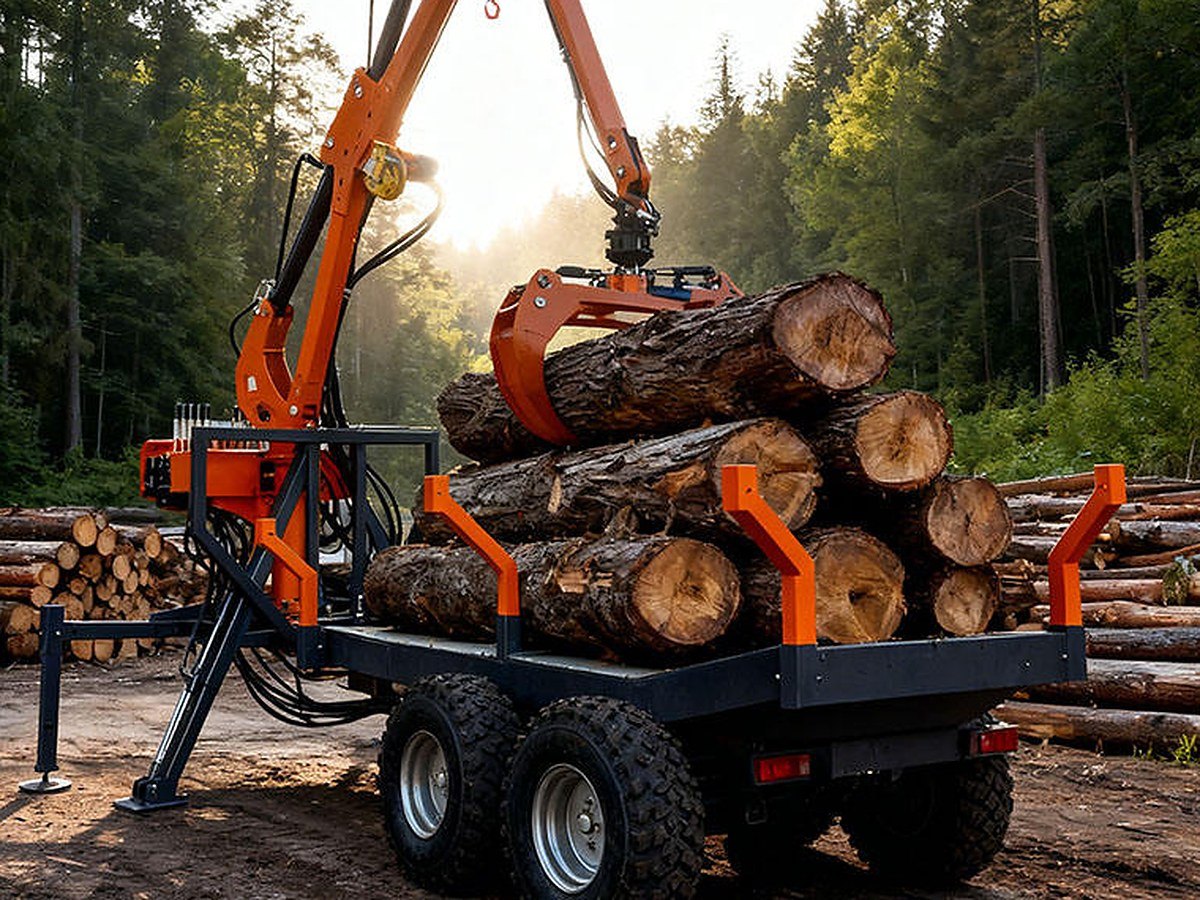
A reach figure on its own tells you where the grapple can go, not what it can pick up there. JERRY publishes both numbers for the same point: 3.4 m maximum reach, and 200 kg lifting capacity at that reach. That is the conservative end of the crane's capability, because capacity rises as the grapple comes closer to the mast — a curve the sheet does not publish, and one this article does not invent.
What 200 kg at full reach means in logs, using green softwood at about 800 kg/m³ and a 3.0 m log length:
| Log diameter | Volume, 3.0 m long | Mass at 800 kg/m³ | Mass at 1,000 kg/m³ | Inside 200 kg at 3.4 m? |
|---|---|---|---|---|
| 250 mm | 0.147 m³ | 118 kg | 147 kg | Yes |
| 300 mm | 0.212 m³ | 170 kg | 212 kg | Yes in softwood, no in dense hardwood |
| 325 mm | 0.249 m³ | 199 kg | 249 kg | At the limit in softwood |
| 400 mm | 0.377 m³ | 302 kg | 377 kg | No |
Calculation method: cylinder volume (π/4 × diameter² × length) multiplied by green log density. Densities of 800 kg/m³ and 1,000 kg/m³ are working assumptions for green softwood and dense hardwood, not measured values for your timber. The practical reading is that a 3 m log of about 325 mm is the size a full-reach pick covers, and anything larger should be picked closer in or cut shorter. Ask the factory for the load chart if your operation routinely lifts 400 mm logs.
How many logs per grab: the 0.08 m² jaw area in practice
The grapple opens to 700 mm and encloses 0.08 m². Opening sets the largest single log; area sets how many logs of a given size close in one grab. Dividing 0.08 m² by the cross-section of each log gives the count:
| Log diameter | Cross-section | Logs per grab inside 0.08 m² |
|---|---|---|
| 150 mm | 0.0177 m² | 4 logs (0.0707 m²) |
| 200 mm | 0.0314 m² | 2 logs (0.0628 m²) |
| 250 mm | 0.0491 m² | 1 log (0.0491 m²) |
| 300 mm and above | 0.0707 m² and above | 1 log |
This is where cycle time is decided. A thinning operation running 150 mm pulpwood moves four stems per grab; a sawlog operation running 300 mm moves one. The 360° crane rotation and two swing cylinders matter more as log size goes up, because each turn carries more mass and the operator cannot make up time by taking bigger bites. On a deck with 2,120 mm of loading length, a 300 mm sawlog operation and a 150 mm pulpwood operation will fill the same bunk in very different numbers of crane cycles.
Bunk volume against payload: which limit binds first
The deck is rated 1.6 to 3 m³ depending on how the stakes are set. That volume figure counts stacked wood, including the air between logs. At an assumed 65 per cent solid content:
| Stacked volume | Solid wood at 65% | Mass at 800 kg/m³ | Mass at 1,000 kg/m³ |
|---|---|---|---|
| 1.6 m³ | 1.04 m³ | 832 kg | 1,040 kg |
| 2.5 m³ | 1.63 m³ | 1,300 kg | 1,625 kg |
| 3.0 m³ | 1.95 m³ | 1,560 kg | 1,950 kg |
On the 2,000 kg models the 3 m³ deck fills before the payload limit is reached at both densities, so the bunk is the practical constraint. On the 1,500 kg JRT03 the order reverses: a 3 m³ load of softwood at 1,560 kg is already over the 1,500 kg payload, so payload binds first and the operator loads to weight, not to the top of the stakes. This is the single most useful reason to choose between the models by timber density rather than by deck size.
Stakes: two sets or three
The JRT03 and JRT03A are published with two stake sets, the JRT03B with three. More stake sets divide the same 2,120 mm deck into shorter bays, which holds a mixed load of short lengths more securely and gives the crane more tie points when the bunk is unevenly loaded. On a single-length operation the third set adds little; on a firewood or mixed sawlog yard it is the difference between a load that travels and a load that shifts.
Hydraulic flow and valve count change the feel, not the geometry
All three models share the same crane geometry, so the difference between them sits in the hydraulic package. The JRT03 runs a 6.5 HP engine and 7.5 L/min through a 5/7 valve set. The JRT03A and JRT03B run 9 HP and 14.4 L/min through 7/9 sets, and the JRT03B adds a second 2/4 block for the remote trailer functions.
Nearly double the flow through the same cylinders means faster boom and grapple movement at the same working pressure of 18–22 MPa. For an operator loading 300 mm sawlogs one at a time, that is time saved on every one of the cycles counted above. For occasional use on a smallholding, the 7.5 L/min package covers the same work with a smaller engine.
Track width against overall length
Overall width with wheels is 1,440 mm on the JRT03 and JRT03A and 1,344 mm on the JRT03B; overall length is 3,230 mm and 3,350 mm respectively. Width divided by length gives 0.446 and 0.401 — the JRT03B is the narrower and longer of the two, which is the more stable proportion on a side slope, and also the one that needs more room to turn at the end of a rack.
Ground clearance is 200 mm on all three models, which is the figure to compare against the ruts and stumps on your extraction route. Below 200 mm of clearance, a loaded trailer starts dragging its frame before it loses traction.
Remote 4WD, telescopic frame and ±45° swing
The JRT03 has no remote drive. The JRT03A and JRT03B add remote 4WD, which moves the trailer under its own power while the operator stands at the controls rather than returning to the towing vehicle for every repositioning. The JRT03B adds a remote telescopic frame and ±45° remote swing, so the deck itself can be extended or angled from the control position.
Those functions are worth their weight in two situations: loading on a landing where the towing vehicle cannot get close to the pile, and unloading into a stack that has to be built from more than one angle. They are also the reason the JRT03B weighs 565 kg against 270 kg for the JRT03 — weight that has to be towed whether or not the remote functions are used that day.
Container loading: 24 or 15 units per 40" high cube
The published container figure is 24 units per 40" high cube for the JRT03 and JRT03A, and 15 for the JRT03B. The difference follows from the remote telescopic frame and the third stake set, which prevent the same nesting. For a dealer ordering a mixed container, that ratio decides how the order is split; for a single-unit buyer it is simply the reason a 40" high cube is not the lowest-cost way to ship one machine.
Frequently asked questions
What is the bunk width of the JERRY log trailer?
Clear bunk width is not published on the product page, which lists overall width with wheels at 1,440 mm for the JRT03 and JRT03A and 1,344 mm for the JRT03B. The clear width between stakes is confirmed on the dimensioned drawing for each order, because the stake setting is built to the buyer's log length.
Can the crane lift a 500 mm log at full reach?
Not at 3.4 m. A 3.0 m log of 500 mm in green softwood is about 471 kg, well above the 200 kg rated at full reach on all three models. A log that size is picked closer to the mast, where capacity is higher, or cut shorter before loading. The capacity curve below 3.4 m is not published; request it if your operation handles large diameters.
Does the trailer come with CE certification?
Yes. JERRY machines are supplied with CE certification, and the factory in Zibo, Shandong has been audited by TÜV Rheinland. Petrol engines are supplied to EPA and Stage V requirements. Certificate copies are provided with the shipping documents.
What is the minimum order quantity and where does it ship from?
MOQ is one set. Machines ship from Qingdao port under FOB, CFR, CIF or EXW terms, and the 40" high cube loading figures above are 24 units for the JRT03 and JRT03A and 15 for the JRT03B.
How is the log trailer coupled to the towing vehicle?
The front plate is 1,100 × 700 mm on all three models. The coupling itself — drawbar eye, ball or clevis — is confirmed per order, because towing standards differ between markets. Send the coupling type and the towing vehicle's drawbar height with the enquiry.
Key facts
Crane: 3.4 m maximum reach, 200 kg lifting capacity at 3.4 m, 360° rotation, two swing cylinders, 18–22 MPa working pressure.
Grapple: 700 mm opening, 0.08 m² area, hydraulic rotator rated 1 t (10 kN) with unlimited rotation.
Payload: 1,500 kg on the JRT03; 2,000 kg on the JRT03A and JRT03B.
Envelope: 3,230 mm long and 1,440 mm wide on the JRT03 and JRT03A; 3,350 mm long and 1,344 mm wide on the JRT03B; 1,600 mm high on all three; 200 mm ground clearance.
Deck: 2,120 mm loading area, extendable to 3,520 mm on the JRT03 and JRT03A; 1.6–3 m³ volume; two stake sets on the first two models, three on the JRT03B.
Wheels: 22 × 11-10 standard on the JRT03 and JRT03A; 25 × 10-12 on the JRT03B.
Hydraulics: 6.5 HP and 7.5 L/min on the JRT03; 9 HP and 14.4 L/min on the JRT03A and JRT03B.
Not published, request in writing: clear bunk width, axle beam rating, tyre load index, lifting capacity below 3.4 m reach.
Trade: MOQ 1 set, Qingdao port, FOB / CFR / CIF / EXW, CE certification, TÜV Rheinland factory audit, Verified Custom Manufacturer.
Choosing between JRT03, JRT03A and JRT03B
Choose the JRT03 for a single-length operation on a smallholding, where the 1,500 kg payload matches the timber and the towing vehicle stays within reach of the pile. Choose the JRT03A where the deck has to carry 2,000 kg and the operator needs remote 4WD to reposition without returning to the vehicle. Choose the JRT03B where the deck has to be extended, angled or loaded from more than one side, and where the 1,344 mm width and 3,350 mm length suit the racks you actually drive.
The three models share one crane, so the choice is about payload, deck configuration and remote functions — not about lifting geometry. Full specifications are on the log trailer with crane page. Two earlier articles cover the related decisions: grapple rotation and stability under load, and wheel-drive assist on log trailers. The first pass on what to compare beyond price covers payload against trailer weight and hydraulic flow in more detail.
Send your log length, typical diameter, timber density and towing vehicle to jerry@jerry-sawmill.com for a model recommendation and a freight quotation from Qingdao. Specifications and list prices for the full range are at forest-machinery.com.