Shipping Forestry Machinery from China: FOB vs CIF vs CFR vs EXW
FOB, CFR and CIF all transfer risk to the buyer at the moment the machine is loaded on board in Qingdao; the difference is only who books and pays the main carriage. EXW transfers risk at our factory in Zibo, before export clearance. FOB is the most common term for a single sawmill or splitter, CIF suits buyers who want one invoice covering freight and minimum insurance, and CFR is CIF without the insurance.
Those four terms carry most forestry machinery sold from China, and most disputes about them come from the same misunderstanding: buyers assume a term that includes freight also includes risk until the machine reaches their yard. It does not. This article sets out what each term covers on a band sawmill, log splitter or firewood processor, how the machine should be packed and loaded, which documents travel with it, and where the real cost differences sit.
The four terms side by side
The table below reflects the Incoterms 2020 rules. Read the "risk passes" row first, because it decides who argues with the insurance company if a container is dropped in Singapore.
| Point | EXW (Zibo) | FOB (Qingdao) | CFR (destination port) | CIF (destination port) |
|---|---|---|---|---|
| Who arranges export clearance | Buyer in principle | Seller | Seller | Seller |
| Who pays inland transport to the port | Buyer | Seller | Seller | Seller |
| Who books and pays ocean freight | Buyer | Buyer | Seller | Seller |
| Who arranges cargo insurance | Buyer | Buyer | Buyer | Seller, minimum cover |
| Risk passes to buyer | At the factory, goods at buyer's disposal | When goods are on board the vessel | When goods are on board the vessel | When goods are on board the vessel |
| Cost passes to buyer | At the factory | On board the vessel | On arrival at destination port | On arrival at destination port |
| Typical fit | Buyer has its own China agent and consolidation | Buyer has a forwarder and a freight rate | Buyer wants freight priced by the seller but insures itself | Buyer wants one landed-at-port figure |
Two rows matter more than the rest. Under CFR and CIF the seller pays the freight, but the risk still leaves the seller at Qingdao. If the vessel is delayed, the container is wetted or the cargo is discharged at the wrong terminal, the buyer owns that problem - and under CFR the buyer also owns it without insurance unless it bought cover separately.
What each term looks like on a real order
EXW: the machine leaves Zibo on your truck
Under EXW the buyer collects at our factory in Zibo, Shandong. That means the buyer, or its agent, handles export declaration, books the truck to Qingdao, and deals with any terminal charges. For a buyer with a permanent sourcing office in China this is clean and cheap. For a first-time importer it usually is not: export clearance is done in Chinese, the customs broker is the buyer's contract, and a documentation error becomes the buyer's delay.
EXW also starts the risk clock earliest. Once the machine is lifted onto the buyer's truck at the factory gate, damage in transit is the buyer's claim against its own carrier. If you choose EXW, inspect and photograph the machine before it is loaded, and make sure your carrier has cargo insurance that starts at the factory, not at the port.
FOB Qingdao: the default for single machines
FOB Qingdao is what most of our single-machine orders use, and it is the term we recommend when the buyer already has a forwarder. We handle export declaration, inland haulage to Qingdao, terminal handling at origin and loading on board. The buyer pays ocean freight and insurance, and chooses the sailing.
The practical advantage is control of the freight contract. A buyer shipping five containers a year to Lagos or Vancouver already has a rate and a broker; adding our freight would only add a margin. The practical disadvantage is that the buyer must be ready: a machine sitting at the terminal because the buyer's booking is late starts accruing storage, and storage at origin is not covered by anyone's cargo insurance.
CFR: we book the ship, you carry the risk
CFR means we pay the ocean freight to the named destination port. The risk still passes on board in Qingdao, and insurance is the buyer's job. CFR makes sense when the buyer wants a single freight-inclusive price but has its own cargo insurer and prefers its own policy wording - which is common with buyers who ship regularly and insure an annual turnover rather than individual shipments.
Ask for the booking confirmation and the sailing date before you assume CFR means "arranged". The term obliges the seller to contract for carriage on usual terms to the named port; it does not oblige the seller to choose the fastest routing or the newest vessel.
CIF: freight plus minimum insurance
CIF adds one thing to CFR: the seller must arrange cargo insurance for the buyer's benefit. Under Incoterms 2020 that cover is a minimum, normally Institute Cargo Clauses (C), and it is 110 percent of the contract value. Clause C is a named-perils cover. It pays for total loss, and for the listed events, but it does not cover the ordinary handling damage that a crate with a band saw head inside is most likely to suffer.
This is the single most misunderstood point in the whole set. CIF does not mean "insured against everything until it arrives". If the machine matters to your production schedule, either upgrade the cover to Institute Cargo Clauses (A) - which is arranged in minutes and priced as a small percentage of the value - or buy your own policy and use CFR instead.
Packing decides more claims than the Incoterm does
Ocean freight is a wet, vibrating, salt-laden environment, and a forestry machine is a heavy steel structure with exposed machined surfaces. Under any of the four terms, the packing standard is the seller's obligation up to the point where risk passes, so it is worth agreeing in writing before the order is placed.
Three things belong in the specification for a sea shipment. First, a plywood crate or a fully closed case, not an open frame: a band saw head or a hydraulic valve block should not be visible to whatever is stacked next to it. Second, moisture control inside the case - a VCI film or emitter for machined surfaces, and desiccant sized to the internal volume, because a steel crate interior in a container crossing the tropics will condense water on the first cold night. Third, restraint: the machine is bolted to a skid or to the container floor, with the saw head, conveyor and log lifter locked in their transport position.
Surface treatment is part of the same argument. On JERRY machines the non-wear surfaces are powder coated and every contact surface - bunks, feed rails, clamp jaws, conveyor rollers - is hot-dip galvanized, so the parts that cannot hold a paint film are protected by zinc rather than by paint. That matters most in exactly the weeks a machine spends in a container. The two finishes and their behaviour in wet climates are explained in powder coating vs painting and galvanized contact surfaces.
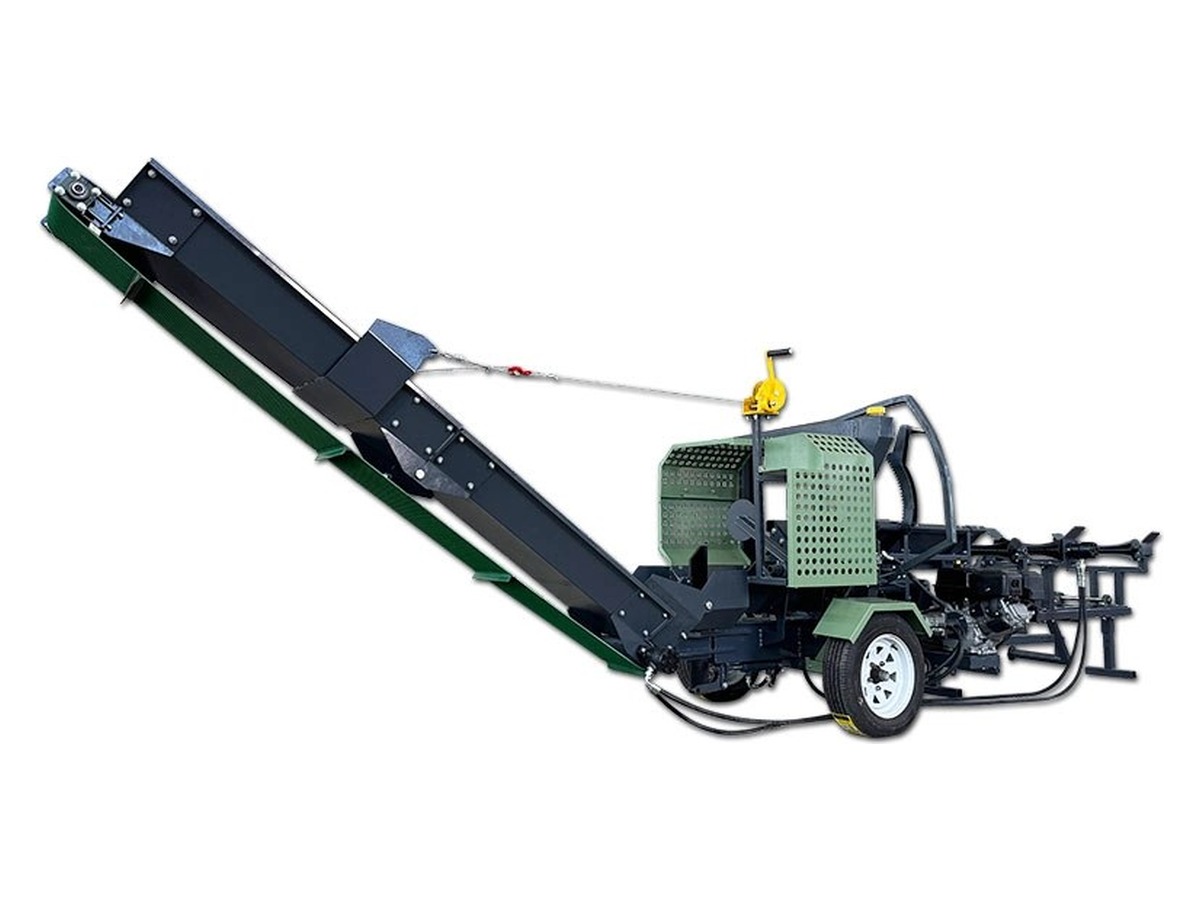
Ask the supplier for photographs of the packed unit, with the crate closed and with the machine inside before closing. Those photographs are the single most useful document if a claim is ever filed, because they fix the condition at the point where risk passed.
Loading arithmetic: does it fit, and how many
Freight is quoted per container or per cubic metre, so the loading plan drives the price at least as much as the term does. The method is simple: take the packed dimensions and gross weight of each unit, divide the usable container volume by the packed volume, then check the result against the payload limit and against whether the units can actually be stacked.
| Worked example | Figure | Note |
|---|---|---|
| Unit | 30T automatic kindling splitter | Fully automatic kindling machine |
| Packed size | 2520 x 1720 x 1630 mm | 0.91 t net machine weight |
| Packed volume | about 7.1 m3 per unit | 2.52 x 1.72 x 1.63 m |
| Nominal 20GP internal volume | about 33 m3 | Internal length about 5.9 m |
| By volume alone | 4 units | Not stacking, not accounting for lashing space |
| Practical planning figure | 3 units per 20GP | Leave room for lashing, dunnage and door clearance |
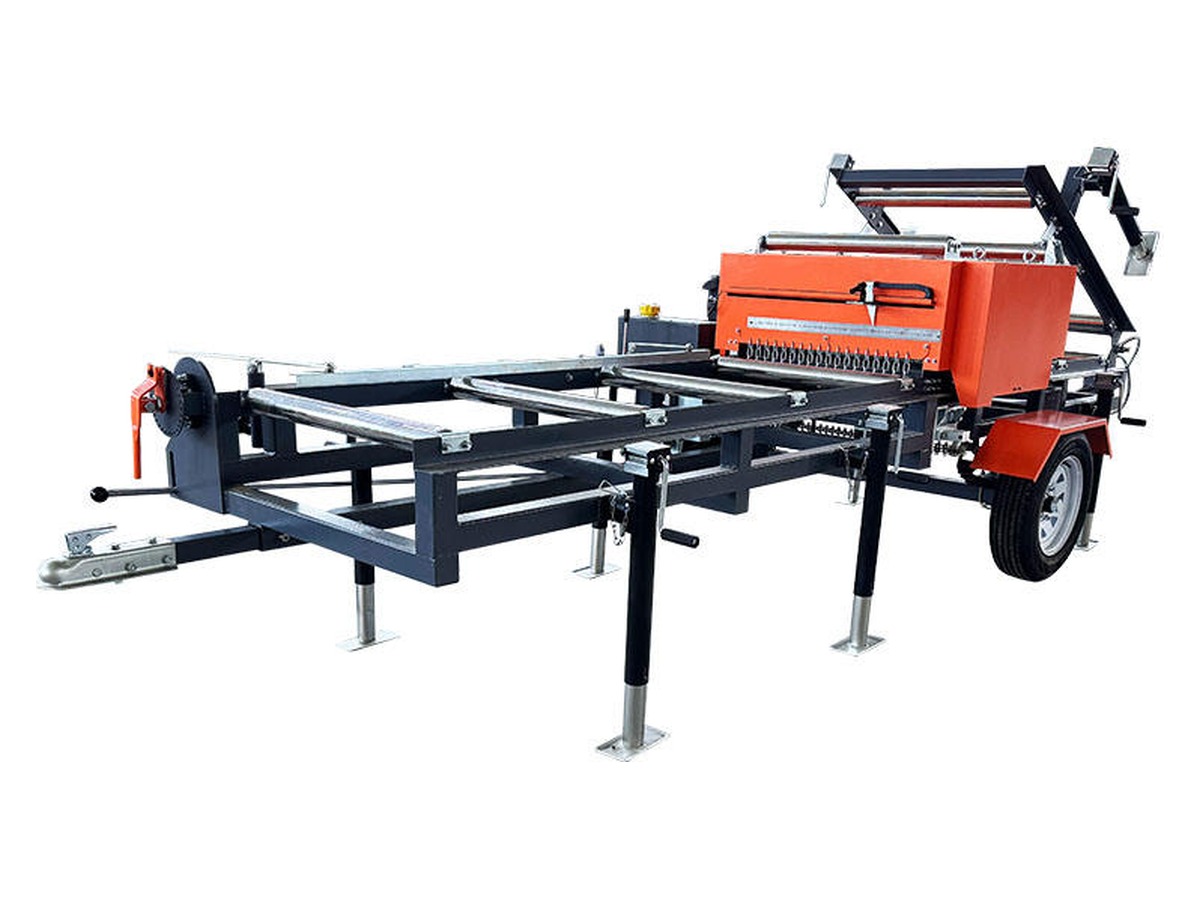
Treat that table as arithmetic, not as a loading plan. A 40HQ roughly doubles the nominal volume but does not double the number of units if the machine cannot be stacked, and heavy machines hit the payload limit before they fill the box. For a portable band sawmill on its trailer, length is usually the constraint rather than weight. The final plan comes from the forwarder, and it should be confirmed before the price in a CIF or CFR quotation is fixed.
Two loading habits are worth insisting on regardless of term. Stuffing should be photographed, and the loading list should record what went into which container, because a mixed container of a sawmill, an edger and spare parts is easy to miscount at destination. And the machine should be braced against fore-and-aft movement, not only side to side: a container ship pitching in a head sea loads a crate along its length.
Documents that should travel with the machine
The commercial documents are the same under all four terms - commercial invoice, packing list, bill of lading or sea waybill, and a certificate of origin where the destination requires one. What changes with the term is who is named as shipper on the bill of lading and who pays the origin charges.
The technical documents are the ones buyers underestimate. A machine entering the EU needs a CE marking and an EU declaration of conformity, and the declaration has to reference the directives and standards applied. A machine with a gasoline engine entering the United States needs EPA certification for the engine, and a machine sold into the EU needs Stage V documentation for the engine fitted. On JERRY machines the certification position is: CE for the machine; EPA for gasoline engines; EU Stage V for gasoline and diesel engines; a TÜV Rheinland factory audit; and Verified Custom Manufacturer status. Those documents should be checked against the engine actually fitted to your unit, because a diesel-powered machine and a gasoline-powered machine do not carry the same emission paperwork.
Spare parts and tooling belong on the packing list as separate line items, with their own values. A crate of blades inside a machine container that appears on no document is a customs question at destination, and it is the kind of question that turns a two-day clearance into two weeks.
Questions buyers ask about shipping terms
Which term should I choose for one sawmill?
FOB Qingdao if you have a forwarder you already use, because you keep control of the freight rate and the sailing. CIF if you want one price at the port and do not yet have a freight relationship - but check the insurance clause and upgrade it to (A) cover if the machine is critical to your schedule. EXW only if you have a China-based agent who handles export clearance.
Is CIF insurance enough if the machine is damaged?
Often not. The default cover under CIF is a minimum, typically Institute Cargo Clauses (C), which is a named-perils cover rather than all-risks. Handling damage, water damage short of total loss and theft are the exposures that matter for crated machinery, and they are better covered by Clauses (A). The upgrade is inexpensive relative to the value of a commercial sawmill.
Who pays for the machine sitting at the terminal?
Whoever owns the cost at that point under the term. Under FOB the buyer owns the freight contract, so a late booking or a missed sailing is a buyer cost. Under CFR and CIF the seller has contracted the carriage, so the seller is the one dealing with the carrier - but storage caused by the buyer's late import documents is still the buyer's problem. Agree the free time at destination before the container sails.
Can you ship several machines in one container?
Yes, and it is usually the cheapest way to move a mixed order such as a sawmill with an edger and a spare blade set. The constraint is physical: packed dimensions, stacking, and the payload limit of the container. Send the machine list and we will return a loading proposal with the container type, the packed volume and the total gross weight for your forwarder to price.
What is the minimum order?
MOQ is 1 set, and the same four terms apply to a single machine as to a mixed container. Shipment is from Qingdao; the factory is in Zibo, Shandong.
Does the term affect the warranty?
The Incoterm decides where risk and cost pass, not what is covered afterwards. What matters for a warranty claim is the condition record at the point risk passed: the packed photographs, the container stuffing photographs and the survey report at destination if there is a dispute. Keep all three.
Key facts
Trade terms: EXW, FOB, CFR and CIF under Incoterms 2020; FOB and CIF quoted from Qingdao.
Port of shipment: Qingdao, China. Factory: Zibo, Shandong, China.
MOQ: 1 set, for a single machine or a mixed container.
Risk transfer: EXW at the factory; FOB, CFR and CIF on board the vessel at Qingdao.
Insurance under CIF: arranged by the seller for the buyer's benefit, minimum cover, normally Institute Cargo Clauses (C), 110 percent of contract value. Clauses (A) available on request.
Packing: plywood crate or closed case, VCI protection and desiccant for machined surfaces, machine bolted to skid or container floor, moving assemblies locked in transport position.
Finishes relevant to sea freight: powder-coated non-wear surfaces; hot-dip galvanized contact surfaces - bunks, feed rails, clamp jaws, conveyor rollers.
Certification: CE; EPA for gasoline engines; EU Stage V for gasoline and diesel engines; TÜV Rheinland factory audit; Verified Custom Manufacturer.
Documents: commercial invoice, packing list, bill of lading, certificate of origin where required, CE declaration of conformity, engine emission documentation for the engine fitted.
Get a quotation on the term you actually use
Send us the machine or machine list, the destination port, and whether you want the price under EXW, FOB Qingdao, CFR or CIF. We will come back with the packed dimensions and gross weight of each unit, so your forwarder can price the carriage against real numbers rather than an estimate, and with the certification documents that apply to the engine and voltage you specify.
Email jerry@jerry-sawmill.com or visit forest-machinery.com with your model list and destination port.