Galvanized Contact Surfaces: Rust Protection in Wet Climates
Rust on forestry machinery starts where wet wood, grit and steel rub together, not on the painted panels. JERRY powder-coats the non-wear surfaces and hot-dip galvanizes the contact surfaces - sawmill bed frames and bunks, log trailer decks, processor feed rails, clamp jaws and conveyor rollers - so the parts that cannot keep a paint film are protected by zinc instead.
Why paint fails exactly where wood touches steel
A paint or powder film is a barrier. It works as long as it is continuous, and it stops working the moment the film is broken, because bare steel in the presence of water and oxygen starts to corrode immediately. On a forestry machine the film is broken constantly, and in the same places every day.
Green timber is abrasive. A log dragging across a sawmill bed carries sand, grit and bark with it, and that slurry acts like grinding paste on whatever it passes over. The contact patch on a bunk or a deck plate can lose a 100-micrometre paint film in a single season of daily work. Once the film is gone the steel is bare, and the rust front then creeps back under the remaining coating from the edge, lifting it off in flakes.
Zinc behaves differently. It is anodic to steel, which means that where the coating is scratched the zinc around the scratch corrodes first and protects the exposed steel next to it. That sacrificial action is the reason a galvanized surface tolerates the abrasion that destroys a paint film, and it is why the finish decision on a forestry machine is really a decision about which surfaces will be rubbed.
The three corrosion zones on a forestry machine
Zone 1 - the wear path
This is the obvious one: the sawmill bed rails and log bunks, the trailer deck, the infeed chute and feed rails of a firewood processor, the splitting table of a log splitter. These surfaces see sliding timber, chain tension and constant abrasion. Any coating here must be able to lose material and still protect the steel underneath.
Zone 2 - the water trap
Less obvious, and usually the first place a machine actually perforates. Water sits in overlaps, inside box sections, under deck plates, behind stake pockets and in the gap between a bracket and the frame. A machine parked outside collects condensation every clear night even when it never rains, because the steel cools faster than the air around it. Paint cannot reach the inside of a closed section properly, so the steel rusts from the inside out and the failure only becomes visible when the paint blisters.
Zone 3 - the fastener interface
Every bolt that clamps two parts together creates a crevice, and every tightening action cracks the coating around the washer face. A painted frame held together by untreated bolts rusts at the bolt heads first, and a rusting bolt loses preload. This is why fasteners and contact plates belong in the same protection system as the structure, not outside it.
Two finishes, two jobs
JERRY does not apply one finish to a whole machine. The finish follows the function of the part:
| Surface type | Finish | Why |
|---|---|---|
| Covers, guards, tanks, folded sheet panels | Electrostatic powder coating, oven cured | Thick, continuous film that covers edges and folds; colour-stable outdoors; resists stone chips |
| Sawmill bed and track frames, log bunks, trailer deck plates, stake posts, processor feed rails and clamp jaws, conveyor rollers | Hot-dip galvanizing | Zinc-iron layer that survives abrasion and keeps protecting at scratches |
| Scale rulers, board-edger feed rollers, some guard hardware | Stainless steel | No coating to wear off in a high-friction, high-moisture position |
| Blades, chains, guide bars, hydraulic piston rods, pins | Oil and grease, no coating | A coating here would be destroyed by the working motion; lubrication is the protection |
What is galvanized on each machine
Sawmills
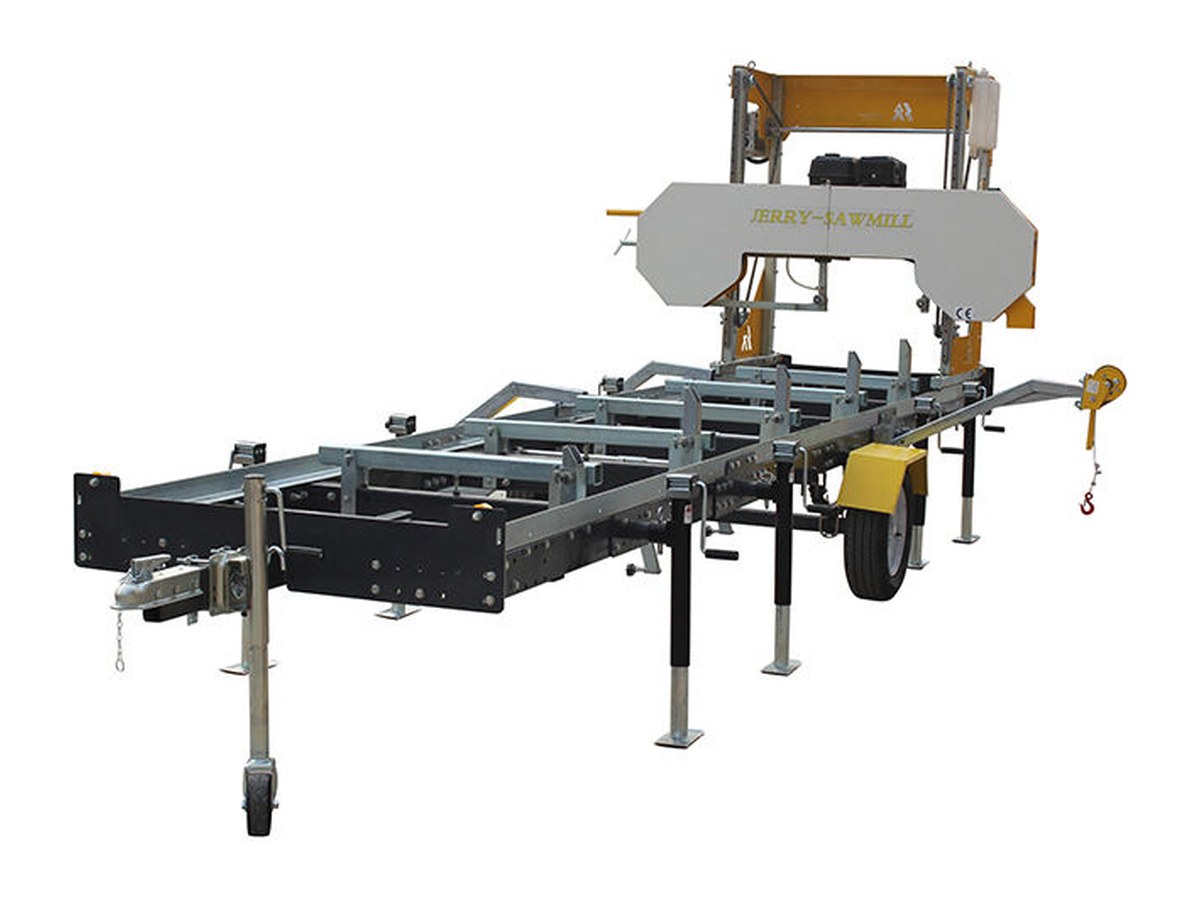
On the portable and commercial band sawmills the parts that carry the log are galvanized: the bed and track frame, the log bunks and side supports, and the bracket plates that tie the track sections together. The saw head carriage, guards and covers are powder coated. On the commercial machines the hardened rails themselves are a separate matter - they are 58-63 HRC through-hardened steel, machined so that the rail seat thickness tolerance stays inside 0.01 mm - and a coating would be wrong there, because the rail has to present bare, hard, flat steel to the guide blocks. The galvanizing protects the structure around the rail, not the rail face.
Log splitters and firewood processors
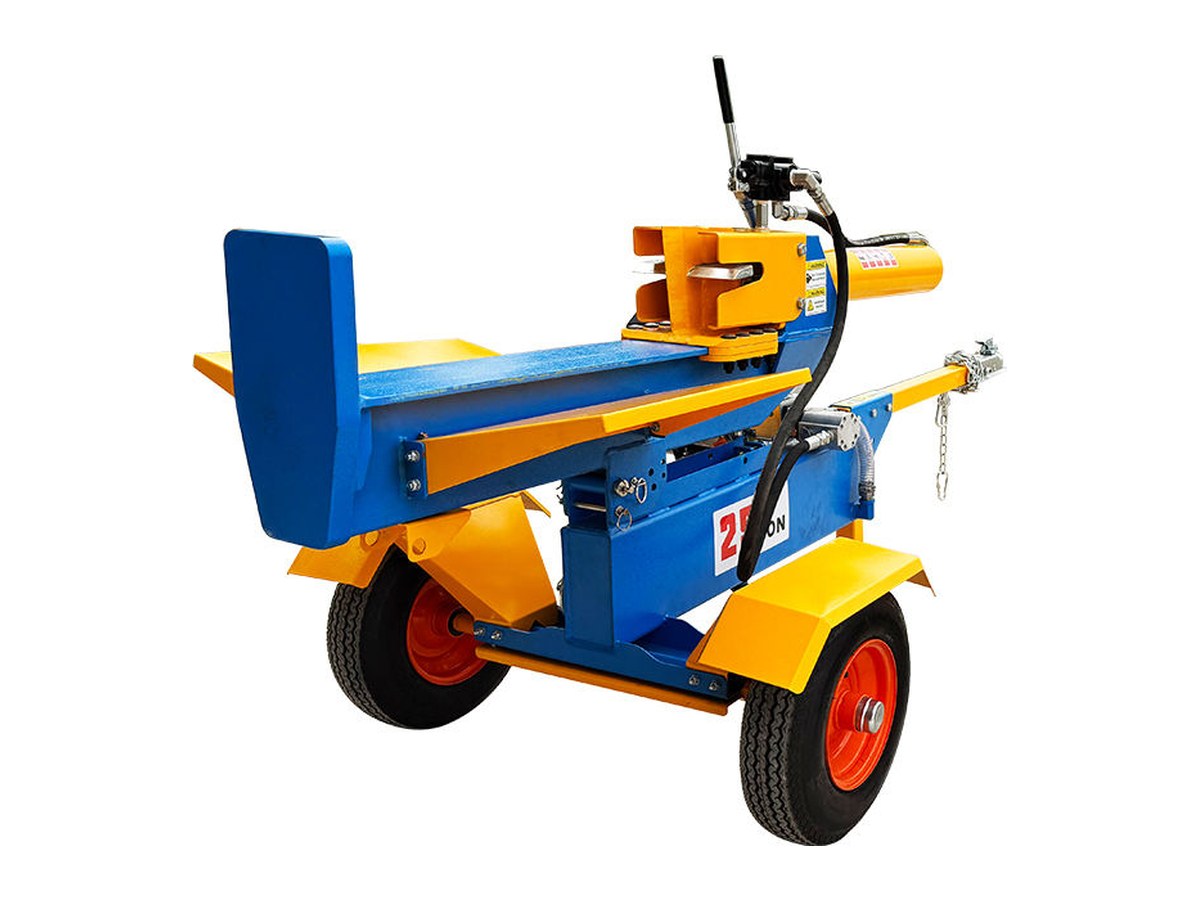
On a splitter the splitting table and the log cradle are galvanized, because they see wet roundwood and chain contact all day. On a firewood processor the protection matters most at the feed rails, the hydraulic clamp jaws and the discharge conveyor rollers - three places where wet chips pack against steel and stay wet. The conveyor rollers on our processors are galvanized, the side plates above the log path are stainless, and the frame and guards are powder coated. The hydraulic clamp jaws are galvanized rather than painted because a painted jaw loses its film against bark within weeks.
Log trailers and board edgers
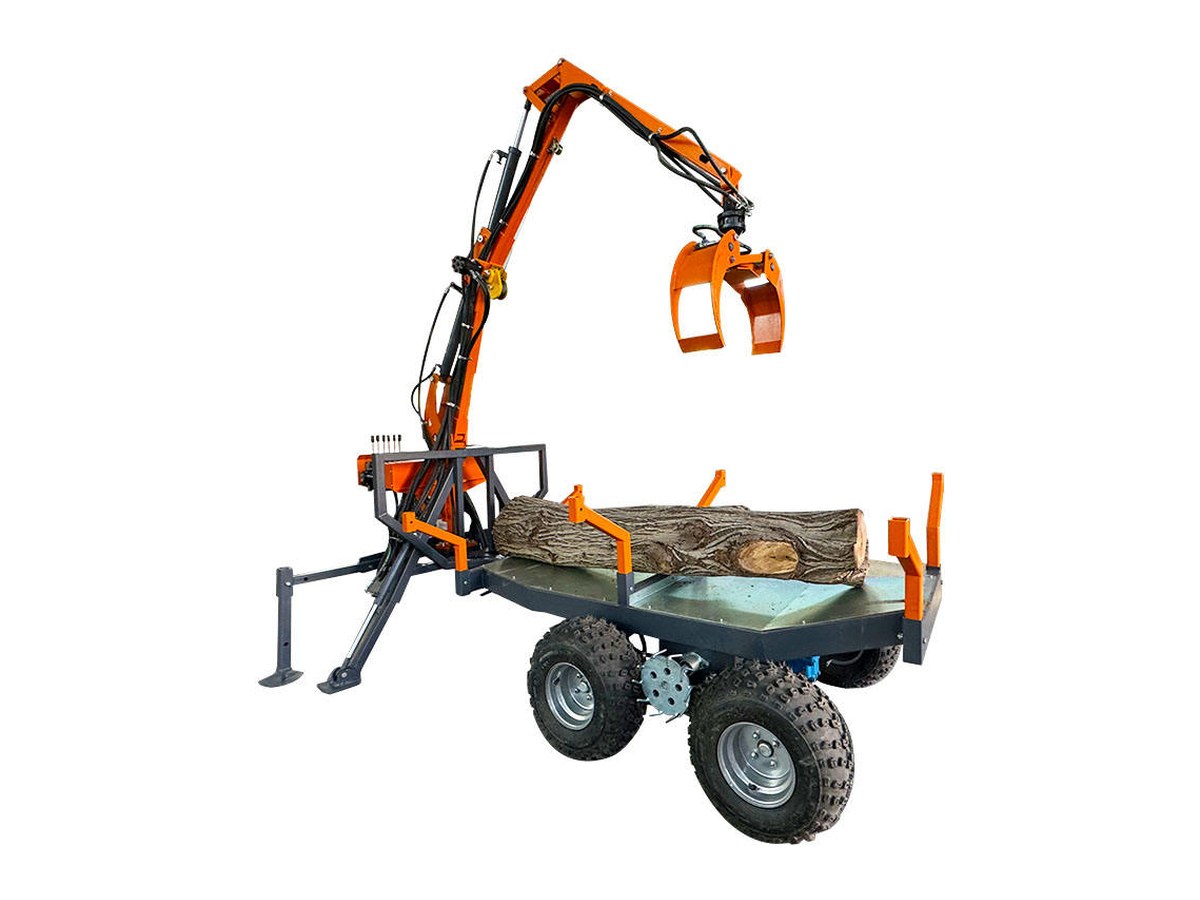
On a log trailer with crane, the deck plate, stake posts and hydraulic support legs are galvanized; the crane boom and the grapple body are powder coated, with the grapple rotating on a machined pivot rather than a coated one. On a board edger the infeed and outfeed rollers are stainless and the anti-kickback chains are stainless, because both sit in the wettest, most abrasive part of the machine.
Hot-dip, electro-galvanized and zinc-rich paint are not the same thing
The word "galvanized" covers three different processes, and only one of them belongs on a wear surface.
Hot-dip galvanizing immerses the finished part in molten zinc. The zinc reacts with the steel and forms zinc-iron alloy layers that are metallurgically bonded, typically tens of micrometres thick. It is the most abrasion-resistant of the three, and it is what we specify for frames, decks and bunks.
Electro-galvanizing plates a thin zinc layer onto sheet steel in an electrolytic bath, usually in single-digit micrometres. It is uniform and dimensionally neutral, which makes it right for thin sheet and small hardware, and too thin for a surface that slides timber.
Zinc-rich paint is a paint loaded with zinc dust. It is the correct product for repairing damaged galvanizing in the field, and it is not a substitute for hot-dip on a new part.
There is a practical constraint on hot-dip too: the molten zinc is around 450 degrees Celsius, so thin panels and precision-machined parts can distort. That is exactly why the split in the table above exists. Hot-dip goes on structural plate and heavy section, powder goes on cosmetic sheet, and machined surfaces stay bare and oiled.
The sea voyage is the wettest part of the machine's life
A machine shipped from Qingdao to a tropical port spends weeks inside a steel container that cycles between hot days and cold nights. Moisture migrates through the container floor and the pallet timber, condenses on the coldest steel surface overnight, and runs down. In the trade this is called container rain, and it does more corrosion damage than the destination climate does in the first year.
Three things limit it, and they are worth asking about on any quotation:
Desiccant capacity matched to the container volume, not a token bag per machine.
Void fill and stretch wrapping that stops the machine moving and stops wet pallet wood touching bare steel.
Drain and vent holes left open, and no trapped water inside box sections before the doors close.
On arrival, open the container and ventilate it the same day, and inspect within the first 48 hours. A white or grey powdery film on galvanized steel is zinc hydroxide - storage stain - and it is a surface deposit, not a failure; it brushes off. Red-brown rust is base metal corrosion and should be photographed and raised with the supplier before the machine goes into service.
Field repair that does not trap moisture
Galvanizing is repairable, but the repair has to be done in the right order:
Clean back to sound metal or sound zinc. Wire brush, grinding disc or a needle descaler - not a paint scraper.
Remove all chloride residue with fresh water and let the surface dry fully. Salt left under a new coating restarts the corrosion.
Apply a zinc-rich primer to bare steel, then a topcoat if the part is visible or sees abrasion.
Replace fasteners rather than reusing them. A plain steel bolt in a galvanized plate makes a galvanic couple, and the bolt goes first.
Two habits shorten the life of any coating system: washing galvanized parts with an acidic cleaner, and painting directly over rust. Neither is recoverable later.
What galvanizing does not do
It is worth being precise about the limits, because a coating system sold as universal is a coating system that disappoints.
It does not protect cutting edges, saw blades, chains or guide bars. Those need daily oiling and inspection, and no coating survives the cutting action.
It does not survive continuous immersion, or contact with acid and fertilizer. A machine used to handle treated timber or stored next to silage will still corrode, whatever the finish.
It does not resist impact damage. A forklift strike during unloading dents the steel and cracks the zinc-iron layer, and that spot needs the field repair above.
It is not a substitute for grease. Pins, pivot bushes and cylinder rods still need a lubrication schedule, and dry pins wear out long before any coating fails.
Specifying for your climate
| Operating climate | What matters most | Practical specification |
|---|---|---|
| Tropical, high rainfall (Southeast Asia, West Africa, Pacific) | Constant wet timber and no drying period | Hot-dip galvanized deck, bunks and feed rails; stainless rollers; monthly inspection of fasteners |
| Coastal salt air (Caribbean, Gulf coast, Mediterranean islands) | Chloride attack on every exposed edge | Galvanized structure plus stainless fasteners; fresh-water rinse of the undercarriage after each storm season |
| Snow and road salt | Salt spray thrown up from the road | Galvanized frame and deck; wash the underside when the machine comes off the trailer |
| Dry continental or highland | Abrasion more than moisture | Powder coating is adequate on panels; galvanizing still pays at bunks and deck plates |
The cheapest time to specify a galvanized deck or stainless roller set is when the order is placed. Retrofitting a deck plate after the machine is in the yard costs more than the original upgrade, because the frame has to come apart.
Frequently asked questions
Will galvanized surfaces still rust in a tropical climate?
The zinc corrodes, but slowly, and it protects the steel while it does. Expect the surface to turn from bright silver to dull grey within the first year outdoors; that is normal. What matters is that no red rust appears at welds, cut edges or bolt holes. Inspect those three places twice a year.
Can I paint over galvanized steel to match the machine colour?
Yes, but not with ordinary paint straight onto new zinc. New galvanizing has a smooth, slightly reactive surface that ordinary paint does not grip; it needs a sweep blast or an appropriate pre-treatment and a primer specified for galvanized substrate. On our machines the galvanized parts are left unpainted on purpose, because a painted contact surface is a surface that will peel.
Is powder coating or galvanizing the better finish?
They solve different problems. Powder coating gives a thick, uniform, colour-stable film on parts that are looked at and not rubbed. Galvanizing gives sacrificial protection on parts that are rubbed, bolted and exposed to standing water. A machine that uses only one of them is either peeling at the deck or dull grey where the buyer expects paint.
How do I check the galvanizing when the machine arrives?
Look for a uniform dull-silver appearance with no bare patches, and check that welds, cut edges and bolt holes are covered. A magnetic coating thickness gauge will read the zinc layer in micrometres if you want a number for your records. Photograph anything that looks like red rust rather than white storage stain, and raise it before commissioning.
What are the order terms and certifications?
Minimum order quantity is 1 set. Machines ship from Qingdao under FOB, CFR, CIF or EXW, and the factory is in Zibo, Shandong. CE certification covers the machines; gasoline-powered units also carry EPA, and the engine range is available with EU Stage V (Euro 5) compliance. The factory holds a TÜV Rheinland audit and Verified Custom Manufacturer status. Commercial sawmills can be specified with our patented pre-cut debarker, which opens the bark and grit layer ahead of the main blade.
Key facts
Coating split: powder coating on non-wear panels and guards; hot-dip galvanizing on timber-contact surfaces
Galvanized parts: sawmill bed and track frames, log bunks and side supports, trailer deck plates and stake posts, processor feed rails, hydraulic clamp jaws, conveyor rollers
Stainless parts: sawmill scale rulers, board-edger feed rollers, anti-kickback chains, processor log-path side plates
Fasteners: galvanized or stainless at every contact plate, to avoid a galvanic couple
Related tolerances: 58-63 HRC hardened rails on commercial sawmills, 0.01 mm rail seat thickness tolerance, 0.3-0.5 mm finished board tolerance
Certification: CE; EPA on gasoline engines; EU Stage V (Euro 5) available
Factory: Zibo, Shandong, China; TÜV Rheinland audited; Verified Custom Manufacturer
Trade terms: MOQ 1 set; FOB Qingdao, CFR, CIF, EXW
Choosing the right machine for a wet site
If your yard stays wet for months, the finish question is only half of the specification. Deck height, bunk spacing, roller material and drainage all change how much water the machine holds after a shift. Send us the log diameter range, the species, the annual volume and a description of the site - rainfall, salt exposure, whether the machine sleeps indoors - and we will recommend a model and a surface specification to match. Machines are quoted FOB Qingdao, CFR, CIF or EXW, minimum order 1 set.
Email: jerry@jerry-sawmill.com
Website: forest-machinery.com
Related reading: Powder Coating vs Painting on Forestry Machinery and What 58-63 HRC Track Hardness Means for Board Tolerance.