Powder Coating vs Painting on Forestry Machinery
Powder coating is a dry finish sprayed electrostatically onto bare or phosphated steel and cured in an oven; wet painting is a liquid primer and topcoat sprayed on and dried. On forestry machinery the practical split is: powder for covers, guards and folded sheet-metal panels, wet paint for large weldments and field touch-up, and hot-dip galvanizing for any surface that stays in contact with wet timber.
What powder coating actually is
Powder coating starts with a bare steel part. It is degreased, rinsed and usually phosphated so the surface has something for the film to grip. The part is then earthed and passed through a spray booth where a gun charges dry powder - polyester, epoxy or a hybrid - at roughly 60 to 100 kV. The charged particles wrap the part and cling to it electrostatically, including the backs and edges that a spray gun would never reach from one angle.
The coated part then goes into a curing oven. Typical polyester powders flow and cross-link between 180 and 200 degrees Celsius for ten to fifteen minutes of metal temperature. The film that comes out is between 60 and 120 micrometres thick, hard, and continuous over edges because it was attracted there rather than sprayed there.
There is no solvent to evaporate, so one coat does the work of a primer plus a topcoat in most outdoor applications, and the film does not shrink back off sharp edges the way a thin liquid coat does.
What wet painting actually is
Wet painting is a liquid system: a primer for adhesion and corrosion inhibition, then a colour coat for UV and appearance. It can be air-dried at ambient temperature or low-baked, and it can be applied with a conventional gun, an airless unit or, for large weldments, a roller in a repair bay.
The advantages are real and they are different from powder. Liquid paint can be applied to a 4-metre weldment that will never fit in an oven. It can be tinted to any RAL shade in small batches. It can be sprayed over a repaired area in the field, and it can be touched up with a brush on a machine that is already in the forest.
Side-by-side comparison
| Property | Powder coating | Wet paint |
|---|---|---|
| Film build per pass | 60-120 micrometres in one application | 25-40 micrometres per coat; usually two to three coats |
| Edge coverage | Good - electrostatic attraction pulls powder onto edges | Weaker - liquid pulls back from sharp edges as it dries |
| Impact and chip resistance | High, because the film is thick and cross-linked | Moderate; depends on primer quality and total film build |
| Solvent content | None | Present; needs ventilation and drying time |
| Size limit | Part must fit the curing oven | No practical size limit |
| Small-batch colour change | Needs a dedicated batch and booth clean-down | Easy; tint to any shade on the spot |
| Field repair | Not possible in the field; a damaged panel is recoated or replaced | Straightforward with matched touch-up paint |
| UV stability | Good with polyester powders; epoxy powders chalk in sunlight | Good with an aliphatic topcoat; poor with cheap enamels |
| Best use on a forestry machine | Covers, guards, tanks, folded panels, crane components | Large weldments, chassis repairs, on-site touch-up |
Where each finish belongs on a forestry machine
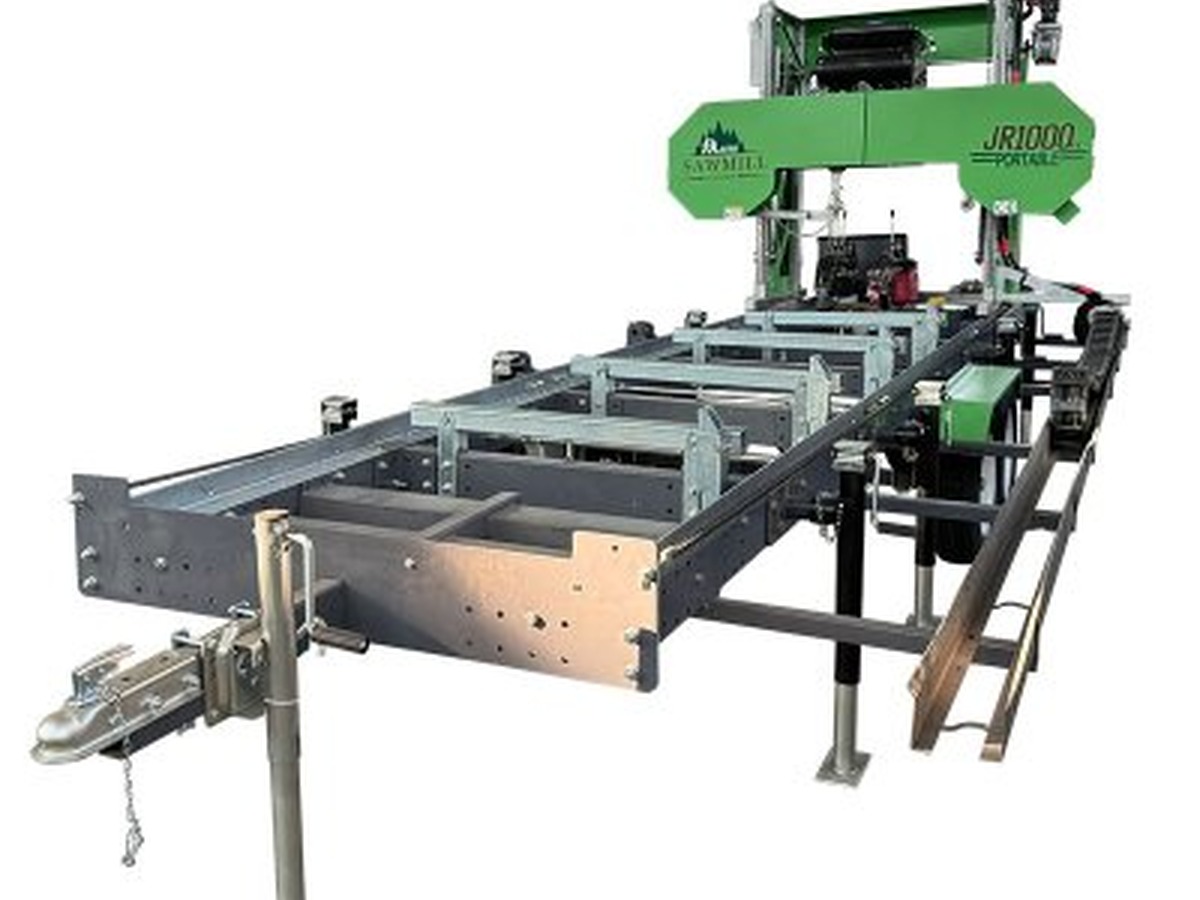
A log splitter, a band sawmill, a firewood processor or a log trailer is not one surface. It is a collection of surfaces that see different abuse, and the finish should follow the abuse rather than the catalogue.
Covers, guards and folded panels
These are the parts a buyer looks at, and they are also the parts that rust first, because they are thin. Folded sheet metal takes powder coating well: the film reaches the fold, the edges are covered, and the panel resists stone chips from a tractor throwing gravel. This is where powder earns its cost.
Large weldments and chassis
A welded main frame with gussets and brackets does not fit in a standard oven, and the inside corners are impossible to cover evenly with powder anyway. Wet paint with a zinc-rich primer is the practical answer here, applied after shot blasting, with a colour coat on top.
Contact surfaces
Anywhere green timber slides - the deck of a trailer, the bed of a sawmill, the infeed chute of a processor - paint is the wrong answer, because a paint film wears through in a season and then the steel starts. Hot-dip galvanizing puts a zinc-iron layer on the steel that sacrifices itself instead of the base metal, and it survives abrasion far better than a 100-micrometre film.
What we do at Jierui
On our own machines the finish is chosen per part rather than per product:
Covers, guards, crane arms and folded panels are powder coated in polyester, cured in an oven, and checked for film thickness and adhesion before assembly.
Main frames and large weldments are shot blasted and wet painted with a primer and a colour coat.
Decks, chutes and other timber-contact surfaces are galvanized rather than painted.
Fasteners and pivot pins are zinc plated so that a painted component is not held together by rusting hardware.
That combination is the reason a machine can sit outside between jobs without the panels bubbling, while the deck that sees wet logs every day still has its zinc layer after a season.
Choosing for a wet climate
If the machine will work in snow, coastal air or a yard that never dries out, the finish decision matters more than the colour. Three things drive corrosion on a forestry machine: standing water in a crevice, abrasion that opens the film, and dissimilar metals in contact.
Powder coating handles the first two well on panels because the film is thick and continuous. It does less well at the third, because a coated bolt thread is not a protected thread - which is why plating and galvanizing belong in the same conversation as paint.
What about chips and scratches
Powder resists chipping better than a thin enamel film, but when it does fail it fails locally: a chip exposes bare steel and the rust creeps under the film edge. The repair is a matched touch-up paint, applied after cleaning back to sound coating. Every machine we ship carries a colour code so the buyer can order the same shade locally.
Frequently asked questions
Is powder coating always better than paint?
No. It is the stronger choice on folded panels that fit an oven and see abrasion. It is the weaker choice on very large weldments, on parts that will be repaired in the field, and on anything that needs a colour matched in a small batch.
Can a powder-coated part be repainted?
Yes, after abrading and priming the surface, but it is a workshop job. The usual field repair is touch-up paint on the damaged spot rather than a full recoat.
How thick is the coating on your machines?
Powder-coated panels are specified in the 60 to 120 micrometre range and checked with a magnetic gauge during production. Galvanized contact surfaces are measured by coating weight rather than by micrometres, because the zinc-iron layer is not a paint film.
Does galvanizing replace painting?
On contact surfaces, yes - it is the finish, not a primer. On visible panels it is usually left bare or painted over with a system designed for zinc substrates.
Which finish should I ask for on a machine that stays outside?
Powder-coated panels, a primed and top-coated frame, and galvanized timber-contact surfaces. Ask for the colour code as well, because the finish is only as good as your ability to repair it five years later.
Talk to us about the finish on your machine
We build sawmills, log splitters, firewood processors, board edgers and log trailers in Zibo, Shandong. Machines are CE certified, our factory is audited by TÜV Rheinland, and we are a Verified Custom Manufacturer on Alibaba.com. MOQ is one set, shipped from Qingdao on FOB, CFR, CIF or EXW terms.
Tell us where the machine will work and what it will handle, and we will tell you which parts are powder coated, which are painted and which are galvanized. Write to jerry@jerry-sawmill.com or call +86 188 6612 6681.