Log Trailer with Crane: How Grapple Rotation and Stability Work Under Load
A log trailer with crane uses a hydraulic grapple that rotates 360° continuously, so the operator can turn a log to the angle the deck needs without unhooking. Stability comes from the chassis, not the crane: two hydraulic telescopic legs carry the load into the ground before the boom lifts.
A crane on a trailer looks like the hard part. In practice the crane is a known quantity - the failures that stop a logging day are the grapple that will not rotate when a log is jammed against a stake, and the trailer that lifts a wheel because the legs were never deployed. Both are decided by design details that a spec sheet rarely prints. This is what actually matters.
What 360° grapple rotation changes in the field
The grapple is the only part of the machine that touches the log. If it can only swing a few degrees, the operator has to compensate with the boom, the swing cylinder and the trailer position - three controls to achieve what one rotation joint should do.
A continuous 360° rotator decouples the log angle from the boom angle. Three situations make the difference obvious:
Crosswise logs in a pile. A log lying at 60° to the trailer needs the grapple turned to match before the jaws close. Without rotation you drag the log sideways with the boom, and the tips dig into the pile.
Loading into a stake pocket. The log has to enter between two stakes at the deck's angle. Rotation lets the operator drop it straight down instead of sliding it in from the side and bending a stake.
Unloading onto a stack. Placing a log parallel to the ones already stacked needs the grapple to be turned relative to the boom at the moment of release.
The rotator on our trailers is a hydraulic unit with continuous rotation in both directions, mounted between the boom tip and the grapple body. There is no index position and no stop to bump against - the joint turns as far as the operator needs in either direction, which matters when a log has to be spun more than half a turn to line up with the deck.
The load path: grapple, boom, frame, legs, ground
Every kilogram the grapple picks up has to reach the ground somewhere. Follow it:
The jaws clamp the log. Clamping force comes from the grapple cylinder, not from the crane.
The rotator carries the log's weight in tension and the turning moment in torsion.
The boom and its cylinders carry the load back to the crane base.
The crane base bolts to the trailer frame, which is the stiffest part of the machine.
The frame hands the load to the tyres and to the stabilizer legs.
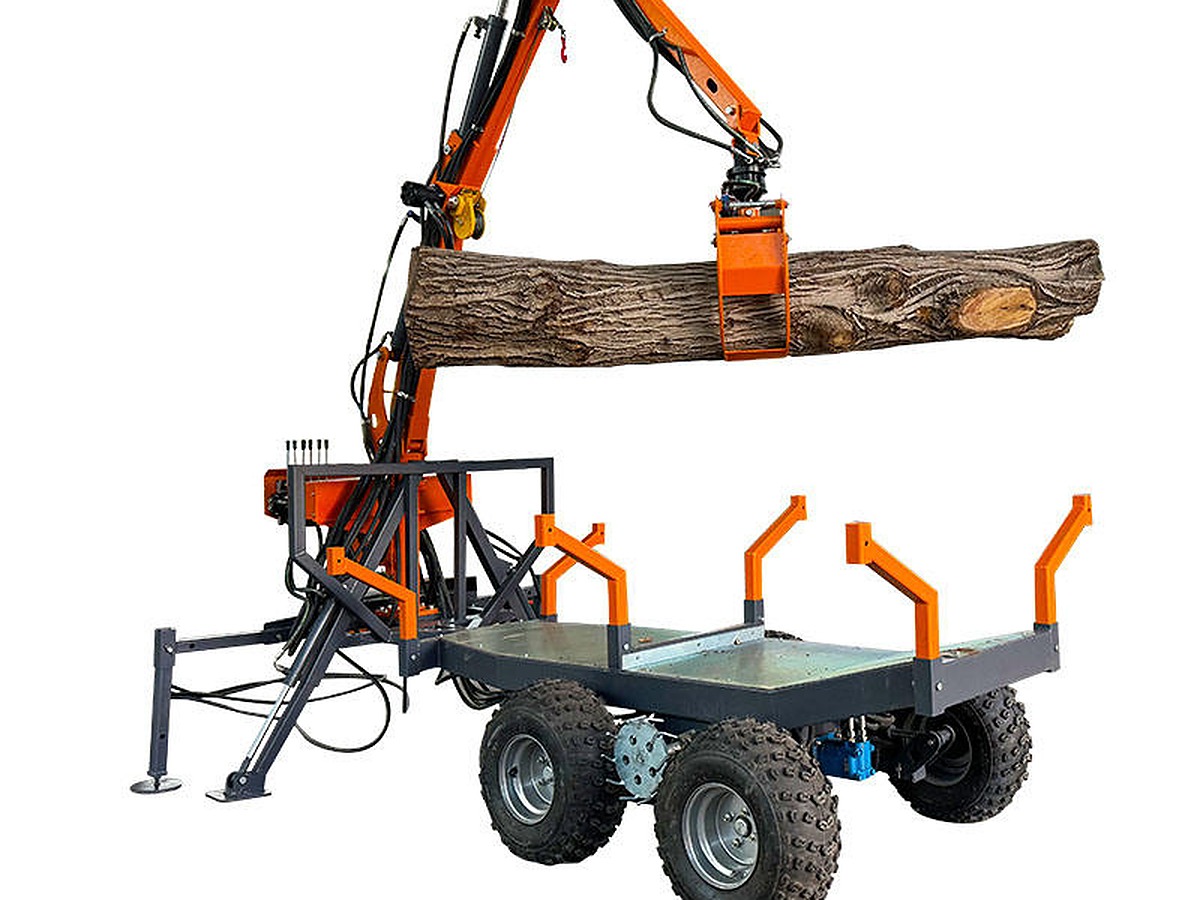
Steps one to four are steel and hydraulics. Step five is where trailers tip. A trailer with a crane and no legs has to resist the crane's overturning moment with its own weight and its track width. That works until the boom reaches out to the side, which is exactly when a log is being swung over the deck.
Why the stabilizer legs decide stability, not the crane rating
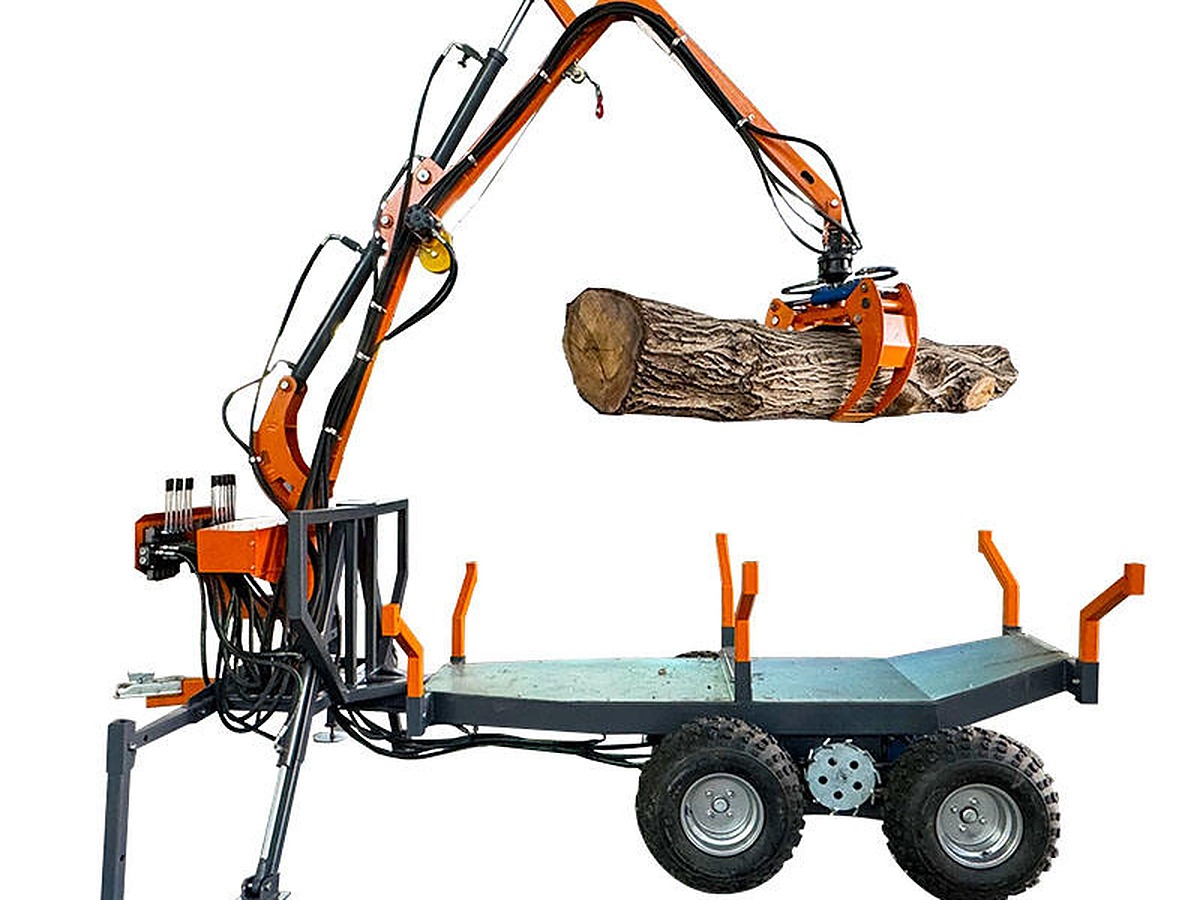
Our log trailers carry two hydraulic telescopic legs, one on each side, that extend down and take the frame load directly. Deploy them before the boom goes up, and the trailer stops behaving like a vehicle and starts behaving like a fixed crane base.
Three habits make the legs work:
Legs down before the first lift, not after the trailer feels light. By the time a wheel lifts, the load is already in the wrong place.
Legs on firm ground, with pads under them on soft soil. A leg that sinks is a leg that does nothing; on forest floor the pad area matters as much as the leg stroke.
Legs retracted before towing. A leg left down is the fastest way to bend a cylinder on a stump.
With the legs deployed the machine is rated to handle logs up to a 3-tonne payload on the deck, carried on a four-wheel heavy-duty chassis with mountain-pattern tyres. The payload figure is a deck figure - the crane lifts what the deck is rated to carry, one log at a time.
The drawbar that swings 30°: tracking, not steering
The drawbar on these trailers is not fixed to the frame. It pivots hydraulically about 30° to each side, which changes how the trailer follows the towing vehicle.
On a straight road this does nothing. In a stand of trees it does a lot: a fixed drawbar forces the trailer to cut the corner, and the wheels end up on the inside of the turn where the stumps are. A drawbar that swings lets the trailer track closer to the line the tractor took, and the operator can offset it deliberately when threading between trees.
It is also a loading aid. With the drawbar swung, the trailer can be parked at an angle to a log pile without repositioning the towing vehicle.
Wheel-drive assist: getting a loaded trailer out of mud
An empty trailer follows a tractor anywhere. A trailer with three tonnes of logs on it does not - the towing vehicle loses grip first, and no amount of throttle fixes it.
The wheel-drive assist system mounts heavy-duty drive discs between the trailer wheels, driven by a hydraulic motor. The discs clamp against the tyres and force them to turn. The trailer stops being a dead weight and starts pushing itself, which is the difference between unloading the deck by hand in the mud and driving out loaded.
It is a recovery and climbing aid, not a road system. Use it when the trailer is stuck or on a slope where the towing vehicle is spinning, then release it and tow normally.
Deck, stakes and the parts that take the abuse
The deck plate is galvanized and reinforced, because it is the surface that logs are dragged across all day. Galvanizing is the reason it survives wet logs and grit without the paint failing in the first season.
Raised stakes are optional. They increase the load volume the deck can hold, and they are the part most likely to be bent by a swung log - which is another argument for grapple rotation: a log that is turned before it enters the deck hits fewer stakes.
Everything above the deck is powder coated rather than painted. A powder coat is a single cured film that resists chipping at the corners where a painted frame loses its coating first.
What to check before you specify one
Six questions separate a trailer that earns its keep from one that sits in the yard:
| Check | Why it matters |
|---|---|
| Continuous rotation or indexed swing? | Continuous rotation lets the log be turned to any angle in either direction without a stop. |
| Legs hydraulic or manual? | Hydraulic legs are deployed from the operator position; manual legs get skipped when it rains. |
| Leg stroke versus ground clearance | Enough stroke to level the deck on uneven ground, enough clearance to tow. |
| Drawbar fixed or pivoting? | Fixed drawbars cut corners; pivoting drawbars track the towing line. |
| Wheel-drive assist or not | The deciding factor on wet ground and slopes, not on dry flatland. |
| Deck finish and stake option | Galvanized plate for wet logs; stakes for volume. |
Frequently asked questions
Can the grapple rotate a full turn with a log in the jaws?
Yes. The rotator is hydraulic and continuous, so the grapple turns with the log clamped. The limit is the load the rotator is rated for, not the number of degrees.
Do I need the stabilizer legs every time I lift a log?
Every time the boom swings a log over the deck, yes. The legs are what stop the crane's moment from reaching the tyres. Lifting a small log alongside the trailer with the legs up is a judgement call; swinging a full-length log over the deck is not.
What does the 3-tonne payload include?
It is the deck payload - the logs the trailer is rated to carry. The crane lifts one log at a time, and the log it lifts should be within that payload.
Does wheel-drive assist replace a bigger towing vehicle?
No. It supplements traction when the trailer is loaded and the ground is soft or sloped. The towing vehicle still has to be rated for the combined weight on the road.
Is the trailer CE certified?
Yes. The trailers are CE certified, and the factory has been audited by TÜV Rheinland. We are a Verified Custom Manufacturer on Alibaba.com, and the minimum order is 1 set, shipped from Qingdao on FOB, CFR, CIF or EXW terms.
Key facts - JERRY log trailer with crane
Grapple: hydraulic, continuous 360° rotation, heavy-duty jaws, powder coated
Stabilizer legs: hydraulic telescopic, both sides, deployed before lifting
Drawbar: hydraulically pivoting, about 30° to each side
Wheel-drive assist: hydraulic motor driving discs clamped to the trailer tyres
Deck: galvanized reinforced plate, optional raised stakes
Chassis: four-wheel heavy-duty, mountain-pattern tyres
Payload: 3 tonnes on the deck
Certification: CE; factory audited by TÜV Rheinland; Verified Custom Manufacturer
Trade: MOQ 1 set, Qingdao port, FOB / CFR / CIF / EXW
Factory: Zibo, Shandong, China
Specifying a trailer for your ground
Send the log diameter you handle, the towing vehicle, and whether the ground is dry flatland, mud, or slope. Those three answers decide the leg configuration, the drawbar and whether wheel-drive assist is worth having. We build to the requirement rather than to a catalogue number.
Email jerry@jerry-sawmill.com or visit forest-machinery.com for the specification sheet and current options.