Laser Guide Lines on Board Edgers: Cutting Waste on Every Board
A board edger with dual laser guide lines projects two red lines onto the infeed table, one for each saw blade. The operator aligns the wany edge to the lines before the board reaches the blades, so the trim allowance is set from what the board actually contains instead of being guessed at the moment of cut.
Every board that comes off a sawmill arrives at the edger with two edges the band could not square: one live edge still carrying bark, one wany edge where the cant tapered. Both have to go. The only question the edger operator answers, board after board, is how much has to go with them.
Why the wany edge decides the yield, not the saw
The blade does exactly what it is told. The waste is decided upstream of the blade, in the half second where the operator looks at a board and decides where to place it. A board 200 mm wide with 15 mm of wany on each side carries about 30 mm that must leave. Trim 40 mm to be safe and 10 mm of sound timber goes to chips on every single board.
Run that at scale: on a 200 mm wide, 25 mm thick, 3 m board, 10 mm of extra trim is 0.00075 m³ of lost timber per board, or 0.75 m³ across a thousand boards. It is not a dramatic number on one board. It is the number that separates an edger that pays for itself from one that quietly eats margin for a year.
What the two laser lines actually show
Two lines, not one, because there are two cut planes. The left line marks where the left blade will enter; the right line marks the right blade. The gap between them is the finished board width.
Projected at the infeed, so the decision is made before the board is under the blade hood, not while it is moving through it.
Red, because it holds contrast on pale sapwood and on dark, wet bark in the same pass.
Parallel to the blade plane. The lines are a reference for the blades, so blade spacing and line position have to be re-referenced together, never one without the other.
The practical effect is that the operator stops sighting along the board and starts placing the board against a fixed reference. Placement is repeatable; sighting along a 3 m board with a bark edge is not.
Where laser lines stop helping
Worth being straight about the limits, because a buyer who expects magic will blame the machine:
Dust on the lens. A line with a flour of sawdust across the emitter turns into a fuzzy band. Wipe the lens at every fuel or shift change.
Low sun across an outdoor infeed. Direct sunlight washes a red line out on pale timber. Orient the infeed or work the shaded side of the pile.
Very wet, very dark bark. Red on saturated bark loses contrast; the line is still there, it is just harder to read.
A knocked bracket. Lasers do not drift on their own, brackets do, especially after a road move. Re-check the line against the blade with a square after transport, before the first board.
Setting the blade spacing to match the batch
Blade spacing is adjusted through a handwheel-and-winch mechanism and locked before cutting. The efficient habit is to batch by width class rather than to reset the spacing for every board: sort the pile into two or three width bands, set the edger once per band, and let the laser lines handle the variation inside the band.
Keeping the board straight through the cut
A laser line is only useful if the board stays where it was placed. At the infeed, heavy stainless anti-kickback chains hang over the board. They do two jobs at once: they stop the board from climbing and skewing as the blades bite, and they block anything the blade tries to throw back at the operator.
Underneath, stainless transfer rollers carry the board without the galling and rust that plain steel develops in a wet yard. Stainless is not cosmetic here: a roller that rusts stops rolling, and a roller that stops rolling drags the board off the line.
Second pass without lifting the board
Some boards are not ready after one pass, usually a thick slab where the first trim leaves a sliver of bark on one corner. Return rollers set on top of the edger let the operator push the board back over the frame to the infeed and run it again, rather than carrying a 3 m board around the machine. On a heavy slab that is a two-person job turned into a one-person job.
Choosing power and chassis
The edger runs on petrol, diesel or electric drive. For a yard with single-phase power available at the infeed, electric removes fuel handling and exhaust from a workspace that is already dusty; for a yard that moves between sites, petrol or diesel keeps the machine independent.
The chassis uses road-rated tyres and is rated to 60 km/h for transport between yards, so the edger can follow the sawmill rather than sitting at one landing.
Where the cut actually starts
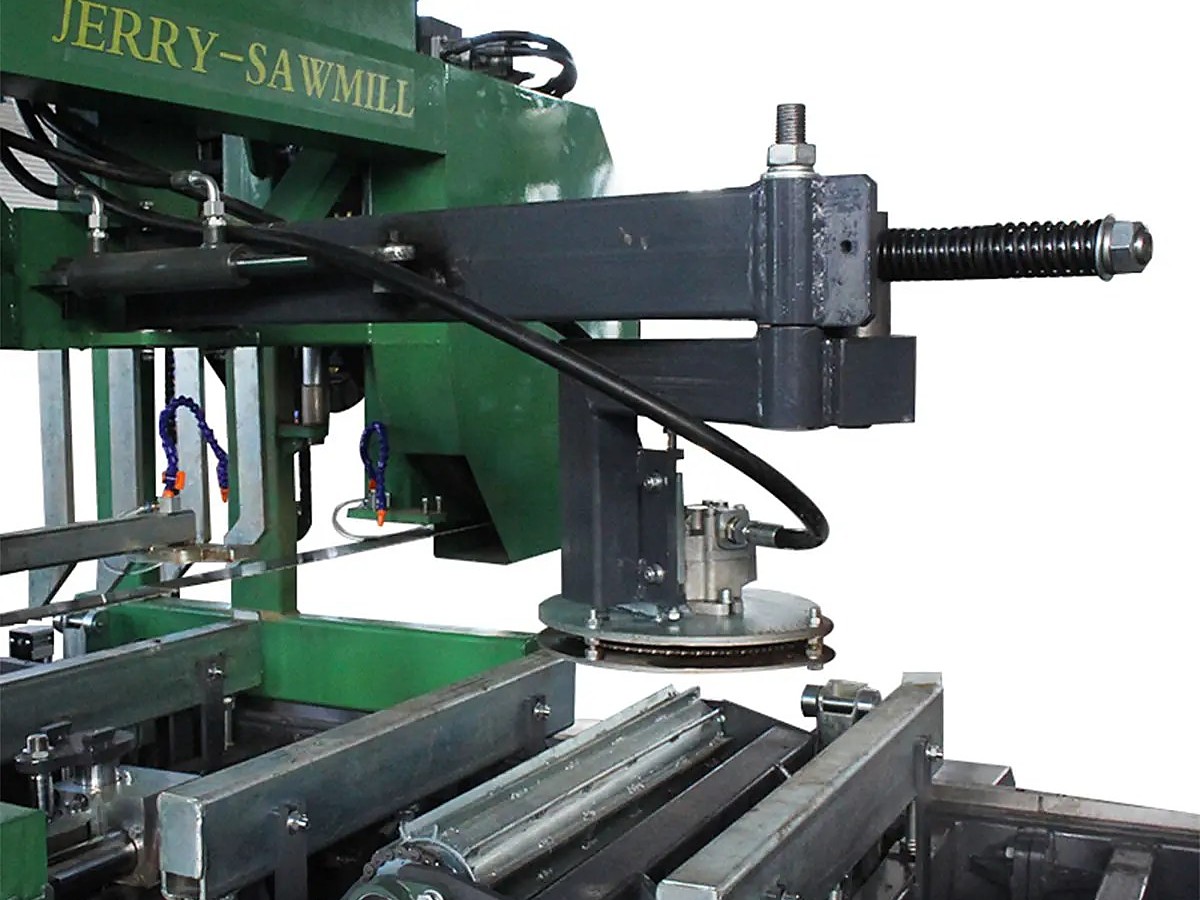
On a commercial line, the quality of the edge is decided before the edger by whatever is still on the surface of the log. Grit, sand and frozen dirt packed into bark blunt teeth faster than timber does. That is why the upstream machines carry a pre-cut station: a circular blade that opens the bark line ahead of the main cut, so the main blade meets clean wood.
Edger with laser lines, and without: what changes
| Decision point | Edger without guide lines | Edger with dual laser lines |
|---|---|---|
| Placement of a wany board | Sighted along the edge by eye | Placed against a fixed projected reference |
| Trim allowance | Operator adds margin to be safe | Margin set by the gap between the two lines |
| Repeatability across a shift | Drifts with fatigue and light | Constant while the bracket is true |
| Changeover to a new width | Re-sight and re-learn | Reset spacing, re-reference the lines once |
| Training a new operator | Weeks of judging by eye | Placing a board on a line |
Neither column makes a board wider than the log allows. The difference is whether the operator spends the available width or gives part of it away.
Questions buyers ask before ordering
Do the laser lines measure the board for me?
No. They show position, not dimension. The lines tell the operator where the blades will cut; the finished width is set by blade spacing. Measuring a board is still a tape job, and batched width classes are what make that cheap.
Can the lines be added to an edger we already own?
Send photographs of the infeed frame and the blade guards, and we will tell you what mounting the frame can take. It depends on the structure above the infeed table, not on the laser unit itself.
What happens to the line when we change blade spacing?
It has to be re-referenced. The lines are aimed relative to the blades, so any change in spacing, or any blade change that alters the blade plane, needs the lines re-checked against the blade with a square. It takes a minute and it is the step people skip.
Which drive should a small yard order?
Electric if single-phase power reaches the infeed and the machine stays put. Petrol or diesel if the edger has to move with the sawmill or work where there is no supply. Confirm the voltage and socket type for your country when ordering.
What is the minimum order and how does it ship?
MOQ is 1 set. Machines leave from Qingdao, on FOB, CFR, CIF or EXW terms as you prefer. The factory is in Zibo, Shandong.
Key facts
Cutting station: two circular saw blades, spacing set by handwheel and winch
Alignment: dual red laser guide lines projected at the infeed
Safety: stainless anti-kickback chains over the infeed
Board handling: stainless transfer rollers, return rollers on top for a second pass
Drive options: petrol, diesel or electric
Transport: road-rated tyres, 60 km/h
Certification: CE; TÜV Rheinland factory audit; Verified Custom Manufacturer
MOQ: 1 set · Port: Qingdao · Terms: FOB / CFR / CIF / EXW
Factory: Zibo, Shandong, China
Ask for the configuration that matches your board widths
Tell us the width range you edge, the board lengths you handle, and whether the machine stays in one yard or moves with the sawmill. We will come back with the blade spacing, drive option and infeed arrangement that fit that range, rather than a generic quotation.
Email: jerry@jerry-sawmill.com
Site: forest-machinery.com