What 58–63 HRC Track Hardness Means for Board Tolerance
Short answer: a 58–63 HRC track does not make boards accurate on its own. It stops the rail surface from deforming under the weight of the saw head and the log, so the head always travels on a stable datum — and that is what lets a commercial sawmill hold finished board thickness inside 0.3–0.5 mm.
Why track hardness is a tolerance problem, not a marketing number
Every cut puts load on the rail. The saw head, the blade tension and the log all push down through the carriage wheels onto a narrow strip of steel. Ordinary unhardened mild steel sits at roughly 18 HRC. Under that load it does not crack — it slowly indents and wears, a few hundredths of a millimetre at a time.
Those few hundredths matter, because the head sits on top of them. As the rail wears unevenly along its length, the head tilts by a small angle, and the same board comes out thicker at the head end than at the tail end. The operator compensates, the next log cuts differently, and the tolerance drifts.
A rail hardened to 58–63 HRC resists that indentation. The rail stays flat, the head keeps the same attitude from the first board to the thousandth, and the tolerance you measured on day one is still the tolerance you measure in month six.
The rail is only half of it: the mounting surface has to be machined
Hardness without flatness buys nothing. A hard rail bolted to a soft, unmachined frame simply transfers the frame's errors upward, and the head still tilts.
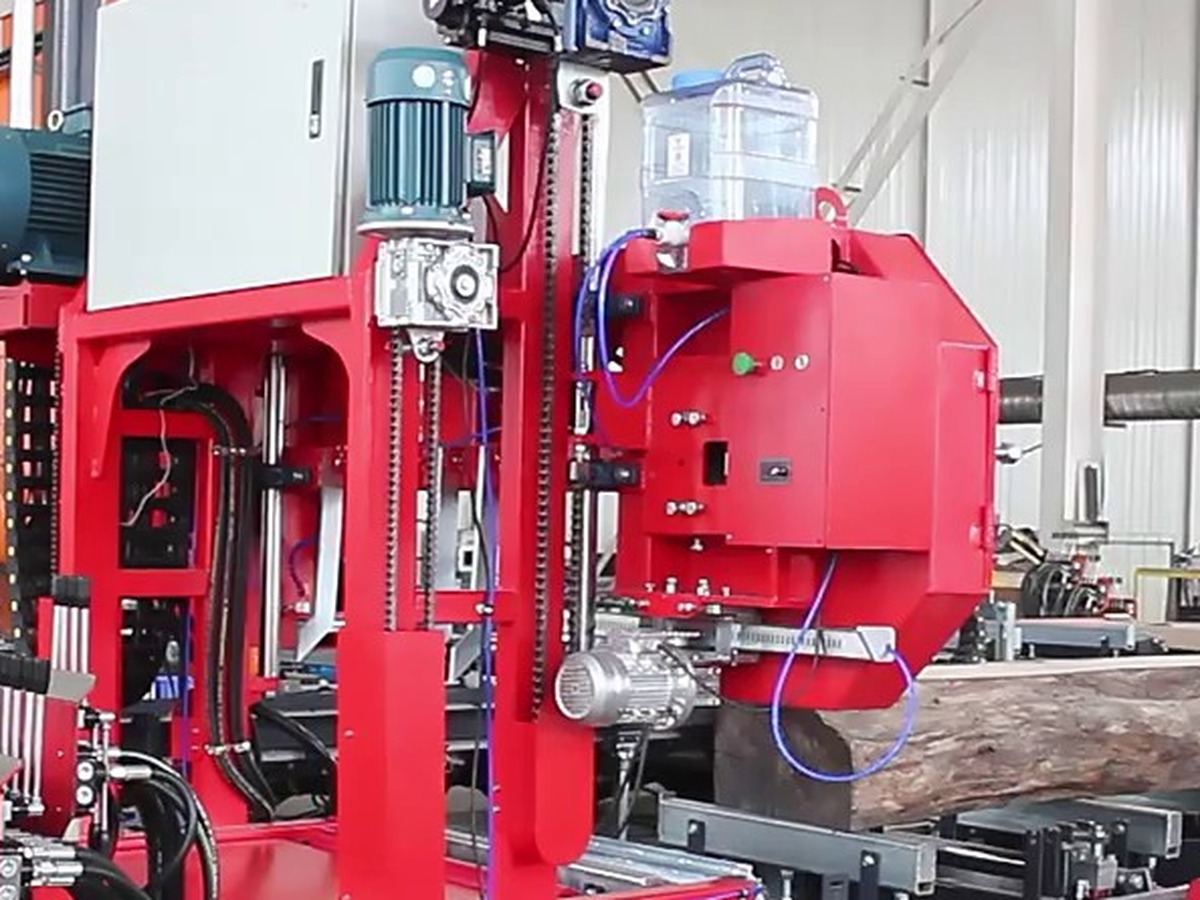
On our commercial sawmills the rail mounting surface is fully machined after hardening, with the top and bottom thickness held within 0.01 mm. That is the datum the whole machine references: the carriage wheels, the head, the log clamps and the blade guide all derive their position from it.
What actually holds 0.3–0.5 mm on a finished board
Rail hardness is the foundation, but four other parts decide whether a board leaves the mill inside tolerance:
Height guide columns on bronze bushings. The up/down travel of the head runs on bronze bushing bearings rather than plain steel. The sliding fit stays consistent as the head rises and falls, so the set height does not change between the first and last cut of a log.
Heat-resistant ceramic blade guide blocks. Blade vibration is the largest single source of thickness variation on a bandsaw mill. The guide blocks are fitted with ceramic inserts that damp that vibration and hold the blade square to the bed.
Scraper plates on the rail, blade and main wheel. Sawdust left on the rail is, in effect, a variable shim. Scrapers clear the rail, the blade and the main wheel continuously while the head travels, so the head does not climb over a film of dust.
Tension held constant. Blade tension changes the blade's behaviour in the cut. We offer manual screw tensioning, hydraulic tensioning and servo-electric automatic tensioning, the last holding the set tension without an operator re-checking it during the shift.
Blade protection changes tolerance over time, not on the first board
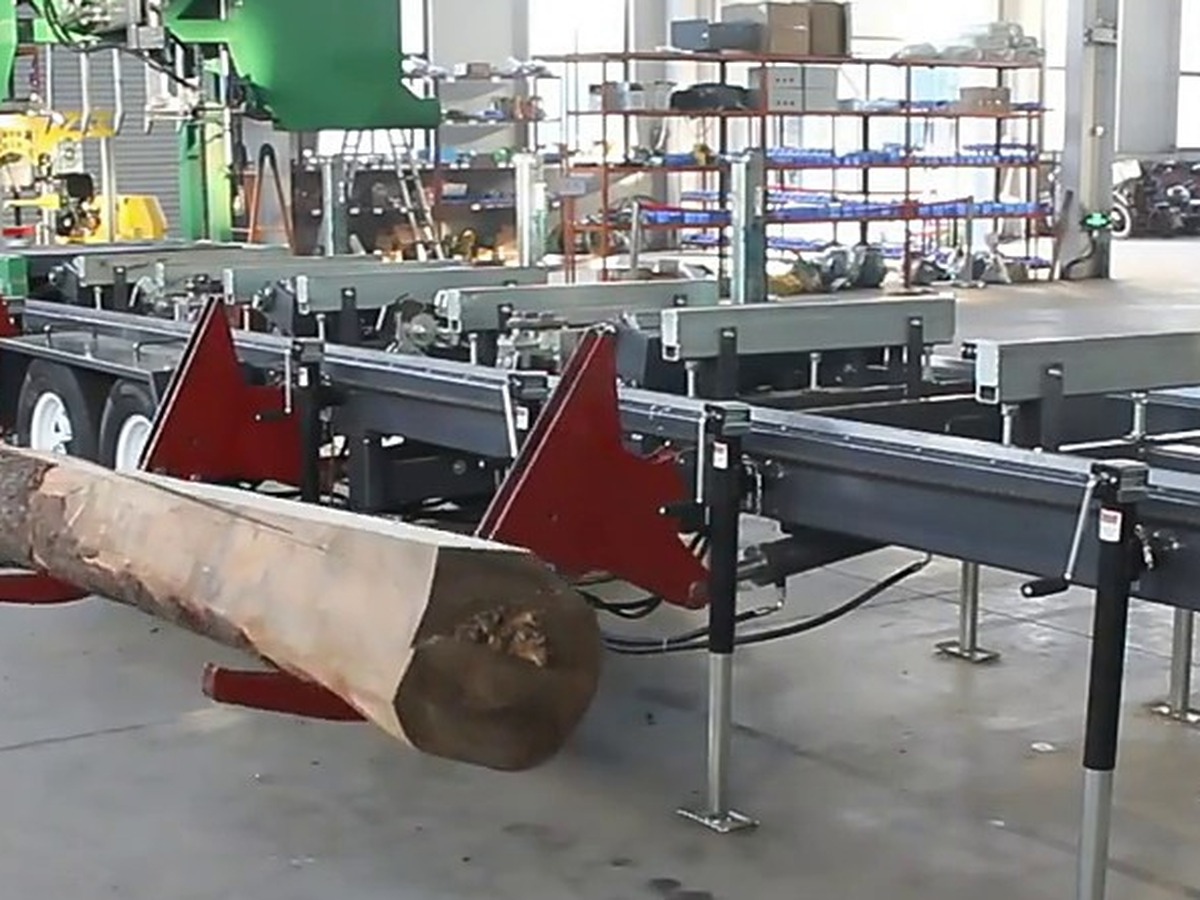
Boards drift out of tolerance because blades dull and get re-tensioned. That is why the pre-cut debarker matters. It is a cutting blade mounted ahead of the main blade: it opens the abrasive outer layer of the log — sand, grit and hard bark — before the main blade reaches it, so the saw teeth are not the parts taking the impact.
The device is covered by our own patent, and it is an option we recommend on commercial machines where blade cost and tolerance drift both accumulate. It is available as a factory-fitted configuration on commercial sawmill orders; please specify it at the enquiry stage.
Two further systems protect the cut: a high-sensitivity blade breakage sensor that cuts machine power if the blade fails, and dual infrared probes at the front and rear of the head that slow and stop the travel as it approaches either end of the bed.
Specification summary — commercial sawmill
| Item | Specification |
|---|---|
| Track hardness | 58–63 HRC, hardened steel rail |
| Reference for comparison | roughly 18 HRC for unhardened mild steel |
| Rail mounting surface thickness tolerance | within 0.01 mm (surface fully machined) |
| Finished board thickness tolerance | 0.3–0.5 mm |
| Height guide | bronze bushing bearing columns |
| Blade guide | heat-resistant precision ceramic blocks |
| Blade tensioning options | manual screw / hydraulic / servo-electric automatic |
| Blade protection | patented pre-cut debarker (option) |
| Safety | blade breakage sensor; dual infrared end-of-travel probes |
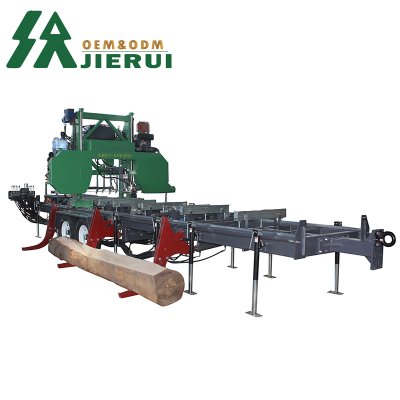
| Transport chassis | dual-axle highway tyres, up to 60 km/h, 8 t load |
| Certification | CE; Stage V (EU Stage V) for diesel; EPA and Stage V for gasoline |
| Factory audit | TÜV Rheinland audited factory |
| Trade terms | FOB / CFR / CIF / EXW, Qingdao port |
| MOQ | 1 set |
How to check board tolerance yourself, on site
You do not need a laboratory to verify a claim like 0.3–0.5 mm. Run one log, then measure the same board at three points — 200 mm from each end and at the middle — with a vernier caliper or a micrometer. Repeat on a second log cut at the same set height. If the twelve readings sit inside the same band, the machine is holding its datum. If the spread grows between logs, look at blade condition and rail cleanliness before you touch any setting.
Buyer questions
Q: Is a harder rail always better?
Not by itself. Very hard rail on a poorly machined mounting surface behaves like a straightedge resting on a wavy table. Hardness and a machined mounting surface have to come together.
Q: Do I need the hydraulic version to get 0.3–0.5 mm?
No. Manual machines can hold the tolerance, provided the operator keeps the blade tensioned and the rail clean. What the hydraulic and CNC packages change is how repeatable that is across a long shift and how much labour it takes.
Q: Which is the bigger source of thickness variation — the rail or the blade?
Over a single log, the blade. Over months of production, the rail and the blade guide. That is why we treat rail hardness, guide blocks, scrapers and tensioning as one system rather than four separate options.
Q: Can the pre-cut debarker be retrofitted?
Tell us the model and the year of the machine at the enquiry stage and we will confirm whether it can be fitted in the field or needs to be specified on a new build.
Q: What documents come with the machine?
CE documentation for the configuration supplied, engine emission documentation for the power unit chosen (EPA and Stage V for gasoline; Stage V for diesel), and the factory TÜV Rheinland audit is available on request. Where a certificate number exists we will quote it in the quotation.
Key facts
Track: hardened steel rail, 58–63 HRC; unhardened mild steel is roughly 18 HRC.
Rail mounting surface: fully machined, thickness held within 0.01 mm.
Finished board thickness tolerance: 0.3–0.5 mm.
Blade protection: patented pre-cut debarker (option).
Certification: CE; EPA and Stage V for gasoline engines; Stage V for diesel.
TÜV Rheinland audited factory.
Trade terms: FOB / CFR / CIF / EXW, Qingdao. MOQ 1 set.
Related reading
Next step
If you are specifying a commercial sawmill, send us the log diameter range, the species you cut, the board sizes you sell and your target output per shift. We will come back with a configuration — including whether the pre-cut debarker belongs on your machine — instead of a generic price list.
Jerry Gao — Shandong Jierui Machinery Equipment Co., Ltd.
Email: jerry@jerry-sawmill.com
Web: forest-machinery.com