Wheel-Drive Assist on Log Trailers: Getting Out of Mud
Wheel-drive assist on a log trailer is a hydraulic motor at the trailer axle that turns the trailer's own wheels. It does not replace the tow vehicle - it adds traction at the trailer end, so a loaded trailer can pull itself out of a rut, cross soft ground, and be spotted on a landing without the tractor slipping.
Every forestry trailer problem looks like a crane problem until the trailer stops moving. A 3-tonne load of green logs on soft ground will sink the tyres to the axle, and once that happens the tow vehicle is dragging dead weight instead of towing a trailer. Drive assist is the part of the trailer that addresses that specific failure.
Why a loaded trailer stops moving in mud
Rolling resistance is the whole story. On firm ground a trailer needs a small fraction of its weight in pull. On soft ground the tyres sink, the soil in front of each wheel has to be compressed or sheared, and the required pull rises steeply - while the tow vehicle's own tyres are sinking at the same time. The result is a loop: the tractor spins, the trailer does not move, the ruts get deeper.
Three things make it worse on a log trailer specifically:
Load position. Logs loaded on the deck put weight high and behind the axle. Tongue weight drops, the tow vehicle loses drive traction on its rear axle, and the trailer behaves like a plough.
Narrow tyres on wet clay. Contact pressure is load divided by footprint. The same load on a wider, deeper-lug tyre sinks less.
No independent control. A towed trailer can only follow. If the tow vehicle cannot get traction, nothing on the trailer can help - unless the trailer has its own drive.
What drive assist actually does
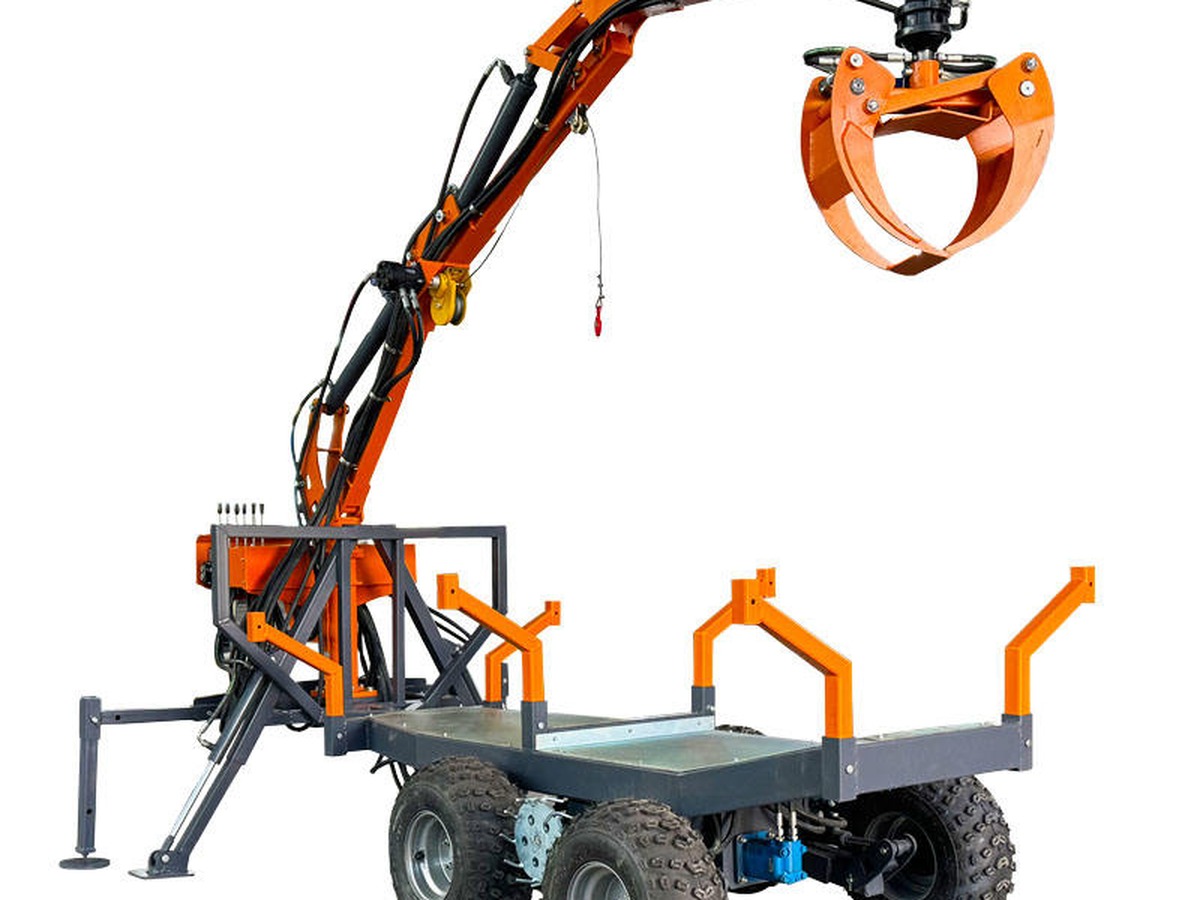
Our log trailers carry a hydraulic motor at the axle, fed from the same hydraulic circuit as the crane, that drives the trailer wheels through a chain reduction. It is engaged from the operator position and works independently of the tow vehicle: with the assist on, the trailer pushes itself while the tow vehicle steers.
That changes the practical situation in three ways:
It breaks the traction deadlock. The trailer no longer relies on the tow vehicle's rear axle for all of the pull. Part of the force now comes from the axle that is carrying the load.
It allows short self-propelled moves. Spotting the trailer under the crane, or shuffling 20 metres between two stacks on a landing, can be done without hitching up.
It recovers a stuck trailer. With the crane legs down and the assist engaged, a trailer that has sunk can often be walked out instead of winched out.

When drive assist helps - and when it does not
Drive assist is not a substitute for ground conditions. Being explicit about the limits is more useful than a claim that it "goes anywhere":
| Situation | What drive assist does |
|---|---|
| Shallow rut, soft top layer | Usually enough on its own - the trailer drives out while the tow vehicle idles. |
| Deep rut, frame grounded | Helps only after the deck is lifted or the logs are offloaded; a grounded frame has no traction to give. |
| Wet clay slope | Adds drive at the trailer axle but cannot exceed tyre grip - reduce the load and take the slope at an angle. |
| Firm gravel or hardstanding | No benefit to traction; useful only as a spotting aid. |
| Long road transport | Must be disengaged. Drive assist is a low-speed function, not a road drive. |
Operating procedure that avoids damage
Set the stabilizer legs before lifting. The two hydraulic legs carry the load into the ground; a crane working off an unpropped frame loads the axle in a direction it was not designed for.
Engage assist only at walking pace. The motor is a low-speed, high-torque unit. Running it at road speed overheats the oil and loads the chain beyond design.
Keep the tow vehicle attached and steering. The trailer drives, the tow vehicle directs. Reversing with assist on and no tow vehicle is how drawbars get bent.
Watch the return line temperature. Sustained assist work in soft ground heats the hydraulic oil faster than crane work does. If the tank is hot to the touch, stop and let it circulate.
Disengage before transport. Confirm the drive is out before the trailer goes on the road.
What to check on any trailer with drive assist
Where the motor sits. An axle-mounted motor with a guarded chain reduction is serviceable in the field; a motor buried inside the frame is not.
Which circuit feeds it. Sharing the crane circuit means one pump, one oil supply, one thing to diagnose. A separate circuit means the crane can work while the drive is isolated - but it is another pump to maintain.
Whether the drive can be isolated. There must be a positive way to take the drive out, not just a neutral position on a lever.
Tyre specification. Deep-lug off-road tyres on a wide footprint do as much for soft-ground performance as the motor does.
Legs and frame. Galvanized contact surfaces and a deck that does not flex under a 3-tonne load are what make the machine last in wet conditions.
Frequently asked questions
Does wheel-drive assist replace a 4x4 tow vehicle?
No. It reduces how much pull the tow vehicle has to find, and it can move a trailer that the tow vehicle cannot move alone. It does not give the combination four-wheel drive, and it does not change the fact that the tow vehicle still has to steer and brake.
Can it be used to load the trailer?
No. Loading is done by the crane and grapple, with the legs down. Drive assist moves the trailer; it does not lift logs.
What load can a trailer with drive assist carry?
Our crane trailers are rated for a 3-tonne load. The rating is a structural limit for the deck and axle, and it does not increase because the trailer has drive - on soft ground the practical limit is lower, because traction and sinkage, not the frame, become the constraint.
Does the grapple rotate independently of the drive?
Yes. The grapple rotates a full 360 degrees continuously on its own circuit, so a log can be turned to the angle the deck needs regardless of whether the drive is engaged.
Is drive assist available on all models?
It is a configuration option on the crane trailer line rather than a standard fit on every unit. Tell us the ground conditions and the tow vehicle and we will confirm which configuration fits.
Key facts
Function: hydraulic drive at the trailer axle, engaged at walking pace, disengaged for transport
Load rating: 3-tonne deck on the crane trailer line
Crane: hydraulic, with a grapple rotating 360 degrees continuously
Stabilization: two hydraulic telescopic legs, set before any lift
Chassis: four off-road tyres, galvanized contact surfaces, raised stake posts
Compliance: CE certified; factory audited by TÜV Rheinland
Trade: Verified Custom Manufacturer on Alibaba.com, MOQ 1 set, shipped from Qingdao on FOB / CFR / CIF / EXW terms
Factory: Zibo, Shandong, China
Choosing the configuration
If the trailer will work on a landing with firm access, drive assist is a convenience. If it will work in cut-over ground, on clay, or anywhere the tow vehicle is a farm tractor rather than a forwarder, it is the difference between a trailer that works and a trailer that has to be winched. Send us the tow vehicle, the typical load and the ground, and we will tell you which configuration to order.
Email jerry@jerry-sawmill.com or visit forest-machinery.com.