Band Sawmill Blade Cooling: Water Spray vs Mist Systems
A band sawmill cuts best when the blade stays cool, and there are two common ways to keep it that way. A water spray system delivers a continuous stream from a tank and pump, flushing heat and sawdust out of the kerf. An air-atomized mist system mixes water with compressed air at the nozzle, so a far smaller volume of water reaches the blade as fine droplets. Spray is simpler and clears grit better; mist uses less water and leaves a drier machine.
Both systems solve the same three problems - tooth temperature, sawdust recirculation and airborne dust - but they solve them with different plumbing, different maintenance and different consequences for a machine that lives outdoors. This article compares them on the points that decide the purchase: water supply, compressed air, corrosion load, winter operation and nozzle upkeep.
Why a band blade heats up even when the cut feels easy
A band blade generates heat in four places, and only one of them is the tooth tip. The tooth tip rubs the kerf floor. The back and sides of the band rub the guide blocks. The band flexes as it passes over each wheel. And sawdust that stays in the kerf is re-cut dozens of times per second, which is friction with no chip removal to show for it.
Heat matters because a band blade is a tensioned spring. The steel is hardened and tempered to hold tension and tooth set; when the band runs hot, it expands, tension drops, and the blade starts to wander. A wandering blade cuts a wavy board, and a wavy board means the operator feeds slower or pushes harder, which adds more heat. The loop is self-reinforcing, which is why blade problems rarely appear gradually - they appear as a sudden run of bad boards.
Two failure modes follow heat directly. Tooth set is lost first, because the tips are the thinnest section and the first to soften. Resin and pitch then bake onto the band, and a coated band cannot clear the kerf. Cooling water attacks both: it removes heat by mass flow, and it keeps the band wet enough that resin does not bake on.
What a water spray system does
A spray system is a tank, a pump, a filter and one or more nozzles aimed at the band just before and just after the cut. Water lands on the blade, absorbs heat, and carries sawdust out of the kerf and off the guides. The same water wets the sawdust stream, so less of it becomes airborne around the operator.
The engineering is simple enough to repair anywhere: a stainless tank, a low-pressure pump, a strainer and replaceable nozzles. There is no compressor to size and no air line to drain. On a portable mill working in a yard with a water barrel and a hose, a spray system is the only option that does not require a second power source.
The cost of that simplicity is water volume and wetness. A spray system puts a continuous film of water on the machine, the bed and the ground behind the mill. On a sawmill with hot-dip galvanized bunks and a powder-coated frame that is manageable - the contact surfaces are protected by zinc rather than by a paint film - but the water still has to go somewhere, and standing water under a mill is a maintenance problem in its own right.
What an air-atomized mist system adds
A mist system uses compressed air to shear water into fine droplets at the nozzle. Two things change as a result. First, the water arrives as a spray rather than a stream, so it wets the band and the kerf edges without flooding the bed. Second, much of it evaporates on contact with hot steel, and evaporation absorbs far more heat per litre than simple warming does. That is why a mist system can hold blade temperature with a fraction of the water a spray system uses.
The air does a second job: it is a directed blast that pushes sawdust away from the guides and the kerf, which is where recirculation starts. On a commercial frame with a dedicated dust extraction port, mist plus extraction is a cleaner combination than spray plus extraction, because the water load on the filter is lower.
The trade-off is the compressor. A mist system needs compressed air at stable flow for the whole shift, which means a compressor sized for continuous duty rather than for a nail gun. The air must be dry and oil-free: water-borne oil in the line ends up as an emulsion on the band, and an emulsion collects sawdust instead of rinsing it away. Nozzle orifices are small, so the water needs filtration before the nozzle, not just at the tank.
Water spray vs air-atomized mist: side-by-side
| Point of comparison | Water spray | Air-atomized mist |
|---|---|---|
| Cooling medium | Water delivered as a stream or coarse spray | Water sheared into fine droplets by compressed air |
| Water consumption | Higher - continuous flow for the whole cut | Lower - much of the water evaporates on the band |
| Kerf flushing | Strong: sawdust is washed out and away | Moderate: chips are blown clear rather than washed |
| Airborne dust | Suppressed by wetting the dust stream | Suppressed by wetting plus air movement |
| Compressed air needed | No | Yes - continuous, dry, oil-free |
| Machine wetness | Bed, guides and ground stay wet | Surfaces dry quickly; less standing water |
| Corrosion load | Higher on unpainted steel and fasteners | Lower, but any leaked water still pools |
| Filtration demand | Tank strainer is usually enough | Tank strainer plus inline filter before each nozzle |
| Nozzle maintenance | Simple: unblock, replace tip | More frequent: scale and grit block small orifices |
| Sub-zero operation | Tank and lines must be drained after each shift | Same requirement, plus a dryer on the air line |
| Field repairability | Any workshop can service a pump and hose | Needs an air supply and clean water on site |
| Typical fit | Outdoor yards, portable mills, gritty or muddy logs | Indoor shops, high-dust species, dry climates, tight water supply |
Choosing by where the machine actually works
Outdoor yard, no compressed air, mixed log supply
Spray. A portable mill in a yard is usually cutting logs that came out of mud, and grit on the bark is the dominant wear source. Washing the kerf is worth more than saving water, and there is no compressor to maintain. Pair the spray with a pre-cut device so the teeth meet clean wood rather than the bark layer that carries the grit.
Indoor shop with dust extraction
Mist. In a closed building, water on the floor is a slipping hazard and a humidity problem, and a wet dust collector is a maintenance item. Mist keeps the blade cool, and the air blast feeds the extraction hood instead of fighting it.
Dry, hard, resinous species
Spray, and keep it running between cuts rather than only during the pass. Resin softens with water and bakes without it. If the band comes off the mill with a brown glaze on the gullet, the cooling is arriving too late or in too little volume, not too early.
Coastal sites and high humidity
Mist, with a rinse routine. Less standing water means less time at dew point on cold steel. This is also where surface preparation earns its keep: on JERRY machines the non-wear surfaces are powder coated and every contact surface - bunks, feed rails, clamp jaws, conveyor rollers - is hot-dip galvanized, so the parts that cannot hold a paint film are protected by zinc. See powder coating vs painting and galvanized contact surfaces for how those two finishes are specified.
Sub-zero winters
Either system, drained daily. A full tank left overnight in freezing weather splits a pump body or a strainer bowl, and a cracked bowl is discovered at the start of the next shift. If the mill works through winter, fit a drain valve at the lowest point and make draining part of the shutdown routine rather than a seasonal job.
Where the cooling water ends up
Water plus sawdust is not neutral. Sawdust from many species turns acidic as it sits, and a wet mat of it against steel holds that acidity in place. Three habits keep this from becoming corrosion: aim the nozzles at the blade and kerf rather than at the frame, keep the area behind the mill drained rather than puddled, and clean the sawdust off the bed at the end of the shift instead of letting it dry onto the galvanized surfaces.
Keep water away from the engine, the electrical panel and the control console. On a mill with a CNC console or a servo tensioning system, the cooling circuit should be routed so that a failed hose drips onto the ground, not onto a terminal block.
Maintenance that keeps either system working
| Interval | Water spray | Air-atomized mist |
|---|---|---|
| Every shift | Check the spray pattern reaches the band on both sides of the cut; top up the tank; clean the tank strainer | Check the nozzle cone; drain the air-line water trap; confirm the inline filter is clear |
| Weekly | Flush the lines; look for scale on the nozzle tip; inspect the band for blue or straw discolouration | Soak nozzles in clean water; check the dryer; confirm air pressure holds through a full cut |
| Monthly | Descale the tank; check pump seals and hose ends; verify the drain valve closes | Replace or clean nozzle filters; check for oil carry-over in the air line; check fitting seals |
| Seasonally | Drain and dry the tank before frost; replace perished hose | Same, plus service the compressor and dryer |
Band condition tells you whether the setting is right. Straw or blue discolouration near the tooth line means the blade has been running hot. A band that is cool to the touch after a pass, with no glaze in the gullet, is being cooled adequately - whatever the water volume says on paper.
How JERRY builds the cooling circuit
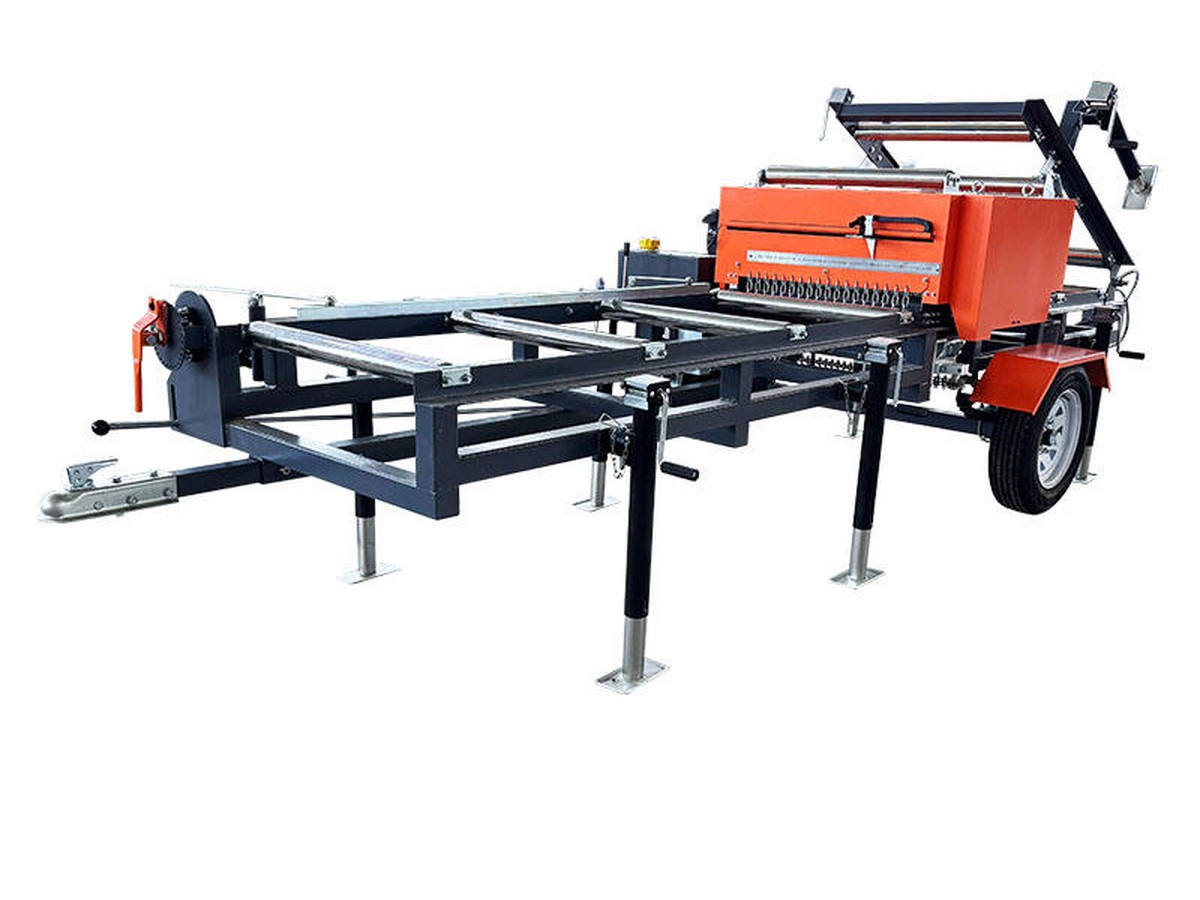
On the portable band sawmill range, the cooling system sprays water at the blade during the cut, which lowers blade temperature, helps hold band stiffness and suppresses dust at the same time. The rest of the frame is built to survive that water: powder-coated non-wear surfaces, galvanized contact surfaces, stainless steel hardware where it matters, and a stainless steel cutting-height scale instead of a plastic one.
On commercial frames the circuit is specified further. The cooling tank is stainless steel rather than mild steel, and high-pressure mist nozzles are available as an option: the nozzle head can run water or an air-and-water mist, and the mist mode requires a compressed air supply at the machine. Track, blade and wheel scrapers remove sawdust before it can be dragged into the guide path, and the band guides use wear-resistant precision ceramic blocks to keep friction at the guide low.
Cooling works best when the teeth are not cutting through grit in the first place. JERRY commercial mills can be fitted with our patented pre-cut debarker, a cutter mounted ahead of the main blade that opens the bark and the gritty outer layer before the tooth line reaches it. Less grit at the tooth means less friction heat and less tip wear, which is why the pre-cut device and the cooling circuit are usually specified together on a mill that cuts dirty logs all day.
Precision is part of the same package. The hardened track on the commercial range runs at 58-63 HRC with the rail mounting face machined to a 0.01 mm thickness tolerance, the linear guides hold clearance down to 0.02 mm, and finished board thickness is held to 0.3-0.5 mm. None of that survives a blade that is running hot and wandering, which is the practical reason cooling is a precision item and not an accessory.
Cooling on the other blades in the yard
The same logic carries over to the rest of a small saw line. Two machines in particular share the problem of a blade that is asked to run continuously in abrasive wood.
Twin-blade board edgers
An edger runs two circular blades through the wany edge of a board, which is the dirtiest part of the log - bark, grit and knots in one pass. The blades have more thermal mass than a band, so they tolerate heat better, but they have less exposed surface to cool, and a hot circular blade loses tension in the same way. On the JERRY board edger the operator sets the blade spacing from a handwheel and lines the cut with dual red laser lines before the board enters, so the blades are cutting a defined width rather than being steered into the edge. Correct width plus a steady feed does as much for blade temperature as any cooling nozzle.
Chainsaw cutting on firewood processors
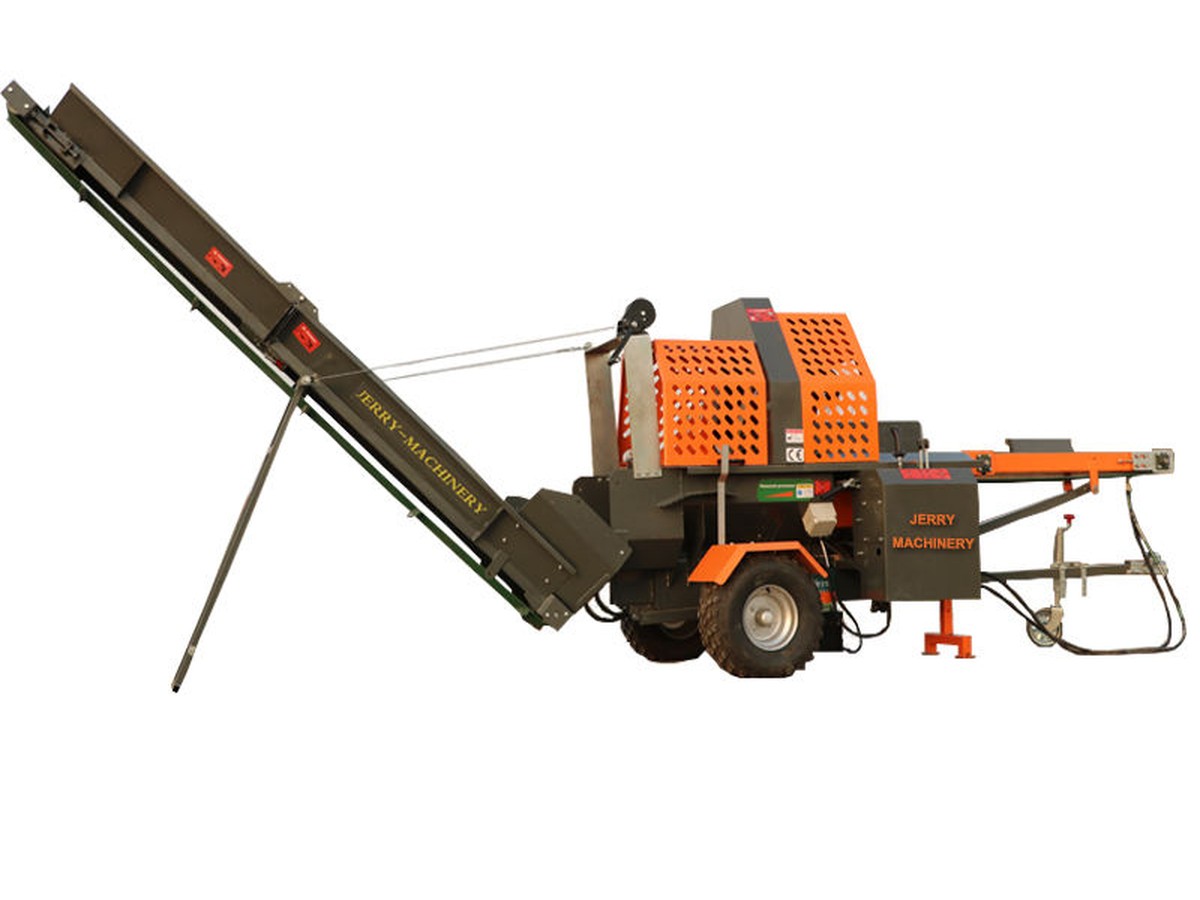
A firewood processor cuts with a bar and chain rather than a band, and cooling there is a lubrication job rather than a water job: the chain needs oil at the bar groove continuously, because a dry chain overheats, stretches and wears the bar. JERRY firewood processors run imported German Stihl bars and chains with a dedicated chain-oil tank, a visible oil-level sight and an adjustable oil-flow valve, so the oil rate can be matched to the species. A blocked oil passage shows up as a blue bar and a slack chain long before the chain fails.
The principle is identical in all three cases: keep the cutting edge cool and clean, and the blade holds its geometry. Let it run hot and the machine starts producing scrap that looks like an operator problem.
Questions buyers ask about blade cooling
Can I run a band sawmill with no blade cooling at all?
For occasional short cuts in dry softwood, a mill will cut. For continuous production it is a false economy: the band loses tension as it heats, the board tolerance opens up, and tooth set goes before the band breaks. If water supply is the constraint, mist is the way to keep cooling with a small water budget rather than removing cooling.
Is mist cooling enough for hardwood?
It can be, if the air supply is continuous and the nozzles are clean. Hardwood generates more heat per cut than softwood at the same feed, so the honest test is the band itself: if the band is cool and free of glaze after a pass, the system is doing its job. If the gullet glazes, move to spray or add a second nozzle.
Does the cooling water rust the machine?
Water alone does not, a wet sawdust mat does. Contact surfaces on JERRY machines are hot-dip galvanized and non-wear surfaces are powder coated, so the frame is not relying on a paint film where wood and grit rub. The routines that matter are draining standing water and clearing sawdust at the end of the shift.
How much water does a spray system use?
There is no single figure worth quoting, because it depends on the number of nozzles, the nozzle size and how much of the shift the mill is actually cutting. The practical way to size a tank is a refill log: note the level at the start and end of a normal day and size the tank for one shift with margin. Tell us your species mix, log diameter and shift length and we will specify the tank and nozzle set for that duty.
Can mist be added to a mill later?
Yes on the commercial frames - the mist nozzle head is an option rather than a different machine, and it mounts on the same cooling circuit. The requirement is a compressed air supply at the mill with dry, oil-free air and enough continuous flow to hold the nozzle pattern through a full cut.
Does cold water shock a hot band?
The band is thin and the water volume in a spray system is small relative to the steel, so the thermal step at the nozzle is not the failure mode operators worry about. Running dry and then cooling hard at the end of a long cut is worse for the band than steady cooling throughout.
Key facts
Cooling options: water spray as standard; high-pressure air-atomized mist nozzles optional on commercial frames (mist mode requires compressed air at the machine).
Cooling tank: stainless steel on commercial frames; stainless steel hardware on the portable range.
Band guidance: wear-resistant precision ceramic guide blocks; scrapers on track, blade and wheel.
Pre-cut: patented pre-cut debarker - opens bark and the gritty outer layer ahead of the tooth line. No patent number is quoted here.
Precision: hardened track 58-63 HRC; rail mounting face machined to 0.01 mm; linear guide clearance down to 0.02 mm; finished board thickness tolerance 0.3-0.5 mm.
Certification: CE; EPA for gasoline engines; EU Stage V for diesel and gasoline engines; TÜV Rheinland factory audit; Verified Custom Manufacturer.
Trade terms: MOQ 1 set; FOB, CFR, CIF or EXW; shipment from Qingdao; factory in Zibo, Shandong, China.
Finishes: powder-coated non-wear surfaces, hot-dip galvanized contact surfaces.
Specify the circuit for your logs, not for the brochure
Send us the species you cut, the typical log diameter, whether the mill works indoors or outdoors, and whether you have compressed air on site. We will come back with the cooling configuration - spray, mist or both - plus the tank size and nozzle arrangement for that duty, and a quotation under FOB, CFR, CIF or EXW terms from Qingdao. MOQ is 1 set.
Email jerry@jerry-sawmill.com or visit forest-machinery.com with your model and site details.