JERRY 15T vs 20-25 Ton Homeowner Log Splitters: Tonnage, Wedge and Duty Cycle
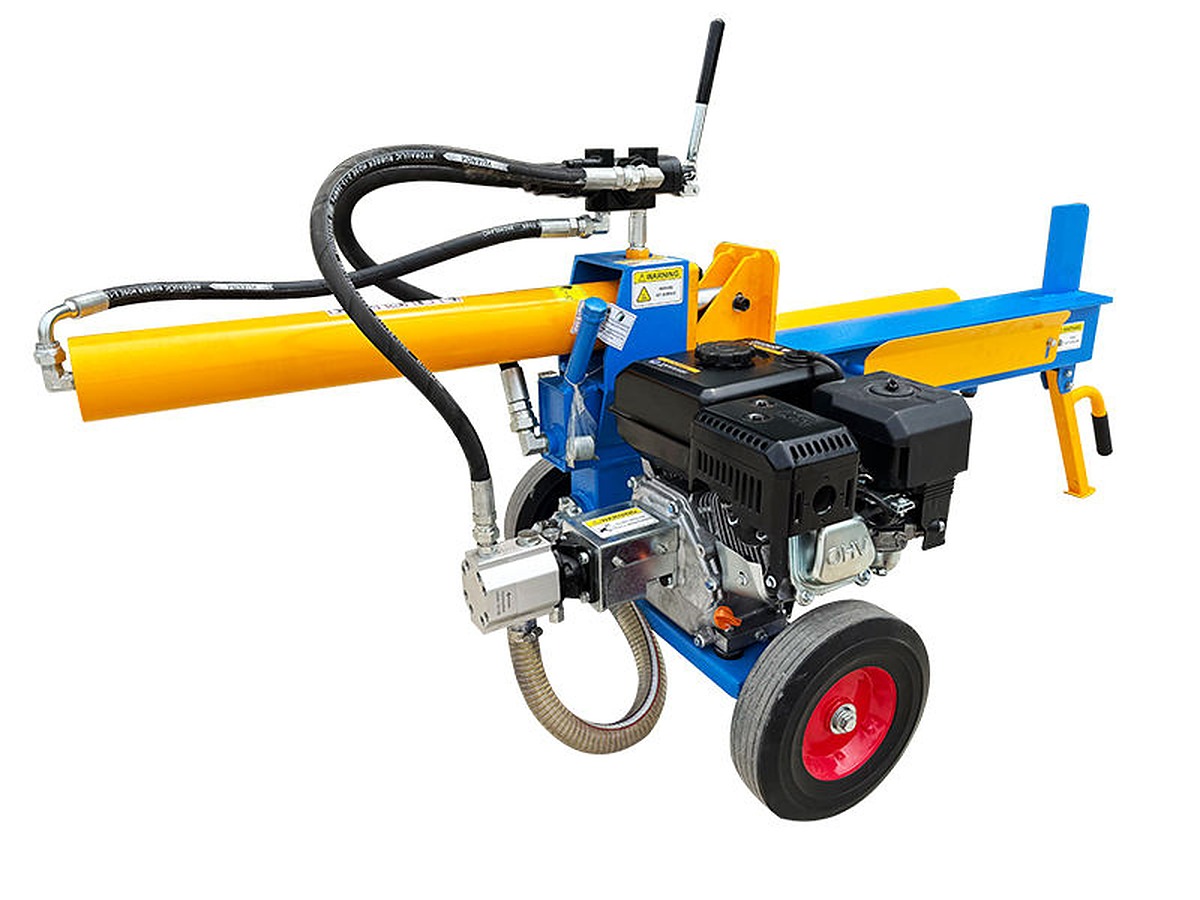
A 15-ton log splitter is sized for firewood work, not for tonnage bragging rights. The JERRY 15T runs a 520 mm stroke on a 15-second cycle, splits in horizontal or vertical position, and accepts a 2-way or 4-way wedge. Splitters rated 20–25 tons add force reserve for knotty or dense hardwood; they do not automatically split faster. Match tonnage to your logs, wedge to your firewood size, and hydraulic oil capacity to how many hours you run without a break.
This comparison uses published specifications only. JERRY figures come from our 15-ton horizontal/vertical product page; the two 20-ton reference machines are compared on the numbers their manufacturers publish. Where a maker does not publish a value, the cell says Not published — no estimate has been substituted.
Published specifications side by side
Three machines in one class: a 15-ton horizontal/vertical splitter built for farm and firewood duty, and two 20-ton homeowner splitters sold in North America. The table below is a specification comparison, not a ranking.
| Parameter | JERRY 15T (horizontal / vertical) | Boss Industrial GD20T24 | Champion 201549 |
|---|---|---|---|
| Rated splitting force | 15 ton | 20 ton | 20 ton |
| Operating positions | Horizontal and vertical, 90-degree change | Not published in the maker's specification table; dual-direction wedge travel is listed | Horizontal |
| Maximum log length | Not published (splitting stroke is 520 mm, customizable) | 24 in maximum splitting length | 24 in maximum log length; 100 lb maximum log weight |
| Cycle time | 15 s | 7 s forward / 6 s return | 11 s |
| Working pressure | 16–22 MPa (approx. 2,320–3,190 psi) | 3,400 psi | Not published |
| Cylinder bore | 70 mm (approx. 2.76 in) | 4.0 in | 4 in; rod 1.6 in |
| Hydraulic pump | CBT1/4.2; flow not published | 11 GPM | 2-stage, 14 GPM |
| Hydraulic oil capacity | 5–6.5 L of No. 46 oil (approx. 1.3–1.7 US gal) | 3.5 gal | 4.5 gal system, 3.4 gal tank |
| Engine | Runtong 180 cc air-cooled four-stroke; electric start and recoil start | Kohler 6.5 hp, 196 cc; recoil start | Champion 212 cc; recoil start, low-oil shut-off |
| Wedge | 2-way or 4-way, selectable at order | 8 in wedge height; 4-way wedge offered as an accessory | Single wedge, hardened steel, skewed profile |
| Control valve | 40 L three-position manual valve | Three-position control, one-hand operation | Auto-return valve |
| Net weight | 125 kg (approx. 276 lb); 145 kg gross | 449 lb net, 512 lb gross | 297.7 lb |
| Overall dimensions | 1,430 × 520 × 1,160 mm; packing 780 × 420 × 1,170 mm | Not published (packing size listed as 76 × 20 × 23 cm) | 79.8 × 35.8 × 39 in |
| Warranty | Not published on the product page | 2-year residential, 180-day commercial | 2-year limited |
| Published price | Quoted per configuration | USD 1,599.99 list price, subject to change | Not published on the model page |
Boss Industrial specification and price as published on boss-industrial.com, November 2026. Champion specification as published on championpowerequipment.com, November 2026. JERRY specification as published on forest-machinery.com, November 2026. Values reproduced as published; unit conversions shown in parentheses are arithmetic, not manufacturer statements.
What tonnage actually buys you
Tonnage is a force rating, not a speed rating. Splitting force comes from hydraulic pressure acting on the piston area, so a machine rated 20 tons is not a machine that splits twice as fast — it is a machine that can hold more pressure before it stalls. Our 15T reaches its rating at 16–22 MPa through a 70 mm bore. The two 20-ton reference splitters use a 4 in bore at 3,400 psi and at an unpublished pressure respectively.
In practice, the extra 5 tons in the 20-ton class becomes useful when three conditions appear together:
Dense, knotty hardwood where the wedge meets a knot instead of a clean grain line.
Large-diameter rounds that must be split across a wide face rather than along a short length.
A 4-way wedge on large logs, which puts four splitting planes under load at once instead of one.
For straight-grain firewood cut to stove length, a 15-ton machine with a sharp 2-way wedge does the job; the limiting factor is usually log handling, not force. If your wood is mostly knotted oak or elm, or you intend to run a 4-way wedge on big rounds, a 20-ton machine gives a wider margin before the wedge stalls.
Wedge geometry: 2-way, 4-way and wedge height
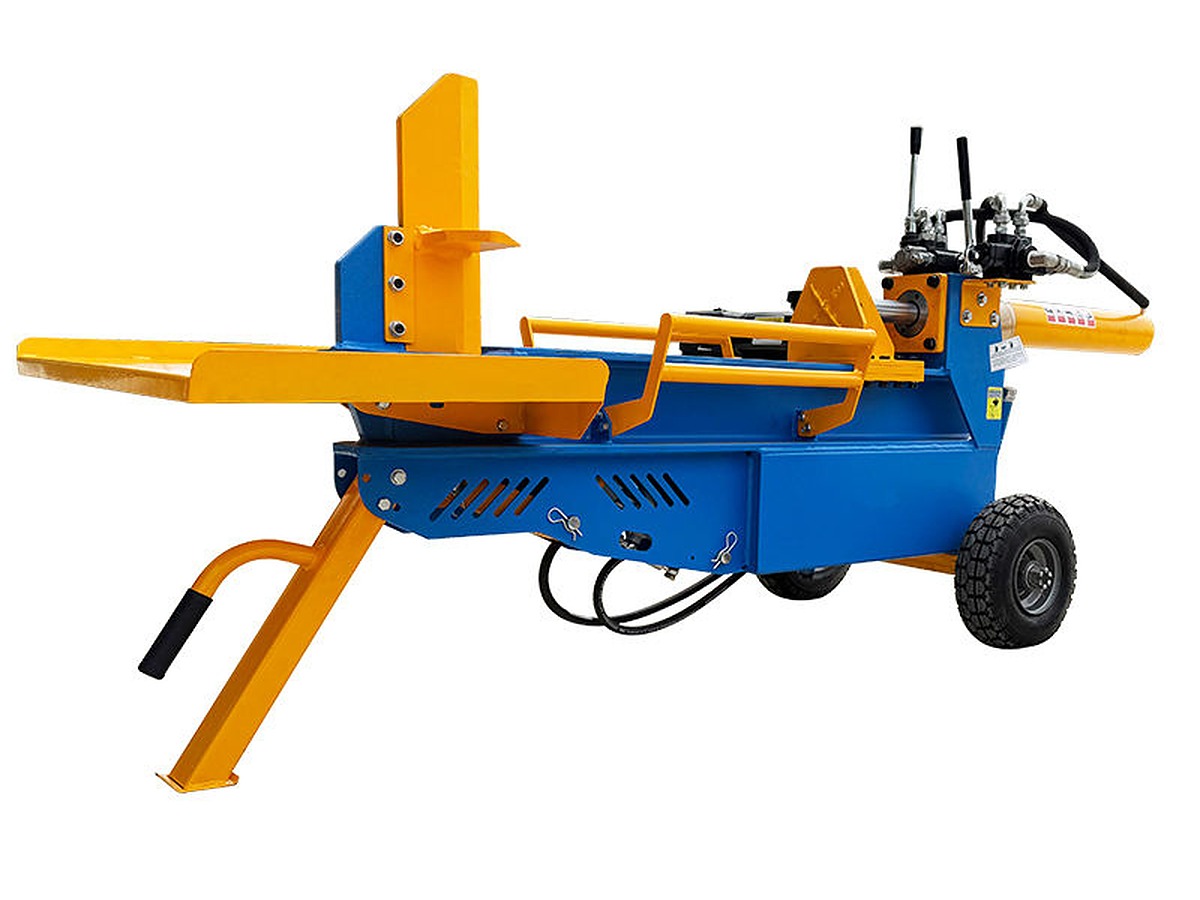
The wedge decides how many pieces one stroke produces; the tonnage decides whether the wedge can push through. A 2-way wedge divides a round into two halves. A 4-way wedge adds two perpendicular blades and produces four pieces in a single pass, which removes one handling cycle per log — the real time saving in firewood work.
The trade-off is force per blade. A 4-way wedge concentrates the same cylinder force onto a larger cutting area, so it needs either smaller logs or more tonnage. That is why a 4-way wedge is an accessory rather than a default on most 20-ton machines, and why we list it as a selectable option on the 15T rather than fitting it as standard: it suits clean, medium-diameter rounds, not oversized knotty butt cuts.
Wedge height also matters. Boss Industrial publishes an 8 in wedge height on the GD20T24; our 15T wedge height is not published as a figure, so it is not compared here. A taller wedge starts the split earlier in the stroke and helps on stringy wood; a shorter wedge concentrates force. Ask for the wedge drawing if you are splitting a specific species.
Duty cycle: cycle time is not throughput
Cycle time sets the floor on throughput; log handling sets the actual number. Published cycle times in this group are 15 s (JERRY 15T), 11 s (Champion 201549) and 7 s forward plus 6 s return (Boss GD20T24, dual-direction). Those differences look large on paper and much smaller in a woodlot.
An illustrative calculation, with an assumed 20 seconds of handling per log (rolling the round to the beam, positioning, clearing the split pieces):
15 s cycle + 20 s handling = 35 s per log, about 100 logs per hour.
11 s cycle + 20 s handling = 31 s per log, about 116 logs per hour.
13 s combined cycle + 20 s handling = 33 s per log, about 109 logs per hour.
These are arithmetic examples with a stated assumption, not tested output figures. They show the point: shaving four seconds off a cycle changes hourly output by roughly one log in six, while better log staging or a second person feeding the beam changes it far more.
The second half of duty cycle is heat. Every cycle pushes oil through a relief valve and a cylinder, and the reservoir is what absorbs the temperature rise. Published oil capacities are 5–6.5 L on the JERRY 15T, 3.5 gal (about 13 L) on the Boss GD20T24 and a 4.5 gal system (about 17 L) on the Champion 201549. A smaller reservoir reaches a higher oil temperature sooner during uninterrupted running, so if your pattern is hours of continuous splitting rather than a few dozen logs at a time, plan cooling intervals and check oil temperature, or specify a machine with a larger tank. For seasonal farm firewood work — an hour in the morning, an hour in the evening — reservoir size is rarely the constraint.
Which machine fits which job
None of these three is a general-purpose "best" choice; each is shaped by a different working pattern.
Farm, cabin and seasonal firewood (a few cords a year): the 15-ton class covers stove-length, straight-grain wood with a 2-way wedge, and the horizontal/vertical change lets you roll a heavy round to the beam instead of lifting it. Vertical operation is where a light machine earns its place — 125 kg is movable by two people and fits a small trailer.
Mixed hardwood, larger rounds, one-pass 4-way splitting: the 20-ton class gives margin for knots and for four-way wedges, at roughly 300–450 lb of machine weight and a longer, heavier frame.
Contract work, rental fleets and processors: above 25 tons, the machine is no longer the constraint — log supply, conveyors and operator shifts are. Machines in that band are outside this comparison.
What is not published
Buyers comparing splitter specifications will hit gaps, on our page and on the other makers' pages. Rather than fill them with estimates, we list them:
JERRY 15T: maximum log length, pump flow in GPM, wedge height, and warranty term are not published on the product page.
Boss Industrial GD20T24: working pressure is published, but maximum log diameter, overall machine dimensions and vertical operating position are not stated in the specification table.
Champion 201549: working pressure is not published on the model page; the machine is listed as horizontal only.
Where a number decides your purchase, ask for it in writing with the model and the date — including from us.
Frequently asked questions
Is 15 tons enough for hardwood firewood?
For stove-length, straight-grain hardwood with a sharp 2-way wedge, 15 tons is the usual working range. The cases that push past it are knots, crotch wood, oversized rounds and 4-way wedges on large logs. If most of your wood is knotted oak or elm, take the 20-ton class.
Should I order the 2-way or the 4-way wedge?
Start with 2-way if your logs vary in diameter or species; it is the more tolerant configuration. Choose 4-way when your rounds are consistent, clean and large enough that one pass into quarters saves a handling cycle. On the JERRY 15T both are selectable at order, and stroke length can be customized to your firewood length.
Why does a 15-second cycle not mean slower production than an 11-second cycle?
Because the cycle is only part of the loop. Handling, positioning and clearing typically add 15–25 seconds per log, so a 4-second difference in cycle time changes hourly output by about 10–15 percent. A two-person team or a raised staging table usually recovers more time than a faster valve.
Can the splitter run all day without stopping?
Hydraulic oil temperature, not the engine, is the limit. Our 15T carries 5–6.5 L of No. 46 oil; machines with 13–17 L reservoirs hold more thermal buffer. For continuous shifts, work in blocks with cooling intervals and check oil temperature; for seasonal firewood, run as needed and check the oil level before each session.
What certifications and trade terms are available?
CE and EPA documentation can be supplied for the applicable ordered configuration, and Stage V documentation is available on request for the applicable engine configuration. The factory is TÜV Rheinland audited and holds Verified Custom Manufacturer status. MOQ is 1 set, shipment is from Qingdao, and FOB, CFR, CIF and EXW terms are quoted. The factory is in Zibo, Shandong, China.
Key facts
Model: JERRY 15T horizontal / vertical hydraulic log splitter
Force and stroke: 15 ton; 520 mm stroke (customizable); 15-second cycle
Hydraulics: 70 mm bore, 16–22 MPa, CBT1/4.2 pump, 40 L three-position manual valve, 5–6.5 L No. 46 oil
Wedge: 2-way or 4-way, selected at order
Engine: Runtong 180 cc air-cooled four-stroke, electric and recoil start
Weight and size: 125 kg net, 145 kg gross; 1,430 × 520 × 1,160 mm
Compliance: CE and EPA documentation for the applicable configuration; TÜV Rheinland audited factory; Verified Custom Manufacturer
Trade: MOQ 1 set; Qingdao port; FOB, CFR, CIF, EXW; factory in Zibo, Shandong, China
Next step
Send your maximum log diameter and length, wood species, whether knots are common, the finished firewood size you sell, and your target daily volume. We will confirm whether the 15T with a 2-way or 4-way wedge fits, or recommend a larger frame, and quote FOB, CFR or CIF from Qingdao.
Email jerry@jerry-sawmill.com or visit forest-machinery.com. For the cycle-time and wedge-position detail behind this class of machine, see our earlier comparison: JERRY 15T Log Splitter vs Timberwolf TW-2: Cycle Time, Wedge and Operator Position. Full specifications are on the 15T horizontal/vertical log splitter page.